







































AI Governance Market Size, Share, Trends & Forecast 2034
Explore the AI Governance Market size, trends, growth drivers, segmentation, regional outlook, and forecast through 2034 with key industry insights.
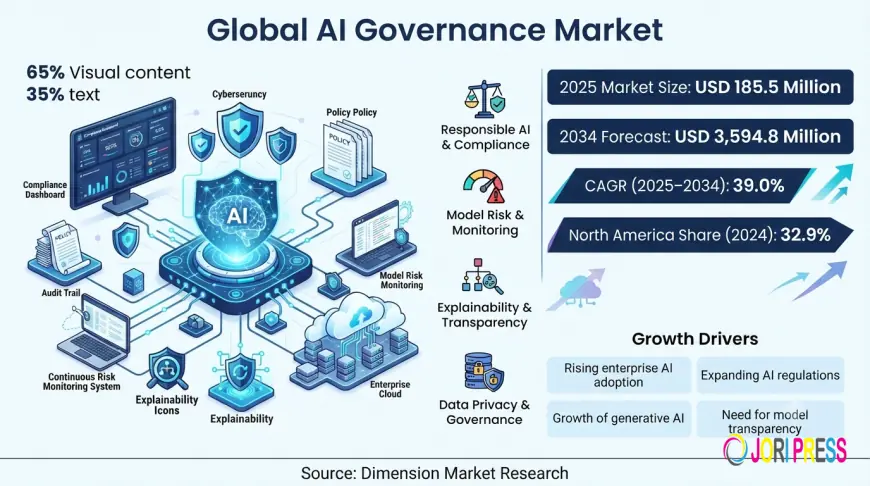
The Global AI Governance Market Size is projected to reach USD 185.5 million in 2025 and expand at a strong compound annual growth rate of 39.0% through 2034, reaching approximately USD 3,594.8 million. AI governance has become an essential component of enterprise artificial intelligence strategies as organizations seek structured approaches for managing algorithmic risks, regulatory compliance, transparency, privacy, accountability, and responsible AI deployment.
Artificial intelligence adoption is accelerating across banking, healthcare, government, telecommunications, manufacturing, retail, technology, and professional services. As organizations deploy generative AI, predictive analytics, automated decision-making systems, and machine learning models at scale, governance requirements are expanding beyond basic compliance. Companies increasingly need frameworks that continuously monitor model behavior, document AI decisions, control access, detect bias, evaluate risks, and establish accountability throughout the AI lifecycle.
The growing complexity of AI ecosystems is therefore creating strong demand for governance software, consulting services, audit capabilities, risk assessment frameworks, policy management tools, and monitoring platforms. Organizations are increasingly integrating governance controls directly into AI development and deployment processes rather than treating responsible AI as a separate compliance function.
? Looking for Specific Data? Get a Customized Sample
Market Overview
AI governance refers to the frameworks, policies, processes, technologies, and organizational structures used to ensure artificial intelligence systems are developed and deployed responsibly. It provides mechanisms for addressing concerns related to explainability, fairness, privacy, security, regulatory compliance, data quality, model performance, accountability, and ethical decision-making.
The market is gaining momentum as businesses move from experimental AI projects toward large-scale operational deployments. Organizations managing hundreds or thousands of AI models need centralized systems for tracking model inventories, documenting intended uses, validating outputs, identifying high-risk applications, and monitoring performance after deployment.
Another significant market development is the transition from voluntary responsible-AI principles toward formalized governance practices. Enterprises are establishing AI governance committees, model review boards, internal risk classifications, documentation standards, approval workflows, and AI-specific compliance policies. This institutionalization of governance is expected to strengthen long-term demand for scalable governance solutions.
Key Market Findings
-
2025 market value: USD 185.5 million
-
2034 forecast value: USD 3,594.8 million
-
2025–2034 CAGR: 39.0%
-
AI regulation is accelerating governance investments.
-
Enterprises are formalizing responsible AI frameworks.
-
Model monitoring is becoming a core governance function.
-
Generative AI is expanding organizational risk exposure.
-
North America remains a major governance adoption hub.
AI Governance Market Dynamics
The AI governance market is shaped by the rapid commercialization of artificial intelligence, expanding regulatory oversight, growing enterprise exposure to algorithmic risk, and increasing public scrutiny of automated decisions. Businesses deploying AI systems are facing greater pressure to understand how models reach decisions, what data supports their outputs, and whether those systems create discriminatory or misleading outcomes.
Governance platforms are becoming especially important as companies introduce generative AI into customer service, software development, finance, marketing, research, and knowledge management. Generative systems can produce inaccurate, biased, confidential, or non-compliant outputs, creating additional governance requirements around validation, human oversight, access controls, model selection, and data usage.
Enterprises are consequently moving toward continuous AI governance models. Instead of evaluating systems only before deployment, organizations are increasingly monitoring them throughout their operational lifecycle. This includes model drift detection, audit logging, explainability checks, policy enforcement, risk scoring, and performance monitoring.
Key Growth Drivers
Rising Enterprise Adoption of Artificial Intelligence
Rapid AI adoption remains one of the most important drivers of the market. Organizations are using AI to automate operational processes, analyze large datasets, personalize customer experiences, optimize supply chains, detect fraud, manage cybersecurity threats, and support strategic decision-making.
As AI becomes embedded within mission-critical processes, failures can create significant financial, operational, reputational, and regulatory consequences. Enterprises therefore require formal governance structures that define ownership, accountability, risk classification, and acceptable AI usage.
-
AI deployments are moving into high-impact workflows.
-
Enterprises require stronger model accountability.
-
Automated decisions increase governance complexity.
-
AI portfolios require centralized oversight platforms.
Expanding Regulatory Requirements
Regulatory developments are encouraging organizations to establish formal governance processes before legal requirements become more restrictive. Companies operating internationally may need to manage different transparency, privacy, documentation, explainability, security, and risk-management requirements across multiple jurisdictions.
This regulatory complexity is encouraging businesses to invest in governance technologies capable of mapping internal controls against regulatory obligations. Organizations also need systems that maintain documentation, track approvals, generate audit evidence, and demonstrate compliance to internal and external stakeholders.
Growing Need for Responsible and Explainable AI
AI explainability has become increasingly important, particularly when algorithms affect financial decisions, healthcare recommendations, employment processes, insurance assessments, customer eligibility, or public services. Organizations need to demonstrate not only that an AI system works, but also how it produces outputs and what risks may influence those decisions.
AI governance solutions help businesses establish documentation requirements, model validation processes, fairness assessments, and human-review mechanisms. These capabilities improve transparency while creating stronger organizational accountability.
Major Market Trends
Integration of Governance into AI Development Platforms
Governance capabilities are increasingly being embedded into broader machine learning operations and AI development environments. This allows organizations to incorporate policy checks, model documentation, risk classification, and approval workflows directly into development pipelines.
Integrated governance can reduce manual compliance processes and improve consistency across large AI portfolios. It also enables governance teams, data scientists, legal departments, cybersecurity teams, and business leaders to collaborate through shared workflows.
Growing Focus on Generative AI Governance
Generative AI is creating a new category of governance requirements because organizations may rely on third-party foundation models, proprietary enterprise models, retrieval systems, and AI agents simultaneously. Governance teams must assess model provenance, data exposure, hallucination risks, intellectual property issues, prompt security, and output reliability.
-
GenAI requires stronger content validation controls.
-
Model provenance is receiving greater attention.
-
AI agents increase accountability requirements.
-
Prompt governance is emerging as a new discipline.
Automated AI Risk Assessment
Organizations are increasingly seeking automated mechanisms to classify models according to business impact, data sensitivity, regulatory exposure, and potential user harm. Automated risk scoring can help businesses prioritize governance resources and apply stronger controls to high-risk use cases.
Future AI governance platforms are likely to combine automated testing, policy enforcement, model monitoring, risk scoring, and governance reporting within unified systems.
Market Challenges
One of the primary challenges is the lack of uniform governance standards across industries and jurisdictions. Organizations frequently operate with multiple internal definitions of responsible AI, creating inconsistencies in risk classification and governance implementation.
Another challenge is balancing innovation with oversight. Excessively restrictive governance can slow AI development, while insufficient controls can expose organizations to operational, regulatory, and reputational risks. Companies therefore need governance frameworks that provide proportional controls based on model risk.
Technical complexity is another significant issue. Modern enterprises may use hundreds of AI tools and models across cloud platforms, internal applications, SaaS products, and external vendors. Maintaining visibility across these environments can be difficult without centralized governance infrastructure.
-
Regulatory expectations vary across markets.
-
AI inventories can become difficult to maintain.
-
Legacy systems may lack governance integrations.
-
Governance skills remain limited in many firms.
-
Balancing innovation and control remains challenging.
Market Segmentation Overview
The AI governance market can be segmented across components, deployment models, organization size, applications, and industry verticals. Solutions typically include governance platforms designed for model monitoring, compliance management, risk assessment, explainability, auditability, policy enforcement, and lifecycle documentation.
Services are also becoming an important part of the ecosystem as enterprises seek consulting support for governance strategy development, implementation, risk classification, compliance readiness, and responsible AI program design.
By deployment, organizations may adopt cloud-based or on-premise governance solutions depending on security requirements, regulatory obligations, IT infrastructure, and AI deployment architecture. Cloud solutions can provide scalability and faster implementation, while on-premise platforms may appeal to organizations handling highly sensitive information.
Large enterprises currently represent a significant opportunity because they generally operate more complex AI environments and face greater compliance obligations. However, governance adoption among small and medium-sized organizations is expected to increase as AI tools become more accessible.
Important application areas include:
-
Risk management and regulatory compliance
-
Model monitoring and lifecycle management
-
Bias detection and fairness assessment
-
Explainability and transparency management
-
AI policy and documentation management
-
Data governance and privacy management
Industry demand is particularly relevant across BFSI, healthcare, government, IT and telecommunications, retail, manufacturing, automotive, and professional services, where automated systems increasingly support critical business decisions.
Competitive Landscape
The competitive landscape is evolving rapidly as software vendors, cloud technology providers, cybersecurity companies, analytics platform developers, consulting organizations, and specialized AI governance firms expand their capabilities.
Competition is increasingly centered on platform integration, automated compliance workflows, explainability, risk monitoring, scalability, and compatibility with multiple AI development environments. Vendors are also strengthening generative AI governance capabilities to address the growing use of foundation models and enterprise AI assistants.
Strategic partnerships are expected to remain important as governance solutions must integrate with cloud platforms, AI development tools, data-management environments, cybersecurity systems, enterprise applications, and compliance workflows.
Competitive differentiation is increasingly based on:
-
Automated AI risk classification
-
Real-time model monitoring
-
Cross-platform AI visibility
-
Regulatory mapping capabilities
-
Explainability and bias detection
-
Generative AI governance controls
-
Enterprise workflow integrations
Regional Analysis
North America is set to lead the global AI governance market with a 32.9% share in 2024. The region's leadership is supported by widespread adoption of artificial intelligence across commercial and governmental organizations, along with increasing attention toward the responsible development and deployment of automated systems.
The United States has experienced growing policy activity surrounding artificial intelligence, with government bodies and legislators establishing frameworks designed to encourage innovation while reducing risks associated with automated decision-making. These developments are prompting companies to strengthen documentation, model oversight, transparency, privacy protection, and risk-management procedures.
Canada is also contributing to regional market growth as organizations adopt machine learning, advanced analytics, generative AI, and automated decision systems. The early adoption of AI technologies across North America creates a large potential market for governance platforms capable of supporting complex AI portfolios.
-
North America held 32.9% share in 2024.
-
Enterprise AI adoption supports regional demand.
-
Policy activity is strengthening governance programs.
-
The U.S. remains a major AI technology ecosystem.
-
Canada supports responsible AI adoption initiatives.
Other regions are also expected to expand as enterprises increase AI investments and governments establish stronger oversight mechanisms. Europe is likely to experience increasing demand for compliance-oriented AI governance solutions, while Asia-Pacific presents significant growth potential due to rapid digital transformation, expanding enterprise AI adoption, and increasing regulatory attention.
Future Market Outlook
The future of the AI governance market will be shaped by the transition from manual governance frameworks toward automated, continuous, and technology-enabled oversight. As organizations deploy more AI models, traditional spreadsheets and decentralized approval processes will become increasingly difficult to maintain.
Governance platforms are expected to evolve into centralized control layers capable of managing AI inventories, monitoring model performance, enforcing policies, producing compliance evidence, and coordinating human oversight. Organizations will increasingly evaluate governance capabilities alongside model performance when selecting AI technologies.
The emergence of autonomous AI agents could create another major opportunity. These systems can perform multi-step tasks, interact with applications, make recommendations, and initiate actions, increasing the importance of permissions, monitoring, audit trails, and accountability controls.
With the market projected to increase from USD 185.5 million in 2025 to USD 3,594.8 million by 2034, AI governance is expected to become a core component of enterprise AI architecture rather than an optional compliance layer.
Frequently Asked Questions
1. What is the Global AI Governance Market Size in 2025?
The global AI governance market is projected to reach USD 185.5 million in 2025. Growth is being supported by increasing AI adoption, stronger regulatory scrutiny, responsible AI initiatives, and rising demand for automated governance and risk-management platforms.
2. What is the expected AI Governance Market Size by 2034?
The market is projected to reach approximately USD 3,594.8 million by 2034, reflecting rapid enterprise investment in AI compliance, lifecycle governance, model monitoring, transparency, explainability, and risk management.
3. What is the projected CAGR of the AI governance market?
The global market is expected to expand at a 39.0% CAGR from 2025 through 2034, demonstrating significant growth potential as organizations institutionalize responsible AI governance.
4. Which region leads the AI governance market?
North America is expected to maintain a leading position, supported by strong enterprise AI adoption and increasing regulatory and governmental attention. The region accounted for approximately 32.9% of the market in 2024.
5. What factors are driving AI governance market growth?
Major factors include expanding AI adoption, stronger regulatory expectations, generative AI deployment, algorithmic risk concerns, increased demand for model transparency, and the need for continuous lifecycle monitoring.
Summary of Key Insights
The Global AI Governance Market is entering a high-growth phase as businesses transition from experimental artificial intelligence initiatives toward enterprise-wide AI deployment. The market is projected to grow from USD 185.5 million in 2025 to USD 3,594.8 million by 2034, expanding at a 39.0% CAGR.
Regulatory complexity, generative AI adoption, automated decision-making, explainability requirements, model risk, and responsible AI initiatives are becoming major investment drivers. Organizations are increasingly embedding governance controls into AI development and operational workflows rather than managing governance through standalone policies.
North America remains an important regional market, holding 32.9% share in 2024, while growth opportunities are expanding across Europe, Asia-Pacific, and other regions. As AI systems become more autonomous and business-critical, centralized governance platforms capable of continuously monitoring risk, compliance, model performance, accountability, and transparency are expected to become essential elements of modern enterprise AI infrastructure.
What's Your Reaction?
 Like
0
Like
0
 Dislike
0
Dislike
0
 Love
0
Love
0
 Funny
0
Funny
0
 Angry
0
Angry
0
 Sad
0
Sad
0
 Wow
0
Wow
0