






































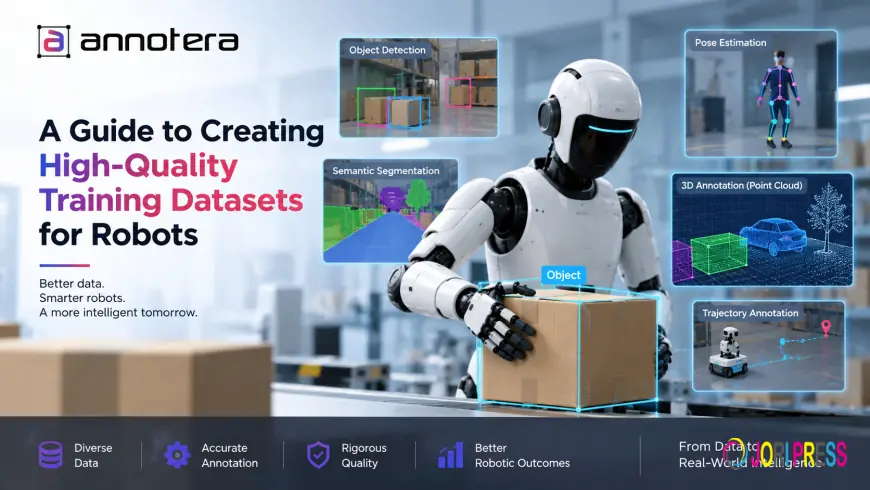
A Guide to Creating High-Quality Training Datasets for Robots
Robots are becoming increasingly capable of navigating environments, recognizing objects, manipulating equipment, and collaborating with people. Behind these capabilities is a critical component that often receives less attention: high-quality training data. Machine learning models used in robotics depend on datasets that accurately represent the objects, movements, environments, and situations a robot is expected to encounter.
Creating a reliable robotics dataset requires more than collecting large volumes of images, videos, sensor readings, or motion sequences. The data must be diverse, accurately labeled, consistently structured, and aligned with the robot’s intended tasks. For organizations developing autonomous and intelligent robotic systems, a disciplined data preparation strategy can significantly improve model performance and reduce costly errors.
This guide explores the essential steps for creating high-quality training datasets for robots.
1. Define the Robot’s Learning Objectives
The first step is to establish exactly what the robot needs to learn. Different robotic applications require different forms of training data.
For example, an autonomous mobile robot may need to identify pedestrians, vehicles, obstacles, doors, and navigable pathways. A robotic arm may require datasets showing objects, grasp points, hand-object interactions, and successful manipulation sequences. A collaborative robot may need human pose and activity information to anticipate movements safely.
Clearly defined objectives help determine:
-
Which sensors and data sources are required
-
What objects or actions should be represented
-
Which annotation types are appropriate
-
How much training data is necessary
-
Which edge cases need additional coverage
A task-specific dataset is generally more useful than a large dataset that lacks relevance to the robot's operating environment.
2. Collect Multimodal and Representative Data
Modern robots rarely depend on a single data modality. Cameras, LiDAR, depth sensors, radar, inertial measurement units, and other sensors can provide complementary information about the physical world.
A strong robotics dataset may combine:
-
RGB images and video
-
3D point clouds
-
Depth maps
-
LiDAR scans
-
Sensor telemetry
-
Robot trajectories
-
Human demonstrations
-
Force and tactile information
-
Audio or environmental signals
Data should also represent the conditions in which the robot will actually operate. Lighting changes, weather, different object appearances, occlusions, clutter, camera angles, distances, and human behaviors can all affect model performance.
The goal is not simply quantity. The dataset should provide meaningful variation that enables models to generalize beyond the exact scenes used during training.
3. Build Diversity Into the Dataset
A robot trained on narrow data may perform well in controlled demonstrations but struggle when conditions change. Dataset diversity is therefore essential for robust robotic perception and decision-making.
For instance, a warehouse robot should encounter different shelf layouts, packaging designs, floor conditions, lighting levels, and human activity patterns. Similarly, a household robot should be exposed to different furniture arrangements, object types, surfaces, and interaction scenarios.
Teams should deliberately include challenging examples such as:
-
Partially hidden objects
-
Unusual object orientations
-
Crowded environments
-
Fast-moving subjects
-
Low-light conditions
-
Reflections and shadows
-
Sensor noise
-
Unexpected obstacles
-
Human-robot interactions
Such examples help models learn to handle real-world variability instead of memorizing predictable patterns.
4. Apply Precise and Consistent Annotation
Raw sensor data does not automatically provide the information required by machine learning models. Annotation converts unstructured observations into meaningful training signals.
Depending on the robotic task, annotation may include bounding boxes, semantic segmentation, instance segmentation, keypoints, 3D cuboids, point cloud labels, object attributes, poses, trajectories, and temporal actions.
For example, a robotic manipulation dataset might identify an object and mark its precise graspable region. A navigation dataset might distinguish between roads, walls, people, furniture, and other obstacles.
Consistency is just as important as accuracy. If similar objects are labeled differently across thousands of samples, the resulting dataset can introduce noise into model training. Clear annotation guidelines, standardized taxonomies, trained annotators, and regular quality checks are therefore essential.
Professional robotics data annotation services can support these requirements by combining domain-specific workflows, annotation expertise, quality assurance, and scalable data processing.
5. Preserve Temporal and Spatial Relationships
Robots operate in physical environments where events unfold over time. A single image may show where an object is, but a sequence can reveal how that object moves or how a person interacts with it.
Temporal annotation can identify events such as:
-
Walking
-
Picking up an object
-
Opening a door
-
Reaching
-
Turning
-
Falling
-
Passing an obstacle
Spatial information is equally important. For 3D robotics applications, annotations may need to capture object dimensions, orientation, position, depth, and relationships between multiple objects.
Maintaining these temporal and spatial relationships helps models understand not only what is present but also what is happening and how the environment is changing.
6. Include Edge Cases and Failure Scenarios
One of the most valuable components of a robotics dataset is often the data that represents unusual or difficult situations.
Robots may encounter objects they have never seen before, unexpected human movements, blocked pathways, sensor failures, unusual lighting, or complex interactions between multiple objects. If these situations are absent from training data, models may behave unpredictably when they occur.
Teams should therefore use operational logs, simulation environments, human demonstrations, and targeted data collection to identify and add difficult scenarios.
This creates a feedback loop: real-world failures reveal weaknesses, additional examples are collected and annotated, models are retrained, and performance is evaluated again.
7. Use Quality Assurance at Multiple Levels
Dataset quality should be measured throughout the annotation pipeline rather than only at the end.
A robust quality-control process can include:
-
Guideline validation: Confirm that annotation rules are clear and practical.
-
Sample review: Inspect completed annotations for errors.
-
Cross-annotator checks: Compare how different annotators label similar scenarios.
-
Automated validation: Detect missing labels, invalid formats, and inconsistent metadata.
-
Expert review: Examine difficult or safety-critical examples.
-
Dataset-level analysis: Identify class imbalance, duplicates, and underrepresented scenarios.
Quality metrics should be documented so teams can track improvements over time.
8. Prepare Data for Physical AI
The development of Physical AI training data requires special consideration because intelligent systems must learn to interact with the physical world. Unlike purely digital applications, robotic models must account for spatial relationships, physical constraints, movement, timing, and interaction outcomes.
Training data may need to connect perception with action—for example, linking what a robot sees with the movement required to grasp, place, push, avoid, or navigate around an object.
Combining real-world data with carefully designed synthetic or simulated data can also expand coverage while helping teams test rare scenarios that are difficult or expensive to capture physically.
9. Continuously Evaluate and Improve the Dataset
Dataset creation should be treated as an ongoing process rather than a one-time project. As robots operate in new environments, new failure modes and data gaps will emerge.
Teams should monitor model performance and identify where predictions fail. Those examples can then be added to the dataset, annotated according to established standards, and incorporated into subsequent training cycles.
This continuous improvement process helps datasets remain relevant as robotic capabilities, environments, and deployment requirements evolve.
Building Better Robotics Datasets With Annotera
High-performing robots require more than sophisticated algorithms. They require training datasets that accurately represent the physical world and provide reliable learning signals.
From multimodal sensor data and 3D environments to human activities, trajectories, object interactions, and manipulation tasks, every component of a robotics dataset can influence model performance. Careful collection, diverse data coverage, precise annotation, rigorous quality assurance, and continuous improvement provide the foundation for dependable robotic intelligence.
Annotera helps organizations develop structured, high-quality datasets designed for demanding robotics applications. With the right data strategy and annotation workflow, robotics teams can move from raw sensor information toward models capable of understanding environments, predicting actions, and interacting with the physical world more effectively.
What's Your Reaction?
 Like
0
Like
0
 Dislike
0
Dislike
0
 Love
0
Love
0
 Funny
0
Funny
0
 Angry
0
Angry
0
 Sad
0
Sad
0
 Wow
0
Wow
0