








































Navigating Time and Faith: How to Determine Today's Hijri Date
Today's Islamic date and how many days are left until Ramadan and Eid

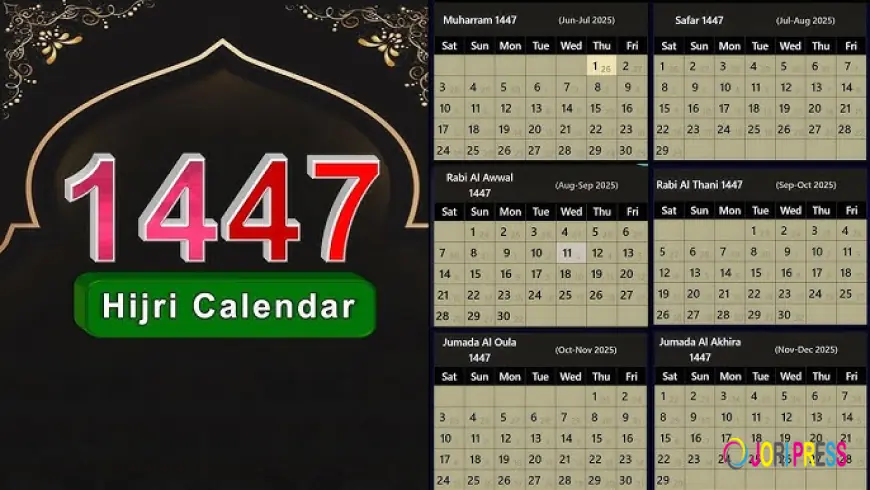
For over a billion Muslims globally, tracking time extends far beyond standard civil schedules. While standard business and international affairs rely heavily on the solar Gregorian calendar, religious obligations, personal milestones, and sacred traditions are governed by the Islamic calendar. Whether you are preparing for voluntary fasts, calculating charity obligations (Zakat), or scheduling family occasions, knowing التاريخ الهجري اليوم serves as a vital bridge between modern life and faith.
Understanding how to check the Islamic calendar involves recognizing its unique lunar structure, observing how its days transition differently from civil standards, and knowing how computational tools work alongside physical moon sightings.
The Foundations of the Islamic Lunar System
When looking up Today's Hijri date, you are viewing a calendar established during the reign of the second Caliph, Umar ibn al-Khattab, which marks its starting point (epoch) from the emigration (Hijrah) of Prophet Muhammad from Mecca to Medina in 622 CE.
Unlike the solar calendar, which measures the Earth's 365-day revolution around the Sun, the Hijri calendar is strictly lunar. Each month tracks a complete cycle of the moon, lasting either 29 or 30 days depending on when the new crescent moon appears on the horizon. A complete Islamic year consists of twelve lunar months, totaling roughly 354 or 355 days.
Because a lunar year is approximately eleven days shorter than a solar year, Islamic dates gradually advance through the solar seasons over a 33-year cycle. This shifting dynamic means that months like Ramadan or Dhul Hijjah occur during different times of the civil year over a person's lifetime. Determining Today's Hijri date connects worshippers directly to this ongoing celestial movement.
Why the Islamic Day Begins at Sunset
A common point of confusion when checking Today's Hijri date involves the timing of calendar transitions. In standard civil practice, a new date begins at midnight. In contrast, an Islamic day officially begins at sunset (Maghrib).
This tradition comes directly from observing the moon's natural visibility. Since a new lunar month can only be visually detected when the faint new crescent moon (hilal) becomes visible in the evening sky shortly after sunset, dusk serves as the natural boundary between dates.
For instance, when Thursday evening arrives and the sun sets, the Islamic calendar transitions directly into Friday (Jumu'ah). Understanding this evening start is crucial for scheduling nightly prayers, planning voluntary fasts, and keeping accurate religious timelines.
Astronomical Calculations vs. Visual Moon Sightings
To find Today's Hijri date instantly, modern digital conversion tools offer tremendous convenience. Online converters utilize standardized computational systems, such as the official Umm al-Qura calendar used in Saudi Arabia. These systems project lunar phases using precise astronomical algorithms to calculate moon visibility years in advance.
Calculated calendars provide a stable baseline for civil planning, judicial records, and administrative deadlines. However, for major worship milestones—such as determining the start of Ramadan, Eid al-Fitr, or Eid al-Adha—traditional visual moon sighting remains the primary authority.
Moon-sighting committees convene on the 29th evening of each lunar month. If the crescent moon is sighted visually, the new month commences at sunset; if obscurities like clouds prevent sighting, the current month completes 30 full days. Digital conversion tools provide an accurate daily guide, while official sighting announcements confirm significant religious observances.
Practical Reasons to Track the Hijri Date
Keeping track of Today's Hijri date offers several practical benefits for daily devotion:
Voluntary Fasting: Many worshippers fast on recommended days, including Mondays and Thursdays, as well as the "White Days" (Ayyam al-Beed), which occur on the 13th, 14th, and 15th of each Hijri month.
Sacred Months: Worshippers remain mindful of the four sacred months (Ashhur al-Hurum)—Rajab, Dhul Qa'dah, Dhul Hijjah, and Muharram—during which good deeds carry heightened spiritual significance.
Obligations: Tracking the exact lunar day allows believers to establish precise dates for calculating annual Zakat obligations and honoring traditional anniversaries.
Conclusion
Checking Today's Hijri date is more than looking up numbers on a screen—it connects daily time management with ancient prophetic tradition and lunar orbits. By understanding how the lunar calendar functions, keeping track of evening day transitions, and utilizing accurate calculation tools alongside visual moon sightings, believers can navigate daily schedules while staying fully aligned with the Islamic calendar.
What's Your Reaction?
 Like
0
Like
0
 Dislike
0
Dislike
0
 Love
0
Love
0
 Funny
0
Funny
0
 Angry
0
Angry
0
 Sad
0
Sad
0
 Wow
0
Wow
0