









































Why Edge-Case Data Matters for Autonomous Vehicle Safety
**Summary & Description (Meta Tag):** Discover why edge-case data matters for autonomous vehicle safety and how accurate data annotation helps AI systems handle rare, complex, and unpredictable driving scenarios.
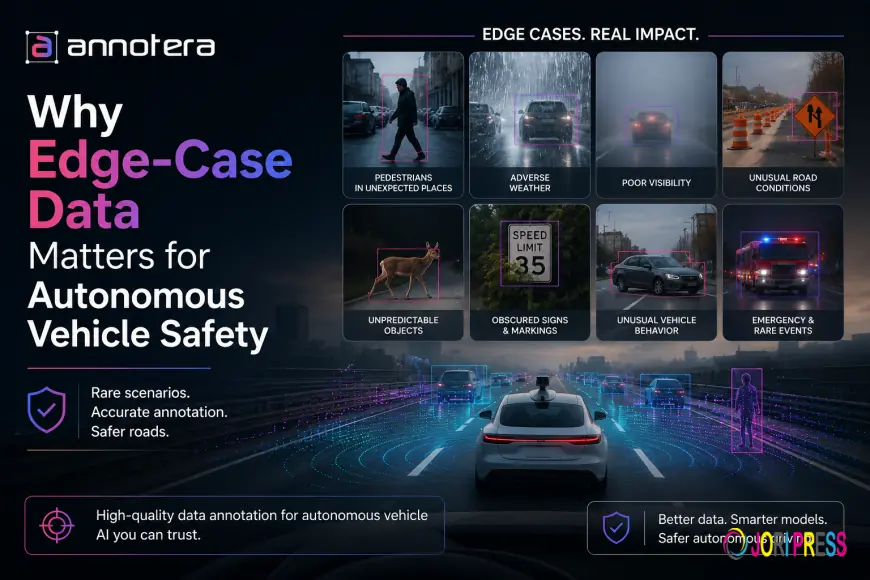
Autonomous vehicles are designed to interpret complex environments, predict the behavior of road users, and make decisions in real time. While everyday driving scenarios provide valuable training data, they do not represent the full range of situations an autonomous vehicle may encounter. Rare, unusual, and difficult situations—known as edge cases—can have an outsized impact on vehicle safety.
From a pedestrian suddenly entering the road to an obscured traffic sign, an unexpected object, or an unusual road configuration, edge cases challenge perception and decision-making systems in ways that routine driving data cannot. Building robust autonomous vehicle AI therefore requires not only large datasets but also carefully identified, accurately labeled, and diverse edge-case data.
What Is Edge-Case Data in Autonomous Driving?
Edge-case data represents uncommon, unusual, or challenging scenarios that fall outside the most frequently observed driving conditions. These situations may occur rarely, but they can create significant safety risks if an autonomous system fails to recognize or respond to them correctly.
Examples include:
-
A pedestrian emerging from behind a parked vehicle
-
A cyclist traveling unexpectedly across a vehicle's path
-
Animals entering the roadway
-
Construction zones with temporary lane markings
-
Fallen objects or debris on highways
-
Damaged, partially hidden, or unusual traffic signs
-
Vehicles behaving unpredictably
-
Emergency responders directing traffic manually
-
Poor visibility caused by heavy rain, fog, snow, or darkness
-
Unusual road layouts or temporary diversions
The difficulty lies in the fact that these scenarios are relatively uncommon compared with standard driving situations. As a result, conventional datasets may contain insufficient examples for AI models to learn how to handle them reliably.
Why Edge Cases Are Critical for Vehicle Safety
Autonomous vehicle systems depend on machine learning models to identify objects, understand road conditions, predict movement, and determine appropriate actions. Models trained predominantly on routine scenarios may perform well during normal driving but struggle when conditions change unexpectedly.
An edge case can expose a weakness in the perception or decision-making pipeline. For example, an autonomous vehicle may correctly detect pedestrians under normal lighting but fail to identify a person wearing dark clothing at night. Similarly, a perception model trained primarily on clearly visible lane markings may have difficulty interpreting lanes in a construction zone.
These failures can have serious consequences. Safety-focused AI development must therefore account for situations that are statistically rare but operationally significant.
The Role of Data Annotation in Edge-Case Training
Raw images, videos, LiDAR point clouds, and sensor data do not automatically provide the contextual information AI models need. They must be annotated to identify relevant objects, behaviors, spatial relationships, and environmental conditions.
For autonomous driving, annotation may include:
-
Bounding boxes around vehicles, pedestrians, cyclists, and other objects
-
Semantic segmentation of roads, sidewalks, barriers, vehicles, and vegetation
-
3D cuboids for objects captured through LiDAR or 3D sensors
-
Lane and road-marking annotation
-
Object tracking across consecutive video frames
-
Traffic sign and signal classification
-
Behavior and activity labeling
-
Occlusion and visibility attributes
-
Weather, lighting, and road-condition labels
Accurate annotation helps models understand not only what is present in a scene, but also how objects interact with their surroundings.
Capturing Diversity Within Edge Cases
Identifying an edge case is only the first step. Autonomous vehicle datasets must also capture variations within the same scenario.
Consider a pedestrian unexpectedly crossing the road. The situation can occur during daylight, at night, in rain, near an intersection, beside parked vehicles, or in an area with heavy traffic. The pedestrian's clothing, position, movement speed, and visibility may also differ.
This diversity matters because AI models need to generalize rather than memorize individual examples. A robust dataset should therefore represent edge cases across different locations, weather conditions, camera perspectives, road types, traffic densities, and object appearances.
Multimodal sensor data can provide additional context. Combining camera imagery with LiDAR, radar, GPS, and other sensor inputs can help annotation teams establish a more complete representation of challenging scenes.
Human Expertise Makes Edge-Case Annotation More Reliable
Edge-case annotation can be considerably more complex than labeling routine objects. Annotators may need to interpret partially visible objects, determine whether an object is relevant to vehicle movement, identify unusual behaviors, and distinguish temporary road features from permanent infrastructure.
This is where experienced human annotators and quality-control processes become important.
A structured annotation workflow can include multiple levels of review. Initial annotations can be checked by quality-control specialists, while ambiguous cases can be escalated to senior reviewers. Clear annotation guidelines, consensus mechanisms, and ongoing feedback can further improve consistency.
For safety-critical applications, annotation quality should be measured through defined quality metrics rather than treated as a one-time activity.
How Data Annotation Outsourcing Supports Edge-Case Projects
Building an internal annotation operation capable of handling large volumes of specialized autonomous driving data can require significant investment in people, infrastructure, training, and quality management.
Data annotation outsourcing can provide access to trained annotation teams and established quality-assurance workflows without requiring organizations to build every capability internally.
An experienced partner can support projects involving image, video, LiDAR, and multimodal datasets while helping organizations scale annotation capacity as dataset requirements change. Outsourcing can also allow autonomous vehicle developers to focus internal resources on model development, sensor engineering, simulation, and testing.
However, outsourcing should not mean compromising on quality. Organizations should evaluate an annotation provider based on domain expertise, security practices, scalability, quality-control processes, and experience with complex autonomous driving datasets.
Building Better Training Data for Autonomous Vehicles
Effective data annotation for autonomous vehicle applications requires a strategy that goes beyond collecting massive amounts of routine driving footage. Dataset development should deliberately identify difficult and underrepresented scenarios.
Active learning can help identify samples where AI models show uncertainty or make errors. These samples can then be prioritized for annotation and incorporated into subsequent training cycles. Simulation and synthetic data can also supplement real-world edge cases that are difficult or dangerous to capture repeatedly.
This creates a continuous improvement loop:
Collect → Identify Edge Cases → Annotate → Validate → Train → Evaluate → Capture New Failure Cases
Such an approach enables development teams to continuously strengthen model performance against emerging scenarios.
Turning Rare Scenarios Into Safety Improvements
Autonomous vehicle safety cannot be measured solely by performance in ordinary conditions. A system must also demonstrate resilience when circumstances become unexpected.
Edge-case data provides an opportunity to uncover blind spots before they become real-world safety problems. When rare scenarios are systematically captured, annotated, reviewed, and incorporated into training and evaluation datasets, autonomous driving systems can become better equipped to handle uncertainty.
At Annotera, we understand that high-quality training data is a critical component of reliable AI development. Through scalable annotation workflows, human expertise, and rigorous quality assurance, organizations can build richer datasets designed to address both everyday driving conditions and the challenging edge cases that matter most.
The goal is not simply to train autonomous vehicles for the road they usually see—it is to prepare them for the road they may encounter next.
What's Your Reaction?
 Like
0
Like
0
 Dislike
0
Dislike
0
 Love
0
Love
0
 Funny
0
Funny
0
 Angry
0
Angry
0
 Sad
0
Sad
0
 Wow
0
Wow
0