







































When Should a Prop Firm Be Rebuilt Rather Than Fixed?
Find out when fixing your prop firm is no longer enough. Learn the warning signs that it's time for a complete rebuild to support future growth.

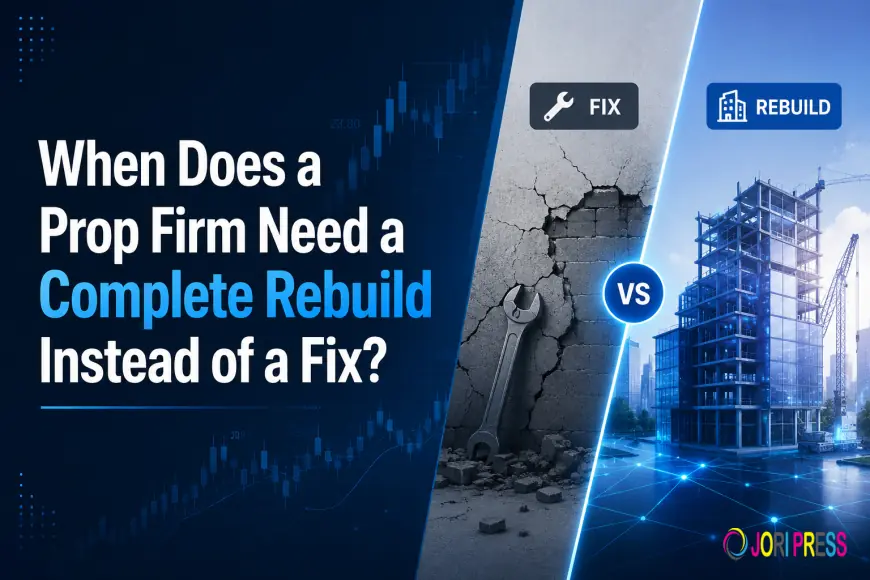
Every prop firm runs into challenges as it grows. Maybe the platform starts slowing down, payouts take longer than expected, or support tickets keep piling up. At first, these problems can usually be fixed with a few updates.
But what happens when the same issues keep coming back?
If your team spends more time fixing problems than growing the business, it may be time to think beyond another quick fix.
In this article, we'll look at the signs that a complete rebuild could be the smarter long-term move.
Why Small Fixes Stop Working
Most businesses begin with a simple setup. As the company grows, new tools, features, and processes are added whenever they're needed.
At first, this approach works well.
Over time, though, the business becomes a collection of disconnected systems. One platform handles challenges, another manages payments, while several third-party tools fill the remaining gaps.
Eventually, every update creates another complication.
Instead of solving problems, each fix introduces new ones. Teams spend more time maintaining the business than improving it.
When this becomes the norm, rebuilding often becomes the smarter investment.
Signs When a Prop Firm Needs to Be Rebuilt Instead of Fixed
Not every challenge requires starting over.
However, if several of the following issues appear together, a complete rebuild deserves serious consideration.
1. Technology Is Holding the Business Back
Many prop firms depend on software that worked well when they launched.
As trading volume increases, that same infrastructure may struggle to handle more users, larger datasets, or additional products.
Common warning signs include:
-
Frequent downtime
-
Slow platform performance
-
Integration failures
-
Delayed account updates
-
Poor mobile experience
If technical problems become part of everyday operations, upgrading individual components may not solve the bigger issue.
2. Traders Are Losing Confidence
A successful prop firm depends on trust.
When traders experience repeated problems, they start looking elsewhere.
Some common frustrations include:
-
Delayed payouts
-
Platform instability
-
Inconsistent challenge rules
-
Poor communication
-
Slow customer support
A few isolated complaints are normal.
A growing pattern of negative reviews usually points to deeper operational problems rather than isolated incidents.
3. Teams Spend More Time Solving Problems Than Building Growth
Internal teams often recognize trouble before customers do.
Support agents constantly respond to the same complaints.
Developers spend weeks fixing bugs instead of improving products.
Operations teams create manual workarounds because systems don't communicate with one another.
When everyone is busy maintaining outdated processes, innovation naturally slows.
4. Growing Feels Harder Every Month
Growth should make a business stronger.
If every new trader creates additional stress, something isn't working properly.
A healthy prop firm should be able to:
-
Launch new challenges quickly
-
Add payment providers easily
-
Expand into new regions
-
Handle higher trading volume
-
Introduce new account models without major disruption
If every expansion requires months of technical adjustments, the underlying structure may need rebuilding.
5. Security Risks Keep Increasing
Trading firms handle sensitive financial information every day.
Older systems often become difficult to secure because they rely on outdated frameworks or unsupported software.
Security concerns may include:
-
Weak user authentication
-
Outdated encryption
-
Compliance gaps
-
Data storage issues
-
Limited monitoring capabilities
When security improvements require major work across multiple systems, rebuilding may be safer than continuing with outdated technology.
How to Rebuild a Prop Firm Without Disrupting the Business
Many owners hesitate because they assume rebuilding requires shutting everything down.
That's rarely necessary.
Most successful projects happen in stages.
A practical approach usually includes:
→ Review your current setup: Find what’s working, what’s causing problems, and what needs improvement.
→ Fix the most important areas first: Prioritize systems that directly impact traders, such as account management, risk controls, and payouts.
→ Upgrade in phases: Replace outdated systems one at a time instead of changing everything at once.
→ Test before launching: Run new solutions alongside existing systems to catch issues early and ensure a smooth transition.
→ Prepare your team: Make sure your employees understand the new processes and tools.
A successful rebuild is about creating a stronger foundation for the future.
If you’re considering rebuilding your prop firm, working with an experienced prop firm solutions provider (eg. Hashcodex) can help you plan the transition and avoid unnecessary disruptions.
Final Thoughts
Every prop firm faces operational challenges as it grows. Fixing isolated issues is part of running any business, but there comes a stage when those fixes no longer address the real problem.
If your team is spending more time maintaining outdated systems than improving the trading experience, it may be time to look beyond another patch.
A complete rebuild requires planning, investment, and commitment. Yet it also creates a stronger foundation for long-term growth, easier operations, and greater confidence among traders.
Sometimes the smartest move isn't fixing what's broken; it's building something ready for what's next.
What's Your Reaction?
 Like
0
Like
0
 Dislike
0
Dislike
0
 Love
0
Love
0
 Funny
0
Funny
0
 Angry
0
Angry
0
 Sad
0
Sad
0
 Wow
0
Wow
0