






































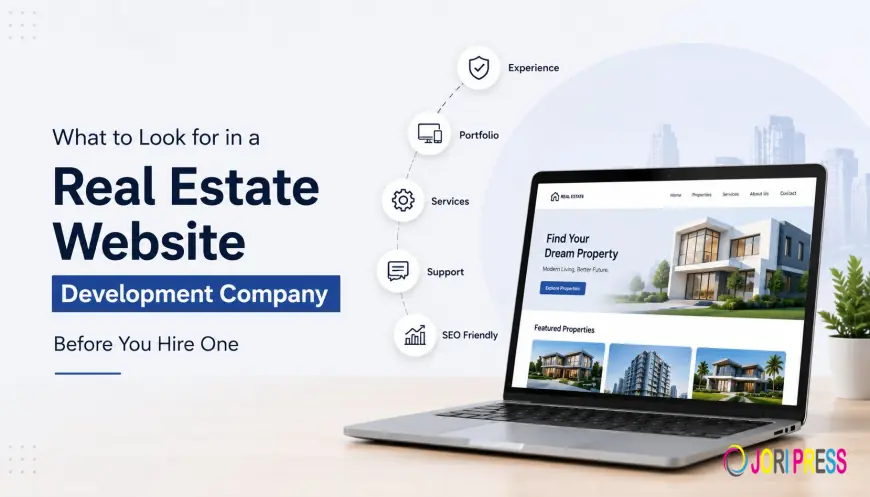
What to Look for in a Real Estate Website Development Company Before You Hire One
Looking to hire a real estate website development company? Here's what features, questions, and platform choices actually matter before you sign on.
The real estate business has moved almost entirely online. Buyers browse listings before they ever call an agent, tenants shortlist properties from their phones, and builders showcase entire projects through virtual tours rather than site visits. A real estate business without a strong website is, in practice, invisible to most of its potential customers.
This has pushed demand for real estate website development companies — agencies and studios that specialize in building property portals, builder websites, and rental or brokerage platforms. But not every web development company understands the specific needs of real estate. Choosing the wrong one often means paying twice: once for a website that looks fine but doesn't function the way property buyers expect, and again for the rebuild that follows.
Why Real Estate Websites Are a Different Kind of Project
A general-purpose website — a brochure site for a service business, for instance — mostly needs to look good and load fast. A real estate website has to do far more. It needs to manage hundreds or thousands of property listings, each with dozens of data points: location, price, area, amenities, floor plans, possession status, and photos or videos. It needs search and filtering that actually works the way a buyer searches — by locality, budget, property type, and configuration, not just a generic keyword box. And it usually needs to support multiple user types at once: buyers browsing, agents managing their own listings, and administrators overseeing the whole platform.
This is why hiring a developer with general web experience but no real estate background often leads to underwhelming results. The site may look polished in a demo, but the day-to-day experience of searching, filtering, and managing listings ends up clunky.
Core Features a Real Estate Website Needs
Regardless of which company builds it, a real estate website should include a certain baseline of functionality:
● Advanced property search and filters — by location, price range, property type, number of bedrooms, and other locality-specific criteria buyers actually use.
● Detailed property pages — with high-quality images, floor plans, amenity lists, nearby landmarks, and, increasingly, embedded virtual tours or video walkthroughs.
● Lead capture built into the browsing flow — inquiry forms, callback requests, and WhatsApp or chat integration placed where buyers naturally want to ask a question, not buried on a separate contact page.
● A CRM or lead management layer — so inquiries don't just land in an inbox and get forgotten, but get tracked, assigned, and followed up on.
● Agent or dealer dashboards — allowing individual agents or property owners to add and manage their own listings without needing a developer involved every time.
● Mobile responsiveness — a majority of property searches now start and often finish on a phone, so the mobile experience has to be as complete as the desktop one, not a stripped-down version of it.
● Local SEO readiness — property searches are almost always tied to a location ("2BHK flats in Salt Lake" or "commercial space for rent in New Town"), so the site's structure needs to support locality and project-specific pages, not just a single generic listings page.
A development company worth hiring should be able to speak to each of these without prompting, because they come up in nearly every real estate project.
Questions Worth Asking Before You Hire
A few questions tend to separate an experienced real estate web development partner from a generalist agency:
1. Have they built property listing or classified-style platforms before? Ask to see one, not just a portfolio screenshot.
2. Can the platform handle growth? A site built for fifty listings today should not need to be rebuilt when it reaches five thousand.
3. Is lead management included, or is it an afterthought? For a real estate business, a missed or unfollowed inquiry is a missed sale.
4. How is the backend managed? Someone on the business side, not just a developer, should be able to add or edit listings without touching code.
5. What is the timeline and cost structure? Custom-built real estate platforms from scratch can take several months and a significant budget; readymade or template-based solutions can shorten that considerably, which matters for businesses that want to launch and start generating leads sooner rather than later.
Custom Build vs. Readymade Platform
This is usually the biggest decision point. A fully custom real estate website, built from the ground up, gives complete control over design and features, but it takes longer and costs more — often a serious commitment for a business that hasn't yet validated its online strategy. A readymade real estate platform, built on an existing, tested codebase and customized with branding, locality-specific content, and the features a particular business needs, gets a business live much faster and at a fraction of the cost, without sacrificing the core functionality buyers expect.
For real estate businesses just establishing their online presence, or for agencies managing multiple listings across localities, the readymade route is often the more practical starting point. It can always be expanded later as the business and its traffic grow.
Originate Soft, a Kolkata-based software development company, works with real estate businesses on exactly this kind of website development — from readymade property portal solutions to real estate CRM tools for managing leads — helping businesses get a functional, search-ready platform live without the long timelines a fully custom build usually requires.
What's Your Reaction?
 Like
0
Like
0
 Dislike
0
Dislike
0
 Love
0
Love
0
 Funny
0
Funny
0
 Angry
0
Angry
0
 Sad
0
Sad
0
 Wow
0
Wow
0