




































What Makes the Best Silicon Wafer Suppliers in India Different?
Discover what makes the best Silicon Wafer Suppliers in India different, from quality and specifications to reliable supply and technical support.

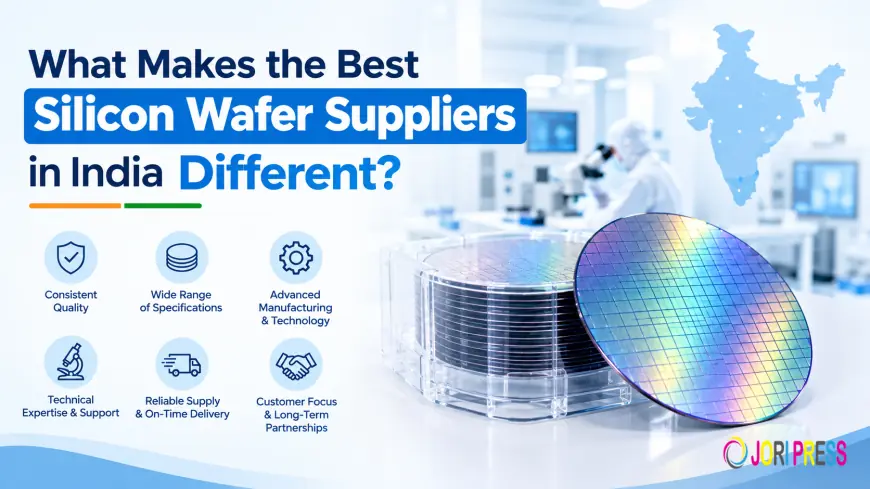
Silicon wafers are an essential component in semiconductor research, electronics, solar technology, MEMS, sensors, and various laboratory applications. The quality, specifications, and consistency of a silicon wafer can directly influence experimental results, device fabrication, and manufacturing processes.
With growing demand for semiconductor and advanced material research in India, choosing the right Silicon Wafer Suppliers in India has become increasingly important. However, not every supplier offers the same level of quality, technical support, customization, or reliability.
So, what actually makes the best silicon wafer suppliers different? Let us explore the key factors that can help laboratories, universities, research organizations, and industries identify a dependable supplier.
1. Consistent Wafer Quality
Quality consistency is one of the most important characteristics of a reliable silicon wafer supplier.
A good supplier should provide wafers with consistent:
-
Thickness
-
Diameter
-
Surface quality
-
Crystal orientation
-
Resistivity
-
Conductivity type
-
Flatness
-
Surface finish
Consistent specifications help researchers and manufacturers achieve repeatable results across different experiments or production batches.
2. Wide Range of Silicon Wafer Specifications
Different applications require different wafer specifications. The best Silicon Wafer Suppliers in India should therefore offer a broad selection rather than a single standard product.
Depending on the application, customers may need wafers based on:
-
Wafer diameter
-
Thickness
-
Crystal orientation
-
N-type or P-type conductivity
-
Resistivity range
-
Polished or unpolished surface
-
Single-side or double-side polishing
-
Prime, test, or research-grade quality
Having multiple options makes it easier for customers to select wafers according to their specific research or manufacturing requirements.
3. High-Quality Surface Finish
Surface condition plays a major role in semiconductor processing and laboratory research.
Applications such as thin-film deposition, lithography, microscopy, coating, and surface analysis may require highly polished wafers with controlled surface characteristics.
Reliable suppliers should clearly specify whether their wafers are:
-
Polished
-
Unpolished
-
Single-side polished
-
Double-side polished
They should also provide relevant surface-quality information where applicable.
4. Accurate Technical Specifications
A professional supplier should provide detailed and transparent product specifications.
Before purchasing silicon wafers, customers should be able to access information such as:
-
Material type
-
Crystal orientation
-
Wafer diameter
-
Thickness
-
Resistivity
-
Doping type
-
Surface finish
-
Grade
-
Packaging details
Clear specifications reduce the possibility of selecting an unsuitable wafer for a particular application.
5. Customization Options
Research and industrial applications do not always follow standard requirements.
A laboratory may need a particular wafer diameter, thickness, resistivity, orientation, or surface treatment. The ability to provide customized specifications can therefore be a major advantage.
The best suppliers should be able to discuss application-specific requirements and identify suitable wafer configurations where available.
6. Reliable Packaging and Handling
Silicon wafers are delicate and can be damaged by improper handling, contamination, or inadequate packaging.
A dependable supplier should use appropriate packaging designed to protect wafers during storage and transportation.
Proper handling can help minimize issues such as:
-
Scratches
-
Surface contamination
-
Breakage
-
Particles
-
Moisture-related problems
For research laboratories and semiconductor applications, maintaining wafer cleanliness and physical integrity is particularly important.
7. Application-Based Technical Support
Buying a silicon wafer is not simply about selecting a diameter or thickness. The correct choice often depends on the intended application.
A knowledgeable supplier can help customers understand which specifications may be appropriate for applications such as:
-
Semiconductor research
-
Thin-film deposition
-
Solar-cell research
-
MEMS fabrication
-
Sensor development
-
Nanotechnology
-
Surface science
-
Material characterization
-
Electronics research
Technical guidance can make the procurement process easier, especially for researchers working with specialized requirements.
8. Reliable Availability and Supply
Research and manufacturing projects often operate according to specific schedules. Delays in receiving essential materials can affect experiments, fabrication cycles, and project timelines.
Reliable Silicon Wafer Suppliers in India should maintain dependable sourcing and supply processes.
Customers should consider:
-
Product availability
-
Standard lead times
-
Bulk-order capabilities
-
Custom-order timelines
-
Delivery reliability
-
Stock consistency
A supplier with an organized supply chain can help customers plan their projects more effectively.
9. Suitable Options for Research and Industrial Applications
Different users have different requirements.
For example, a university laboratory may need small quantities for research experiments, while an industrial organization may require larger quantities for development or manufacturing.
A capable supplier should be able to serve different customer segments, including:
-
Universities
-
Research laboratories
-
Semiconductor companies
-
Electronics manufacturers
-
Solar research organizations
-
Material science laboratories
-
Engineering institutions
-
R&D departments
Offering products suitable for different application environments makes a supplier more versatile.
10. Quality Documentation
Documentation is another important factor when purchasing laboratory and semiconductor materials.
Depending on the product and application, customers may require documentation related to specifications, batch information, quality, or material characteristics.
Good documentation helps laboratories maintain proper procurement and experimental records.
Before placing an order, customers should confirm what documentation is supplied with the wafers and whether additional certificates can be provided when required.
11. Competitive and Transparent Pricing
Price is important, but it should not be considered separately from quality.
The lowest-priced wafer may not always provide the specifications or consistency required for a particular application. Instead, customers should compare suppliers based on overall value.
Important considerations include:
-
Product quality
-
Specifications
-
Quantity
-
Customization
-
Packaging
-
Documentation
-
Technical support
-
Delivery
-
After-sales service
A transparent supplier should clearly communicate pricing, minimum order quantities, and applicable delivery terms.
12. Strong Customer Support
Good customer support can make the purchasing process much easier.
Customers may have questions about wafer specifications, compatibility, availability, or ordering requirements. Responsive suppliers should provide timely communication before and after an order.
Strong support can be particularly useful when researchers need specialized wafer specifications or are purchasing silicon wafers for the first time.
How to Choose the Right Silicon Wafer Supplier in India
Before selecting a supplier, customers can use the following checklist:
-
Define your application – Understand whether the wafer will be used for research, fabrication, coating, testing, or another application.
-
Identify required specifications – Determine diameter, thickness, orientation, conductivity type, resistivity, and surface finish.
-
Compare product quality – Look for consistent and clearly documented specifications.
-
Check customization options – Confirm whether the supplier can meet specialized requirements.
-
Review packaging and handling – Ensure the wafers are adequately protected against damage and contamination.
-
Evaluate technical support – Choose a supplier that can answer application-related questions.
-
Consider availability and lead time – Make sure the supply schedule fits your project.
-
Compare overall value – Consider quality, service, delivery, and pricing together.
Why Supplier Selection Matters
The silicon wafer is often the starting surface for multiple research and fabrication processes. Any variation in wafer properties can potentially affect subsequent steps.
For example, differences in thickness, resistivity, orientation, or surface condition may influence processes involving deposition, lithography, etching, characterization, or device fabrication.
This is why selecting dependable Silicon Wafer Suppliers in India is an important part of laboratory and industrial procurement.
Conclusion
The best silicon wafer suppliers differentiate themselves through consistent quality, accurate specifications, product variety, customization, proper packaging, technical support, dependable supply, and customer service.
Rather than focusing only on price, laboratories and industries should evaluate the complete supplier offering. Understanding your application requirements and comparing suppliers against those requirements can help you source silicon wafers that are suitable for your research or production needs.
For researchers, universities, semiconductor companies, and laboratories, working with a reliable supplier can simplify procurement while supporting greater consistency throughout the experimental or fabrication process.
What's Your Reaction?
 Like
0
Like
0
 Dislike
0
Dislike
0
 Love
0
Love
0
 Funny
0
Funny
0
 Angry
0
Angry
0
 Sad
0
Sad
0
 Wow
0
Wow
0