






































What Happens If a Parent Violates a Custody Order?
what happens when a parent violates a custody order in Texas, the legal consequences, enforcement options, and how courts protect the child's best interests.

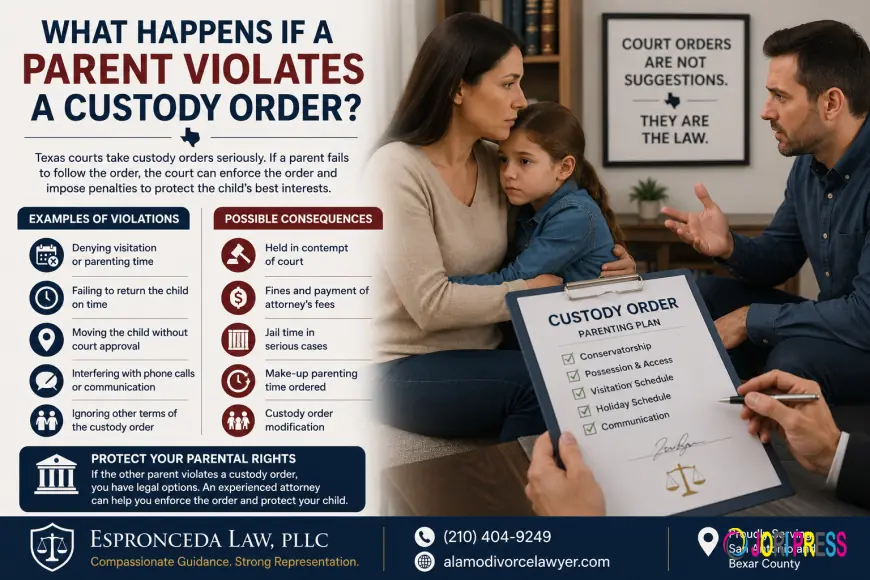
When parents separate or divorce, a child custody order establishes each parent's legal rights and responsibilities. Unfortunately, not every parent follows the court's orders. If a parent violates a custody order in Texas, it can create emotional stress for both the child and the other parent while disrupting the stability the court intended to provide. Whether a parent repeatedly misses visitation, refuses to return the child, or ignores important custody provisions, understanding your legal options is essential. Consulting with a Texas child custody enforcement attorney can help you determine the appropriate steps to protect your parental rights and enforce the existing court order.
What Is a Custody Order?
A custody order is a legally binding court order that outlines each parent's rights and responsibilities regarding their child.
In Texas, custody orders generally address:
-
Conservatorship (legal decision-making authority)
-
Possession and access (visitation schedule)
-
Parenting responsibilities
-
Exchange locations
-
Holiday schedules
-
Summer visitation
-
Communication between parents
Both parents are expected to follow the order exactly as written unless it has been modified by the court.
What Is Considered a Custody Order Violation?
A custody violation occurs when one parent intentionally or repeatedly fails to comply with the court's custody order.
Common examples include:
-
Refusing to return the child on time
-
Denying scheduled visitation
-
Keeping the child beyond the authorized parenting period
-
Interfering with communication between the child and the other parent
-
Relocating the child without court approval
-
Ignoring exchange locations or times
-
Making major decisions without required consent
-
Violating geographic restrictions
Even if a parent believes they have a good reason, they generally cannot ignore a court order without legal authorization.
Why Following the Custody Order Matters
Texas custody orders are designed to promote consistency and stability for children.
When a parent violates the order, it may affect:
-
The child's emotional well-being
-
Parent-child relationships
-
School attendance
-
Daily routines
-
Co-parenting communication
-
Long-term family stability
Consistently following the order helps reduce conflict and provides children with predictable parenting arrangements.
What Should You Do If the Other Parent Violates the Order?
If the other parent refuses to follow the custody order, avoid taking matters into your own hands.
Instead, consider these steps:
Document Every Violation
Keep detailed records, including:
-
Dates and times
-
Missed exchanges
-
Text messages
-
Emails
-
Photographs
-
Witness statements
-
Police reports, if applicable
Accurate documentation may become important evidence if court action becomes necessary.
Continue Following the Order Yourself
Even if the other parent violates the order, continue complying with your own obligations whenever possible.
Violating the order in retaliation may weaken your position before the court.
Attempt to Resolve the Issue
In some situations, communication may resolve misunderstandings.
If appropriate, discuss the issue calmly and document all conversations.
If communication becomes difficult, mediation may provide another opportunity to resolve disputes.
Filing an Enforcement Action
If violations continue, you may ask the Texas family court to enforce the custody order.
An enforcement action requests that the court require the other parent to comply with the existing order.
The court will review:
-
The custody order
-
Evidence of violations
-
Testimony from both parents
-
Any supporting documentation
If the court finds that a violation occurred, it may impose legal consequences.
Possible Consequences for Violating a Custody Order
Texas courts take custody order violations seriously.
Depending on the circumstances, the court may:
Hold the Parent in Contempt of Court
A parent who intentionally disobeys a court order may be found in contempt.
Possible penalties include:
-
Monetary fines
-
Payment of attorney's fees
-
Community supervision
-
Jail time in serious cases
Order Make-Up Parenting Time
The judge may award additional parenting time to compensate for visitation that was wrongfully denied.
Modify the Custody Order
Repeated violations may demonstrate that the current custody arrangement no longer serves the child's best interests.
The court may consider modifying:
-
Conservatorship
-
Parenting schedules
-
Possession orders
-
Geographic restrictions
Require Compliance With Future Orders
The court may issue additional instructions designed to reduce future conflicts and improve compliance.
When Is a Custody Modification Appropriate?
Sometimes repeated violations indicate a larger problem.
A custody modification may be appropriate when there has been:
-
Repeated denial of visitation
-
Ongoing interference with parenting time
-
Safety concerns
-
Relocation without permission
-
Significant changes affecting the child's welfare
The parent requesting modification must generally show that a material and substantial change in circumstances has occurred and that the requested change serves the child's best interests.
Can There Be Valid Reasons for Missing Visitation?
Yes. Certain emergencies may temporarily affect a parent's ability to comply with the custody order.
Examples may include:
-
Medical emergencies
-
Severe weather
-
Natural disasters
-
Unexpected transportation issues
Whenever possible, parents should communicate promptly, provide documentation if appropriate, and work cooperatively to minimize disruptions.
Why Legal Guidance Matters
Custody enforcement cases often involve complicated legal procedures and emotionally charged disputes. Proper documentation and knowledge of Texas family law can significantly influence the outcome of your case.
An experienced attorney can help by:
-
Reviewing the custody order
-
Preparing enforcement petitions
-
Collecting supporting evidence
-
Representing you during hearings
-
Requesting custody modifications when appropriate
-
Protecting your parental rights
Early legal guidance may help resolve disputes before they become more serious.
Frequently Asked Questions
1. What should I do if the other parent refuses to follow the custody order?
Document every violation, continue following your own obligations, and consult a family law attorney about filing an enforcement action if the violations continue.
2. Can a parent go to jail for violating a custody order in Texas?
Yes. In some cases, a parent may be held in contempt of court, which can result in fines, attorney's fees, or even jail time, depending on the circumstances.
3. Can repeated custody violations change the custody arrangement?
Yes. Repeated violations may support a request to modify the custody order if the court finds the change is in the child's best interests.
4. What evidence helps prove a custody order violation?
Useful evidence may include text messages, emails, parenting calendars, witness statements, photographs, police reports, and records of missed exchanges.
5. Can I deny the other parent visitation because they violated the custody order?
Generally, no. Parents should continue following the existing court order and seek legal remedies rather than taking unilateral action.
Final Thoughts
If a parent violates a custody order in Texas, it is important to take the situation seriously while responding through the proper legal channels. Custody orders exist to protect the child's best interests and provide stability for both parents. Documenting violations, following the existing order, and seeking legal assistance when necessary can help safeguard your rights and your child's well-being. If you need guidance regarding child custody enforcement, visitation disputes, or custody modifications, the experienced family law team at Espronceda Law, PLLC can help you understand your options. Learn more by visiting alamodivorcelawyer.com.
What's Your Reaction?
 Like
0
Like
0
 Dislike
0
Dislike
0
 Love
0
Love
0
 Funny
0
Funny
0
 Angry
0
Angry
0
 Sad
0
Sad
0
 Wow
0
Wow
0