






































What Goes Into Building a Game? A Look Inside Game Development Courses in Kolkata
Explore what game development courses in Kolkata actually teach — from design to coding to placement. See how Moople Institute trains job-ready developers.
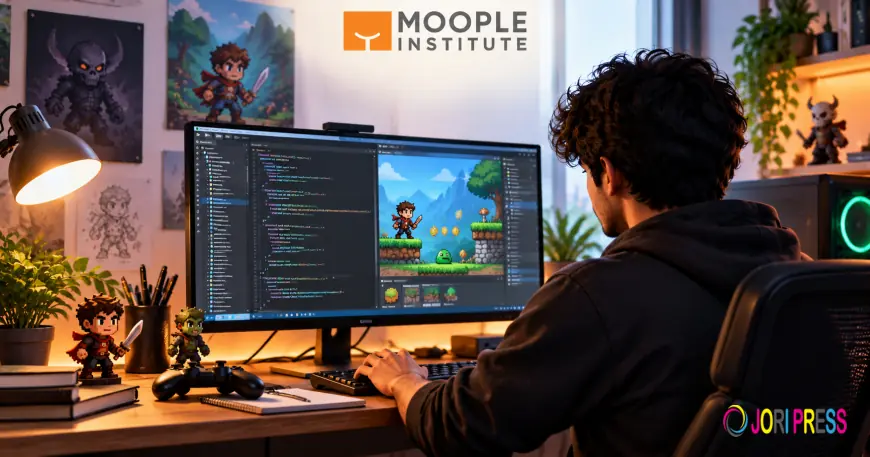
Most people who say "I want to make video games" are picturing one thing: sitting at a computer and writing code that magically turns into a playable world. It's a nice image, but it's only a slice of the real process. Building a game is closer to running a small film production — you need artists, designers, programmers, sound people, and testers, all working in sync. That's exactly why well-structured game development courses in Kolkata don't just teach coding; they teach how a game actually gets made, start to finish.
If you're a student in Kolkata weighing your options between a short certificate, a diploma, or a full game development classes program, this article breaks down what really happens inside these courses — the subjects, the tools, the mistakes students commonly make, and how to judge whether a program is worth your time and fees.
What Game Development Actually Involves
Game development is the process of designing, building, and testing a playable digital experience — it combines art, programming, storytelling, and psychology into one product. A single mobile game might involve a designer planning the rules, an artist building characters and environments, a programmer wiring up the logic, and a tester hunting for bugs before launch.
The Core Disciplines Every Game Needs
A finished game — whether it's a simple mobile puzzle or a full 3D adventure — usually pulls from five disciplines:
-
Game design – deciding how the game is played, what makes it fun, and how difficulty progresses
-
Art and animation – characters, environments, textures, and movement
-
Programming – the logic that makes objects react, score, and respond to input
-
Sound design – music and effects that shape mood and feedback
-
Quality assurance (QA) – testing for bugs, balance issues, and performance problems
Most beginners lean toward just one of these — usually art or code — but a genuinely useful game development course exposes students to all five, because studios rarely hire someone who can only do one thing well.
A Common Myth: "Game Dev" Just Means Coding
This is probably the biggest misconception among first-year students. Programming is essential, but game engines like Unity and Unreal Engine have made a large part of game logic accessible through visual scripting and pre-built systems. What actually separates a hireable game developer from a hobbyist is understanding why a mechanic works — pacing, feedback loops, and player psychology — not just knowing syntax.
Why Kolkata Students Are Choosing Game Development as a Career
India's gaming industry isn't a niche anymore. Industry estimates from Mordor Intelligence put the Indian gaming market at roughly USD 5 billion in 2026, with projections to nearly double to close to USD 10 billion by 2031, driven largely by mobile gaming and a fast-growing base of young players. That growth is creating real, ongoing demand for artists, designers, and developers — not just in Bengaluru or Mumbai, but increasingly through remote-friendly studio work that students based in Kolkata can access directly.
For Kolkata specifically, the appeal is practical: lower cost of living compared to metro hubs, a growing base of design and animation studios, and institutes now offering placement-linked game development courses with placement support that didn't exist in the city a decade ago.
Inside a Game Development Course in Kolkata: What You'll Actually Learn
A genuinely comprehensive game development full course is usually structured in stages, moving from fundamentals to a finished portfolio project.
1. Game Design Fundamentals
Students start with paper prototyping and design theory — level pacing, reward systems, and player motivation — before touching any software. This stage matters more than most students expect; skipping it produces developers who can build mechanics but can't explain why they work.
2. 3D Modeling and Character Animation
Using tools like Blender or Maya, students learn to model characters, props, and environments, then rig and animate them. This overlaps closely with Moople Institute's broader animation and VFX training, which is part of why design-focused institutes in Kolkata often teach game art more thoroughly than purely technical coding bootcamps.
3. Game Engines: Unity and Unreal Engine
This is where design, art, and code come together. Students learn to import assets, set up physics, build interactive environments, and use engine-native scripting (C# in Unity, Blueprints or C++ in Unreal).
4. Programming and Scripting Logic
Core programming concepts — variables, loops, conditionals, and object-oriented thinking — are taught in the context of actual gameplay, such as scoring systems, enemy AI, or inventory logic, rather than abstract exercises.
5. UI/UX and Level Design
Menus, HUDs, tutorials, and level layouts are covered as their own discipline, since a technically sound game with a confusing interface still fails with real players.
6. Capstone Project and Portfolio Building
A strong program ends with students building and publishing a playable prototype — often the single most important asset when applying for studio jobs, internships, or freelance work.
Expert tip: When comparing programs, ask specifically whether you'll leave with a playable, downloadable project you can show a recruiter — not just certificates and screenshots. Studios almost always ask to see or play something first.
Certificate vs Diploma vs Degree: A Quick Comparison
Short certificate: 2–4 months, best for testing interest or upskilling in one tool (e.g., Unity basics); narrow, single-topic coverage.
Diploma / full course: 6–12 months, best for career switchers and beginners wanting job-readiness; broad coverage across design, art, code, and portfolio.
Degree program: 3–4 years, best for students wanting an academic credential alongside skills; very broad, theory-heavy coverage.
For most 18–25-year-olds aiming to enter the industry quickly, a focused diploma-style game development course tends to offer the best balance of depth and speed — enough time to build a real portfolio without a multi-year commitment.
How to Choose the Right Game Development Course in Kolkata
Not all programs advertised as "game development classes" actually cover the full pipeline. Before enrolling, it's worth checking four things:
Placement Support That Goes Beyond a Certificate
Ask how many graduates from the last one or two batches were placed, and where. A program with genuine industry ties should be able to name real studios or freelance platforms, not just say "100% placement assistance."
Access to Industry-Standard Software and Lab Systems
Unity, Unreal Engine, and Blender all demand decent hardware. If a course doesn't guarantee lab access to run these smoothly, students end up learning on underpowered personal laptops, which slows progress considerably.
Mentors With Actual Studio or Production Experience
Not only academic teaching backgrounds. Practical trade-offs — like why a mobile game avoids heavy real-time lighting — are usually taught by people who've shipped something.
A Portfolio-First Teaching Philosophy
Moople Institute structures its game development training around building a demonstrable body of work alongside the theory, since that portfolio is ultimately what gets a graduate hired, not the course completion certificate alone.
Common Mistakes Students Make While Learning Game Development
Even in well-designed programs, certain habits slow students down repeatedly:
-
Jumping straight into a game engine before understanding basic design theory, which leads to mechanically sound but unfun prototypes
-
Trying to master every discipline (art, code, sound) equally instead of building one strong specialization plus working knowledge of the rest
-
Skipping playtesting, so bugs and confusing mechanics go unnoticed until it's too late to fix them properly
-
Treating the final project as a "class assignment" rather than a portfolio piece worth polishing after the course ends
Career Paths After a Game Development Course
Graduates of a solid game development program in Kolkata typically move into one of these roles:
-
Game Designer – plans mechanics, levels, and progression systems
-
3D Artist / Character Animator – builds and animates game assets
-
Gameplay Programmer – implements mechanics inside Unity or Unreal
-
UI/UX Designer for Games – designs menus, HUDs, and onboarding flows
-
QA Tester – identifies bugs and balance issues before release
-
Technical Artist – bridges the gap between art and programming teams
Many graduates also freelance on platforms serving indie studios, which is often a faster route into paid work than waiting for a full-time studio opening.
Frequently Asked Questions
1. Do I need coding experience before joining a game development course?
No. Most beginner-friendly game development courses for beginners start with no assumed coding background and build programming skills gradually, using game-specific examples rather than abstract computer science theory.
2. How long does a full game development course usually take?
A comprehensive, job-oriented program typically runs 6 to 12 months, covering design, art, engine work, and a final portfolio project. Shorter certificate courses (2–4 months) exist but usually cover only one narrow skill.
3. Which is more important for beginners: art or programming?
Neither should be ignored entirely, but most students benefit from choosing one primary specialization — art or code — while still learning enough of the other to collaborate effectively on a team.
4. Is Unity or Unreal Engine better to learn first?
Unity is generally considered friendlier for beginners and mobile game development, while Unreal Engine is stronger for high-fidelity 3D and console-style projects. Many courses introduce Unity first, then Unreal for advanced students.
5. Can I get a job in the gaming industry directly from Kolkata, or do I need to relocate?
Relocation isn't strictly necessary. A growing number of studios hire remotely, and Kolkata's own design and animation ecosystem has expanded enough to support entry-level roles locally, especially for artists and designers.
6. What kind of portfolio do studios actually want to see?
A small number of polished, playable projects almost always beats a long list of unfinished ones. Studios want to see that you can take an idea from concept to a working build, even if it's simple.
Conclusion
Building a game takes far more than knowing how to code — it takes design thinking, art skill, technical execution, and the discipline to test and refine an idea until it's actually fun to play. That's the real value a structured program offers over teaching yourself from scattered tutorials. If you're ready to move from curiosity to a real portfolio, explore the Game Development Course at Moople Institute and see how the curriculum is structured from first principles to a finished, playable project.
Game development is one of the few creative careers where a strong portfolio can matter more than a college name on your resume. The sooner you start building one, the sooner you have something real to show.
What's Your Reaction?
 Like
0
Like
0
 Dislike
0
Dislike
0
 Love
0
Love
0
 Funny
0
Funny
0
 Angry
0
Angry
0
 Sad
0
Sad
0
 Wow
0
Wow
0