







































Vacuum Casting China: A Practical Guide to Prototypes and Low-Volume Manufacturing
Discover vacuum casting China services for high-quality prototypes and low-volume production. Learn about materials, benefits, applications, and more.

What Is Vacuum Casting?
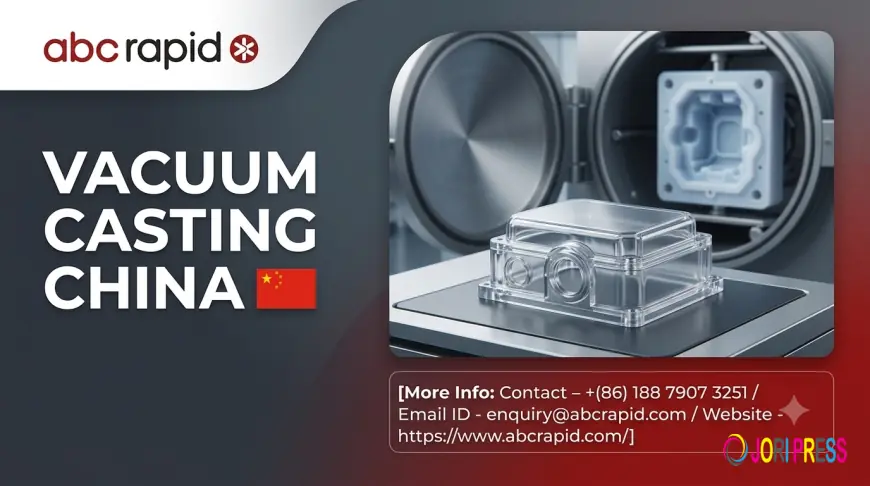
Vacuum casting is a manufacturing process used to produce accurate plastic and polyurethane parts from a master pattern. A silicone mold is created around a CNC-machined or 3D-printed master model. Liquid polyurethane resin is then introduced into the mold under vacuum conditions, helping reduce trapped air and produce detailed, consistent parts. The process is particularly useful for functional prototypes, presentation models, product testing, and low-volume production.
For companies evaluating vacuum casting China suppliers, the process can provide a practical balance between quality, production speed, material flexibility, and tooling cost. Unlike conventional injection molding, it does not require expensive hard tooling, making it attractive when only a limited number of parts are needed.
How Does the Vacuum Casting Process Work?
A typical vacuum casting workflow includes several important stages:
- Master Pattern Creation: The master model is produced from the approved CAD design using CNC machining or high-resolution 3D printing.
- Silicone Mold Making: Liquid silicone is formed around the master pattern and cured to create a flexible mold.
- Resin Preparation: Suitable polyurethane resin is selected according to the required strength, flexibility, appearance, or temperature performance.
- Vacuum Casting: The resin is mixed, degassed, and poured into the silicone mold inside a vacuum chamber to minimize bubbles and voids.
- Curing and Demolding: The material cures before the part is carefully removed from the mold.
- Finishing and Inspection: Flash removal, sanding, polishing, painting, color matching, or other secondary operations can be performed before inspection.
This sequence allows manufacturers to reproduce fine surface details and create multiple copies from one master pattern.
Why Choose Vacuum Casting in China?
China has become a major manufacturing destination for prototype development and low-volume production because manufacturers can combine engineering services, tooling, casting, finishing, and international logistics within one supply chain.
Key advantages include:
- Lower tooling investment: Silicone molds are considerably less expensive than conventional injection molds.
- Fast product development: Parts can generally be produced much faster than waiting for hard tooling.
- Flexible quantities: Vacuum casting is suitable for prototypes, pilot batches, and limited production runs.
- Material selection: Polyurethane systems can replicate properties associated with materials such as ABS, PP, nylon, and rubber.
- Detailed surface reproduction: Silicone molds can reproduce textures, lettering, and other features from the master pattern.
- Custom finishing: Parts may be polished, painted, dyed, or otherwise finished for visual and functional requirements.
These advantages make the process particularly useful between early-stage 3D printing and full-scale injection molding.
Vacuum Casting vs. 3D Printing vs. Injection Molding
| Factor | 3D Printing | Vacuum Casting | Injection Molding |
|---|---|---|---|
| Initial tooling | Very low | Low | High |
| Prototype speed | Very fast | Fast | Slower initially |
| Surface appearance | Depends on technology | Excellent | Excellent |
| Low-volume production | Good | Excellent | Often less economical |
| Material feel | Technology-dependent | Production-like options | Production material |
| Large-volume production | Limited | Limited to moderate | Excellent |
| Design changes | Very easy | Relatively easy | More expensive after tooling |
Vacuum casting is therefore most attractive when a project requires more realistic parts than many 3D-printing methods can provide but does not yet justify the investment in injection-molding tooling.
Materials Commonly Used in Vacuum Casting
Material selection should be based on the intended application rather than simply choosing the lowest-cost resin. Common polyurethane material categories include:
Rigid and ABS-Like Resins
These materials are useful for housings, enclosures, covers, brackets, and general functional prototypes where rigidity and impact resistance are important.
PP-Like Materials
Flexible formulations can be suitable for components requiring some movement, such as clips, covers, and snap-fit designs.
Nylon-Like Materials
These are useful when a prototype needs higher toughness and strength for functional testing.
Clear and Transparent Resins
Transparent polyurethane systems can be used for visual prototypes, lenses, covers, light guides, and demonstration parts.
Flexible and Rubber-Like Materials
Soft materials are suitable for grips, seals, gaskets, protective components, and products where flexibility is required.
The available material range varies by manufacturer, so engineers should confirm mechanical, thermal, hardness, and cosmetic requirements before production.
Applications of Vacuum Casting
Vacuum casting is widely used when companies need production-like components without committing to full-scale tooling.
Typical applications include:
- Product design validation
- Functional prototype testing
- Consumer electronics housings
- Automotive components
- Medical device prototypes
- Industrial equipment
- Robotics components
- Pre-production samples
- Marketing and demonstration models
- Small-batch end-use components
It can also support bridge production while an injection mold is being designed or manufactured. This allows companies to continue product testing or satisfy limited early demand without waiting for the final production tooling.
How to Select a Vacuum Casting Manufacturer in China
Choosing the right supplier is more important than simply comparing quoted prices. Before placing an order, evaluate the manufacturer using these criteria:
1. Engineering Capability
Look for a supplier that can review your CAD model, identify manufacturing risks, and recommend appropriate materials and mold construction.
2. Master Pattern Quality
The master determines much of the dimensional accuracy and surface appearance of the finished castings. Ask how the master will be produced and inspected.
3. Material Options
Make sure the supplier can provide a resin that matches your functional and cosmetic requirements rather than offering only one standard material.
4. Quality Inspection
Confirm that dimensional inspection, visual inspection, and batch quality controls are available for your project.
5. Finishing Services
If your parts require painting, polishing, texture, color matching, logos, or inserts, selecting a supplier with integrated finishing capabilities can simplify production.
6. Communication and Confidentiality
Clear technical communication is essential. CAD files, drawings, specifications, and product information should be handled securely throughout the project.
What Information Should You Provide for a Quote?
A detailed RFQ helps a manufacturer provide a more accurate price and lead-time estimate. Ideally, provide:
- 3D CAD files such as STEP, STL, or IGES.
- Technical drawings where critical dimensions or tolerances matter.
- Required quantity.
- Preferred material or required material properties.
- Surface finish and color requirements.
- Required inserts or secondary operations.
- Target delivery date.
- Intended application and testing requirements.
The more complete the information, the easier it is for the engineering team to recommend a suitable casting process.
When Is Vacuum Casting the Right Choice?
Vacuum casting is a strong option when you need small quantities of high-quality parts, realistic surface appearance, and production-like material characteristics without the cost of a conventional mold.
It may not be the best choice for very high-volume production. When demand becomes large and stable, injection molding can become more economical because the tooling cost is distributed across a much larger number of parts.
For prototypes and short production runs, however, silicone tooling offers an effective middle ground between additive manufacturing and traditional mass production.
Frequently Asked Questions
1. What is vacuum casting?
Vacuum casting is a manufacturing method that uses silicone molds and liquid polyurethane resin to create accurate replicas of a master model under vacuum conditions.
2. Is vacuum casting the same as urethane casting?
In many manufacturing contexts, vacuum casting and urethane casting refer to closely related processes. The term urethane casting emphasizes the polyurethane resin, while vacuum casting highlights the use of a vacuum during casting.
3. Why use silicone molds?
Silicone molds are flexible, relatively inexpensive, and capable of reproducing detailed surfaces from a master pattern.
4. How many parts can one silicone mold produce?
The number depends on the part geometry, resin, mold design, and required cosmetic quality. Manufacturers commonly produce multiple copies from one mold, but the exact mold life should be confirmed for each project.
5. Can vacuum casting produce functional prototypes?
Yes. Appropriate polyurethane materials can provide realistic strength, flexibility, appearance, and other characteristics for fit and functional testing.
6. Can vacuum-cast parts be painted?
Yes. Depending on the resin and specification, parts can receive finishing operations such as sanding, polishing, painting, dyeing, and clear coating.
7. Is vacuum casting suitable for low-volume production?
Yes. It is particularly useful for small batches, pilot production, pre-production builds, and limited end-use applications.
8. Can metal inserts be added?
Yes. Metal inserts, threads, pins, and other components can be incorporated into suitable vacuum-cast designs.
9. Is vacuum casting cheaper than injection molding?
For low quantities, it can be more economical because silicone tooling requires substantially less upfront investment than conventional injection molds. For high production volumes, injection molding may become more cost-effective.
10. How do I choose the right resin?
Consider strength, flexibility, hardness, heat resistance, appearance, transparency, and the actual conditions in which the finished part will be used.
Conclusion
If you are planning a prototype, pilot run, or small production batch, AbcRapid can help you evaluate the appropriate manufacturing approach and move from CAD design toward finished parts. Share your design requirements, quantity, material needs, and finishing specifications to begin the project with a clear manufacturing plan.
What's Your Reaction?
 Like
0
Like
0
 Dislike
0
Dislike
0
 Love
0
Love
0
 Funny
0
Funny
0
 Angry
0
Angry
0
 Sad
0
Sad
0
 Wow
0
Wow
0