







































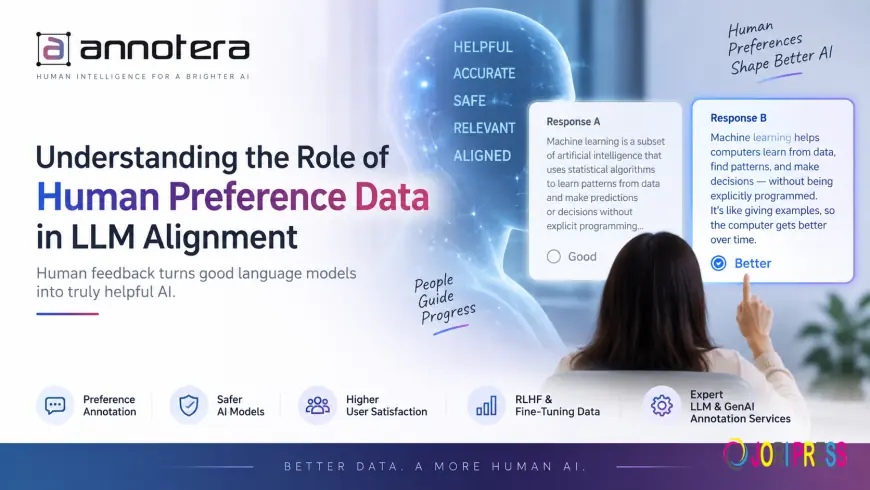
Understanding the Role of Human Preference Data in LLM Alignment
Large language models (LLMs) have become remarkably capable at generating text, answering questions, summarizing information, writing code, and performing complex language tasks. However, a model that can produce fluent text is not necessarily a model that consistently understands what users actually want.
This is where human preference data becomes important.
Human preference data provides a structured way to communicate which model responses are more useful, accurate, relevant, safe, or appropriate for a particular task. By incorporating these preferences into the training and evaluation pipeline, AI teams can move beyond simply teaching models to predict language and begin optimizing their behavior around desired outcomes.
For organizations developing advanced generative AI systems, high-quality preference data is therefore becoming an important component of LLM & GenAI annotation services and modern model alignment workflows.
What Is Human Preference Data?
Human preference data captures judgments about the relative quality of different AI-generated responses.
A common approach is to present an annotator with a prompt and two or more model-generated responses. The annotator then compares the responses and identifies the one that better satisfies predefined criteria.
For example, consider the prompt:
“Explain machine learning to a beginner in simple language.”
The model might generate two responses:
-
Response A: Technically accurate but filled with complex terminology.
-
Response B: Accurate, concise, and written using accessible language.
An annotator could select Response B as the preferred answer because it better matches the user's intended audience.
Preference datasets can contain paired responses, rankings, scores, or other forms of comparative feedback. These datasets are commonly used during the alignment stage to improve dimensions such as usefulness, honesty, instruction-following, and safety.
Why Human Preferences Matter for LLM Alignment
Pretraining exposes an LLM to enormous quantities of text, allowing it to learn linguistic patterns, facts, structures, and relationships. However, pretraining alone does not provide a complete specification of how an AI assistant should behave in every interaction.
Users may expect an assistant to:
-
Follow instructions precisely
-
Give relevant and concise answers
-
Avoid unsupported claims
-
Communicate clearly
-
Recognize potentially harmful requests
-
Refuse inappropriate instructions appropriately
-
Adapt its response to the context
These characteristics are difficult to encode entirely through conventional language-model objectives.
Human preference data provides an additional behavioral signal. Instead of asking only whether a response resembles text found in training data, alignment systems can ask whether one response is preferable to another according to defined evaluation criteria.
Research on InstructGPT demonstrated this principle by collecting human-written demonstrations and human rankings of model outputs, then using those signals as part of an RLHF pipeline. The researchers reported improvements in instruction following, truthfulness, and reduced toxic output compared with the original GPT-3 models evaluated in their study.
How Human Preference Data Supports RLHF
One of the best-known applications of preference data is Reinforcement Learning from Human Feedback (RLHF).
A simplified RLHF workflow can include four major stages:
1. Prompt and Demonstration Collection
AI teams first assemble representative prompts and examples of desirable responses. Human annotators may create demonstrations that illustrate how the model should respond.
2. Response Generation
A language model generates multiple responses for selected prompts. These outputs may differ in factuality, relevance, tone, safety, completeness, or instruction adherence.
3. Preference Annotation
Annotators compare the responses and identify which one better satisfies the evaluation criteria. Detailed annotation guidelines help improve consistency across the dataset.
4. Reward Modeling and Optimization
The resulting preference data can be used to train a reward model that learns to predict which outputs humans are likely to prefer. In the InstructGPT approach, this reward signal was subsequently used during reinforcement learning to optimize model behavior.
This makes preference annotation more than a simple labeling task. It becomes a mechanism for translating qualitative human judgments into structured training signals.
What Makes Preference Data High Quality?
The effectiveness of alignment depends heavily on the quality of the underlying data.
Poorly designed preference datasets can introduce inconsistencies, ambiguity, or unintended biases. High-quality RLHF & fine-tuning data should therefore be developed around clearly defined criteria and robust quality-control processes.
Important considerations include:
Clear Annotation Guidelines
Annotators need explicit definitions for concepts such as helpfulness, factuality, relevance, safety, completeness, and instruction adherence.
Representative Prompts
The dataset should reflect the real-world tasks and use cases for which the model is being developed. A narrow prompt distribution may produce alignment that does not generalize well to deployment environments.
Consistent Judgments
Multiple annotators can evaluate overlapping samples to identify disagreements and measure inter-annotator consistency. Disputed examples can then be reviewed to improve the guidelines.
Diverse Evaluation Perspectives
Human preferences are not universally identical. Different populations, languages, cultures, domains, and user groups can have different expectations. OpenAI's InstructGPT research explicitly noted that alignment to a particular group of labelers should not automatically be interpreted as alignment with the preferences of a broader population.
Rigorous Quality Control
Sampling audits, adjudication, annotator qualification, agreement analysis, and ongoing dataset review can help identify problematic labels before they influence model training.
Human Preference Data Goes Beyond Simple Ranking
Although pairwise ranking is widely used, preference annotation can capture much richer information.
Annotators can evaluate responses according to multiple dimensions, including:
-
Helpfulness
-
Factual accuracy
-
Relevance
-
Completeness
-
Reasoning quality
-
Tone
-
Safety
-
Instruction adherence
-
Bias and harmful content
For example, one response may be factually correct but unnecessarily verbose, while another may be concise but omit critical information. Multi-dimensional evaluation can help AI teams understand these trade-offs instead of reducing every judgment to a single preference label.
This is particularly valuable for enterprise AI applications where response quality may depend on domain-specific requirements.
The Role of Data Annotation Partners
Building large-scale preference datasets requires more than generating examples. Organizations need annotation workflows capable of maintaining quality, consistency, scalability, and traceability across potentially millions of interactions.
This is where specialized LLM & GenAI annotation services can support AI development teams.
A capable annotation partner can assist with:
-
Preference ranking
-
Response comparison
-
Instruction-following evaluation
-
Safety and toxicity labeling
-
Factuality assessment
-
Bias and sensitivity annotation
-
Conversational quality evaluation
-
Domain-specific preference datasets
-
RLHF and fine-tuning dataset preparation
The objective is not simply to increase annotation volume. It is to create reliable human feedback that can be transformed into useful signals for model development.
Emerging Focus: Quality Over Quantity
As preference datasets grow, simply collecting more labels is not always the only objective. Recent research has explored methods for identifying which preference samples provide the most useful alignment signal. A 2026 ACL Findings paper, for example, reported that selecting a subset of high-quality, lower-variability preference samples could achieve comparable or stronger alignment performance than using the full dataset in its experiments.
This highlights an important shift: preference-data quality, diversity, consistency, and relevance can matter as much as raw dataset size.
For AI teams, this means annotation programs should be designed around measurable quality objectives rather than treating labeling volume as the primary KPI.
Building Better-Aligned AI With Annotera
Human preference data creates an important connection between human expectations and machine-generated behavior. By systematically comparing outputs and capturing judgments about quality, safety, relevance, and usefulness, AI developers can create more informative training signals for alignment.
However, preference data is only as valuable as the process used to create it. Clear guidelines, qualified annotators, representative prompts, rigorous quality assurance, and domain expertise are essential for producing reliable datasets.
At Annotera, we support AI teams with specialized LLM & GenAI annotation services designed for the evolving requirements of generative AI development. From preference ranking and response evaluation to RLHF & fine-tuning data preparation, our human-in-the-loop workflows help organizations build structured, high-quality datasets for advanced language models.
Ready to build better training and alignment data for your next-generation AI model? Partner with Annotera to develop scalable, quality-focused human feedback datasets tailored to your model requirements.
What's Your Reaction?
 Like
0
Like
0
 Dislike
0
Dislike
0
 Love
0
Love
0
 Funny
0
Funny
0
 Angry
0
Angry
0
 Sad
0
Sad
0
 Wow
0
Wow
0