






































Topical Authority in SEO: Build Content Clusters That Convert
Learn how to build topical authority in SEO using content clusters, semantic keyword research, internal linking, and strategies that attract qualified traffic.
Topical Authority in SEO: How to Build Content Clusters That Drive Qualified Traffic
Meta Title: Topical Authority in SEO: Build Content Clusters That Convert
Meta Description: Learn how to build topical authority in SEO using content clusters, semantic keyword research, internal linking, and strategies that attract qualified traffic.
Suggested URL Slug: topical-authority-seo-content-clusters
Introduction
Ranking on search engines is no longer just about targeting individual keywords. Businesses need to demonstrate relevant expertise, publish useful information, and create a website structure that helps users find answers throughout their decision-making journey.
This is where topical authority becomes an important part of a modern SEO strategy.
Topical authority refers to a website's demonstrated depth and relevance in a particular subject area. Rather than publishing disconnected articles around high-volume keywords, businesses can organize their content into interconnected resources that address customer questions, explain complex topics, and support commercial decisions.
When implemented strategically, content clusters can strengthen internal linking, improve content discoverability, reduce keyword overlap, and attract visitors whose needs align with a company's products or services.
However, publishing more content does not automatically create topical authority. The real opportunity lies in building a focused, useful, and well-structured content ecosystem that serves both users and business objectives.
What Is Topical Authority in SEO?
Topical authority is a strategic SEO concept that describes how effectively a website covers a subject through relevant, helpful, and interconnected content.
For example, a website offering SEO services might publish a core page about search engine optimization, supported by detailed resources covering technical SEO, keyword research, content optimization, local SEO, and organic lead generation.
Together, these pages can provide a more comprehensive resource for people researching SEO than a collection of unrelated articles.
Search engines use many signals to evaluate and rank content, including relevance, quality, links, and the context of a query. Topical authority should not be understood as a single measurable Google ranking score or a guaranteed ranking advantage.
The objective is to develop a website that consistently satisfies relevant search intent and demonstrates useful subject-matter expertise.
Why Topical Authority Matters
A well-planned topical structure can help businesses:
-
Cover important customer questions across different search intents.
-
Build logical connections between related website pages.
-
Improve the discoverability of supporting content.
-
Identify missing resources and opportunities for content improvement.
-
Attract visitors researching problems that the business can solve.
-
Support the customer journey from initial research to a purchase decision.
The emphasis should remain on relevance and usefulness rather than producing the largest possible number of pages.
What Are Content Clusters in SEO?
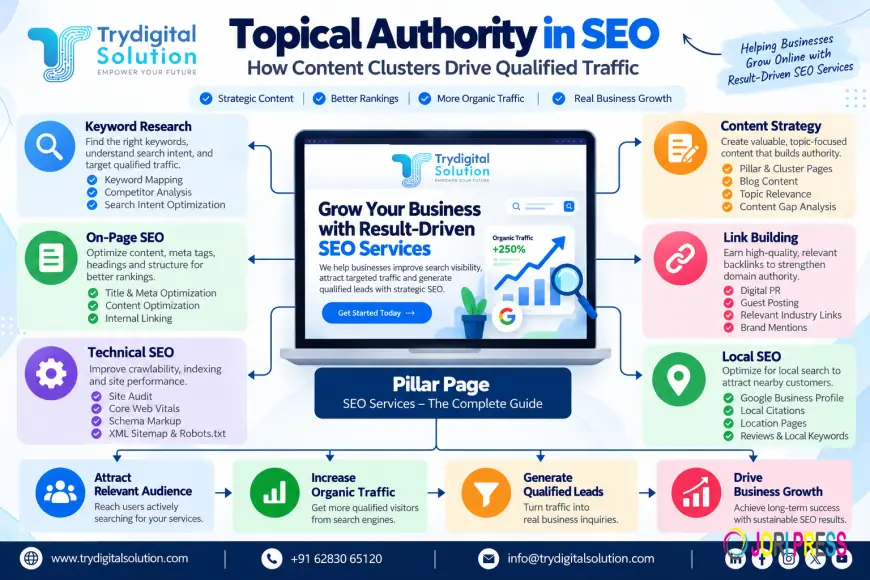
Content clusters are groups of related pages organized around a central topic. They usually contain a pillar page that introduces the broader subject and supporting pages that explore specific subtopics in greater detail.
Internal links connect these pages, helping readers navigate between related resources.
A typical content cluster includes three elements.
Pillar page: A comprehensive overview of the main subject, often targeting a broad, relevant keyword.
Cluster pages: Focused articles addressing specific questions, subtopics, challenges, or use cases.
Internal linking structure: Contextual links that connect the pillar page with supporting articles and relevant commercial pages.
For example, a digital marketing company might create a pillar page about SEO services and support it with articles on technical audits, keyword research, content optimization, and local search strategies.
The structure helps users explore the subject without forcing every page to cover the same information.
Step 1: Define Your Core Topic and Business Objectives
Before creating content clusters, identify the subjects that align with your business offerings, audience needs, and commercial goals.
A common mistake is choosing topics based entirely on search volume. A keyword may attract thousands of searches but generate little business value if those searchers are unlikely to need the company's services.
Start by answering three questions:
-
What products or services does the business provide?
-
What problems do potential customers need to solve before purchasing?
-
Which topics connect those problems with the company's expertise?
For an SEO agency, core topics could include technical SEO, organic lead generation, local SEO, and content strategy.
For a software development company, relevant topics might include custom software development, application modernization, API integration, and workflow automation.
The best starting point is a topic that combines audience demand, business relevance, and the ability to produce genuinely useful content.
Step 2: Conduct Advanced Keyword Research and Search Intent Mapping
Once the core topic is defined, identify the questions, subtopics, and search queries associated with it.
Advanced keyword research should go beyond exporting a list of keywords from an SEO tool. It should identify what users want to accomplish, how their needs differ, and which pages can satisfy those needs most effectively.
Useful research sources include Google Search Console, keyword research platforms, competitor content analysis, customer interviews, and relevant search results.
Group keywords according to:
-
Search intent and expected content format.
-
Topic similarity and semantic relationships.
-
Customer journey stage.
-
Commercial relevance.
-
Existing page performance.
-
Content gaps and competitive opportunities.
For example, a cluster about technical SEO may include queries such as:
-
What is a technical SEO audit?
-
How do canonical tags work?
-
How can indexing issues be diagnosed?
-
How do Core Web Vitals affect user experience?
-
When should a business hire technical SEO services?
These queries are related, but they do not necessarily belong on one page. Some require standalone explanations, while others may be best covered as sections within a comprehensive guide.
Review the search results and the underlying user need before deciding whether a keyword deserves its own URL.
This prevents unnecessary page creation and helps reduce keyword cannibalization, where multiple pages compete for substantially similar search intent.
Step 3: Build a Structured Content Cluster Strategy
A well-planned content cluster organizes related website pages around a central topic, helping users explore a subject in depth while creating a clear internal linking structure.
Start by identifying a primary topic that aligns with your business services and audience needs. Create a comprehensive pillar page covering the main subject, then develop supporting articles that answer specific questions and explore related subtopics.
For example, an SEO agency targeting technical SEO could organize its content around these topics:
-
Main topic: Technical SEO Services
-
Supporting topic 1: How to Identify and Fix Website Indexing Issues
-
Supporting topic 2: Core Web Vitals Optimization for Better Website Performance
-
Supporting topic 3: Canonical Tags and Duplicate Content Management
-
Supporting topic 4: JavaScript SEO and Search Engine Rendering
Each supporting article should address a distinct search intent and provide practical information rather than repeating content from the pillar page.
Connect Related Pages Through Internal Linking
Once the content is published, create contextual internal links between the pillar page and relevant supporting articles. Link to related resources when they provide additional value, and direct readers to the main topic page when they need a broader understanding of the subject.
You can also connect informational articles to relevant service pages. For instance, an article about resolving website indexing problems could link to a technical SEO audit service, giving readers a natural next step if they need professional assistance.
This structure helps search engines discover related pages, supports website navigation, and guides potential customers from informational content toward relevant services.
The goal is to create a connected, useful content ecosystem in which every page serves a clear purpose and contributes to the overall SEO strategy.
Step 4: Create Content That Demonstrates Genuine Expertise
A content cluster becomes valuable when its pages offer meaningful answers rather than repeating the same information with different keywords.
To improve content quality, develop each article around a specific user problem and provide enough depth to solve it.
Effective content should include:
Original insights: Add practical observations, original research, real examples, or lessons from implementation where available.
Accurate explanations: Explain complex concepts clearly and support important claims with reliable sources.
Practical guidance: Provide steps, checklists, examples, or decision frameworks that readers can apply.
Relevant expertise: Use appropriate author information and demonstrate experience where the subject requires it.
Distinct page purpose: Give each article a clear reason to exist instead of duplicating content already covered elsewhere.
For example, an article about canonical tags should explain when they are useful, how they work, common implementation mistakes, and how to validate them. It should not simply repeat a general introduction to technical SEO.
AI tools can assist with research organization, outlining, and editing, but automatically generating large volumes of similar articles is not a substitute for useful, accurate, original content.
Step 5: Strengthen Internal Linking With Contextual Relevance
Internal linking is one of the most practical ways to connect content clusters.
A well-designed internal linking strategy helps readers discover related information and gives search engines additional context about page relationships.
Follow these principles:
-
Link from the pillar page to important supporting articles.
-
Link from supporting articles to the pillar when relevant.
-
Connect related cluster pages when the next resource genuinely helps the reader.
-
Link to commercial service pages when they offer a relevant next step.
-
Use descriptive anchor text that accurately reflects the destination.
-
Ensure important pages are accessible through crawlable links.
-
Review broken links and important orphan pages during content audits.
Avoid using the same exact-match keyword as anchor text in every internal link. Natural, descriptive language is usually more useful than repetitive keyword targeting.
Internal linking should reflect the site's information architecture, not an arbitrary quota of links per article.
Step 6: Align Content Clusters With the Customer Journey
One of the most overlooked benefits of content clusters is their ability to support customers at different stages of the buying process.
A business may attract users who are just learning about a problem, comparing possible solutions, or preparing to hire a service provider. A strategic content plan addresses each stage with relevant information.
During the awareness stage, users are looking for basic information, so an article such as “What Is Technical SEO?” can help them understand the topic and identify potential challenges.
During the consideration stage, users begin evaluating their needs and exploring solutions. Resources such as a “Technical SEO Audit Checklist” can help them assess their website and understand which improvements may be necessary.
At the decision stage, users are more likely to consider professional assistance. A dedicated page about “Professional Technical SEO Audit Services” can explain the available services, their benefits, and how to request a consultation, encouraging qualified inquiries.
Finally, during the retention stage, existing customers may need ongoing guidance and support. Content such as an “Ongoing SEO Monitoring and Maintenance Guide” can help them understand the importance of maintaining website performance and continuing optimization.
These stages are not always linear. A visitor may discover a business through a detailed technical article and immediately request a consultation, while another may explore several educational resources before contacting a provider.
By connecting relevant pages through contextual internal links and using appropriate calls to action, businesses can guide readers toward the next useful step without making educational content overly promotional.
Step 7: Use Data to Prioritize and Improve Content Clusters
Publishing a content cluster is only the beginning. Ongoing analysis helps identify which pages deserve improvement and where additional resources may provide value.
Google Search Console can reveal which queries generate impressions and clicks, while Google Analytics 4 can help assess landing-page activity and configured conversions. Website crawlers and SEO platforms can provide additional information about internal links, indexation, and competing pages.
Review the following opportunities:
High impressions but low click-through rates: Evaluate whether the title and description accurately communicate the page's value and match the query.
Relevant queries with weak page coverage: Identify unanswered questions or subtopics that deserve improvement.
Multiple pages targeting similar intent: Assess whether the pages serve distinct needs or whether consolidation would create a stronger resource.
Organic traffic without meaningful conversions: Review the audience's intent, content relevance, service-page connections, and calls to action.
Important pages with weak internal discovery: Improve contextual links from relevant, accessible pages.
Prioritize work based on expected impact, confidence, implementation effort, and business relevance.
Do not assume that every new article will improve rankings for the entire cluster. Evaluate page-level and business-level performance over suitable periods and account for seasonality, competition, and search engine changes.
Step 8: Measure Topical Authority Through Meaningful SEO Metrics
Topical authority is not a single Google Search Console metric. Businesses should evaluate it through a combination of visibility, content quality, technical accessibility, and commercial outcomes.
Useful indicators include:
-
Organic clicks and impressions across the target topic.
-
Visibility for relevant groups of related queries.
-
Growth in qualified organic landing-page traffic.
-
Number of valuable pages receiving organic traffic.
-
Internal link coverage for important pages.
-
Indexation and technical health of the content cluster.
-
Organic conversions, qualified leads, and attributable revenue.
Review performance at both the cluster and individual page levels. A cluster may attract more traffic overall while one of its pages declines, or a page may rank well for informational queries without generating commercial conversions.
Segmenting performance by search intent and landing-page purpose can reveal whether the content is attracting the right audience.
Ultimately, the most useful measurement framework connects organic search performance to customer needs and business outcomes rather than relying on an assumed authority score.
Common Topical Authority Mistakes to Avoid
Even well-intentioned content strategies can underperform when the emphasis shifts from usefulness to volume.
Publishing too many similar articles: Multiple pages targeting nearly identical search intent can create duplication and maintenance challenges.
Ignoring commercial relevance: High-traffic topics may deliver limited value if they attract people outside the target market.
Over-optimizing internal links: Repetitive anchor text and unnecessary links can make content less natural and harder to navigate.
Neglecting existing content: Updating, consolidating, or improving relevant pages may be more useful than creating additional articles.
Prioritizing quantity over quality: Thin or repetitive content does not become valuable simply because it belongs to a large cluster.
Expecting immediate results: Search performance depends on competition, website conditions, content quality, and many other factors. A content cluster is a strategic framework, not a guaranteed shortcut to higher rankings.
Avoiding these mistakes helps maintain a coherent website structure and keeps the focus on useful content.
Conclusion: Turn Topical Authority Into Sustainable Organic Growth
Building topical authority requires a deliberate combination of search intent research, content architecture, subject-matter expertise, internal linking, and ongoing performance analysis.
Content clusters help businesses organize information around important customer needs, connect related resources, and create a clearer journey from educational discovery to commercial evaluation.
However, success depends on more than publishing a large number of articles. Every page should serve a distinct purpose, contribute useful information, and fit naturally within the broader website structure.
Businesses looking to strengthen their organic visibility should begin by identifying their most commercially relevant topics, auditing existing content, and building a prioritized roadmap of meaningful improvements.
Want to build a stronger organic search strategy? Professional SEO services can help identify content gaps, improve internal linking, optimize website architecture, and develop a content strategy aligned with your audience and lead-generation goals.
What's Your Reaction?
 Like
0
 Dislike
0
 Love
0
 Funny
0
 Angry
0
 Sad
0
 Wow
0