







































# Top 10 Container Desiccant Bag Manufacturers & Suppliers in India 2026
Discover the top 10 container desiccant bag manufacturers and suppliers in 2026 for effective moisture control, cargo protection, and safer global shipping.
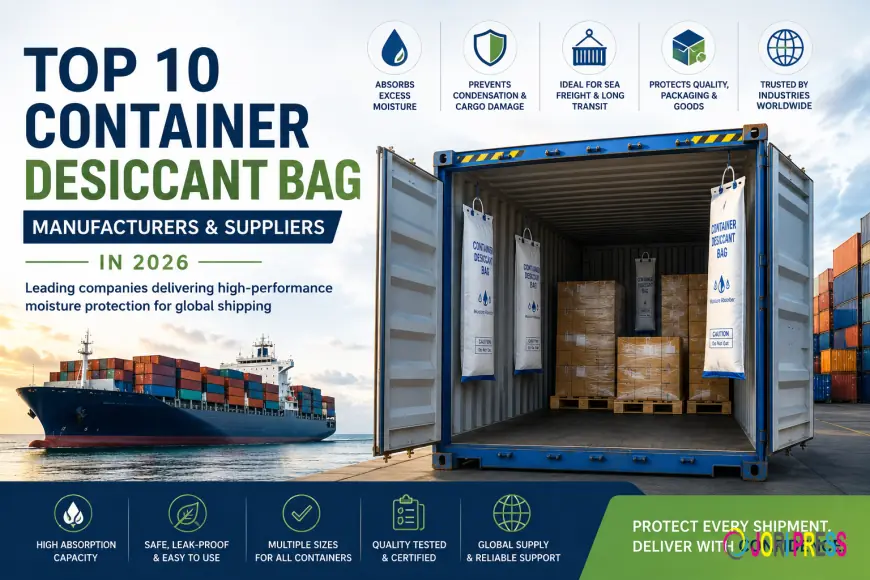
International shipping exposes cargo to a wide range of humidity and temperature conditions. During ocean freight, moisture trapped inside a sealed container can condense as temperatures fluctuate, creating container rain, cargo sweat, corrosion, mold, packaging deterioration, and product damage.
For exporters, manufacturers, freight forwarders, and logistics companies, choosing the right container desiccant bag manufacturer is therefore an important part of cargo-protection planning.
Container desiccant bags work by removing excess water vapor from the air inside a shipping container. Depending on the formulation, they can absorb substantial quantities of moisture and either retain it as a gel or collect it within a controlled reservoir.
With numerous suppliers available globally, buyers should evaluate manufacturers based on absorption performance, product formats, leak resistance, certifications, customization, supply capacity, and experience with international shipping.
Below are 10 container desiccant bag manufacturers and suppliers worth considering in 2026.
Note: This is an informational shortlist, not a definitive ranking. The most suitable supplier depends on cargo type, route, container size, transit duration, humidity exposure, and procurement requirements.
1. DryCon Global
DryCon Global specializes in industrial moisture-control products designed for export cargo, shipping containers, packaging, and storage applications.
Its DryCon Container Desiccant Bag is available in 300 g, 500 g, and 1,000 g formats. The product range includes magnesium chloride and calcium chloride formulations. DryCon states an absorption capacity of at least 250% for its magnesium chloride formulation and at least 300% for its calcium chloride formulation under specified test conditions.
The bags are designed for container-level moisture management rather than simply protecting individual cartons. They can be installed along container walls or doors to help capture water vapor before condensation develops.
DryCon also states that its container desiccant bags are REACH certified, RoHS compliant, and DMF-free, with a stated shelf life of up to 36 months from delivery. Custom weights, OEM labeling, private branding, and bulk procurement options are available.
Best suited for: Exporters, logistics companies, automotive, electronics, textiles, pharmaceuticals, food packaging, machinery, and industrial cargo.
2. Clariant
Clariant is an established global specialty chemicals company with a dedicated Cargo & Device Protection portfolio.
Its Container Dri II is a calcium-chloride-based cargo desiccant specifically designed to absorb moisture inside shipping containers and help prevent condensation or “container rain.” Clariant currently offers the product in several configurations, including individual bags, adhesive strips, poles, packs, and larger formats.
The company states that Container Dri II is DMF-free and designed for safe handling. It is used for applications ranging from agricultural products and food shipments to automotive parts, machinery, furniture, wood, glass, and metal components.
Clariant also provides broader moisture-protection technologies, including silica gel, bentonite clay, molecular sieve desiccants, humidity indicators, and oxygen absorbers.
Best suited for: Large enterprises, global exporters, automotive shipments, food commodities, electronics, industrial equipment, and organizations requiring a broad moisture-protection portfolio.
3. Absortech
Absortech focuses specifically on moisture-control solutions for containerized cargo and international logistics.
Its container desiccant portfolio includes products such as Absorpole, AbsorBag, and AbsorGel, with calcium chloride-based solutions designed for container moisture control. The company offers both gel-based and liquid-based formats.
One of the company's distinguishing approaches is offering different installation orientations. Vertical products can be installed using container lashing points, while horizontal formats can be positioned above cargo. Absortech notes that horizontal installation can provide higher absorption per kilogram of desiccant in suitable applications.
The company also emphasizes selecting desiccant type based on cargo, route, container configuration, and environmental conditions rather than using the same product for every shipment.
Best suited for: Exporters looking for specialized container moisture-management systems and route-specific solutions.
4. Desiccare
Desiccare Inc. offers industrial moisture-protection products under its Cargo Dry range.
Its Cargo DryPak is designed for crates, cartons, and shipping containers and is positioned as a solution for controlling condensation and reducing moisture-related risks during transportation. Desiccare states that its Cargo Dry products can provide more than 50 days of protection and absorb up to 250% of their weight in moisture, depending on the product and conditions.
The company provides multiple configurations and emphasizes strategic placement throughout containers. Its guidance considers container walls, doors, cargo zones, load characteristics, route conditions, and transit duration.
Desiccare also provides a container desiccant calculator that considers container size, cargo type, route humidity risk, and container fill level when estimating requirements.
Best suited for: Industrial exporters, automotive and metal shipments, long-haul logistics, and companies seeking application-based quantity guidance.
5. WiseSorbent Technology
WiseSorbent Technology manufactures a broad portfolio of desiccant and moisture-control products.
Its product range includes silica gel, molecular sieve, clay desiccants, high-performance desiccants, humidity indicators, and WiseCargo container desiccants.
This broad portfolio can be useful for companies that require both package-level and container-level moisture protection. For example, an exporter may need small desiccant packets inside electronics packaging while simultaneously requiring a larger container desiccant for the overall shipping environment.
WiseSorbent also provides different desiccant chemistries and packaging formats for industrial applications.
Best suited for: Manufacturers and distributors requiring multiple desiccant technologies from one supplier.
6. R-Tech
R-Tech supplies desiccants and moisture-control products in the UK and European market.
Its shipping container desiccant uses a hanging configuration designed for easy installation inside containers. According to its product information, the solution is designed to absorb moisture and transition to a solid form as equilibrium is reached, avoiding the handling of free liquid after use.
R-Tech also manufactures other desiccant formats, including molecular sieve sachets and products designed around British and military-related specifications.
Best suited for: European buyers, industrial packaging, defense-related applications, and companies seeking container desiccant solutions alongside conventional packaging desiccants.
7. DesiSorb
DesiSorb is an industrial desiccant manufacturer offering multiple moisture-control materials.
Its portfolio includes silica gel, clay, calcium chloride, magnesium chloride, barrier packaging, and other moisture-control products. The company positions itself as a factory-direct supplier for applications including container shipping, electronics, automotive, and food.
For buyers comparing suppliers, the availability of several desiccant chemistries can be useful because different cargo environments have different moisture loads and performance requirements.
DesiSorb also highlights customization, OEM supply, quality control, and global delivery.
Best suited for: OEM buyers, industrial customers, distributors, and exporters seeking customized desiccant products.
8. Universe Desiccant Products
Universe Desiccant Products is an India-based manufacturer and supplier specializing in container moisture-control products.
The company focuses heavily on calcium chloride container desiccants for export cargo. Its product portfolio includes cargo dry bags and container desiccant bags in multiple sizes, including formats intended for 20-foot and 40-foot containers.
Universe Desiccant states that its high-absorption calcium chloride products can absorb up to 300% moisture and are designed to help prevent container rain, condensation, mold, and corrosion.
Its applications include agricultural products, rice, spices, coffee, textiles, leather goods, machinery, electronics, and metal components.
Best suited for: Indian exporters, manufacturers, freight forwarders, and businesses looking for bulk calcium chloride container desiccants.
9. Samarpann Silica Gel
Samarpann Silica Gel, based in Ahmedabad, India, manufactures container desiccant products in formats including bags, strips, and pouches.
Its container desiccant range is promoted for applications including export packaging, food and beverage, pharmaceuticals, textiles, leather, electronics, machinery, automotive parts, and bulk cargo.
The company lists calcium chloride container bags with hanging configurations and applications covering sea containers, rail containers, pallets, warehouses, and other logistics environments.
For Indian buyers, a local manufacturer can potentially provide advantages in terms of domestic procurement, communication, customization, and shipping lead times.
Best suited for: Indian exporters, distributors, industrial buyers, and companies sourcing container desiccants domestically.
10. Corpac Deutschland
Corpac Deutschland GmbH & Co. KG provides moisture and corrosion-protection solutions for industrial packaging and transportation.
Its portfolio includes container desiccants for overseas shipping, along with VCI-based corrosion-protection products and other packaging technologies. European supplier listings identify Corpac as a manufacturer/producer serving customers internationally.
This combination of desiccant and corrosion-protection technologies can be particularly relevant when exporters are shipping metal components, machinery, automotive parts, and other corrosion-sensitive products.
Best suited for: European industrial manufacturers, automotive companies, machinery exporters, and businesses requiring combined moisture and corrosion protection.
How to Choose the Right Container Desiccant Manufacturer
Choosing a supplier shouldn't be based solely on price. The correct product depends on the moisture load and risk profile of the shipment.
Consider these factors before placing a bulk order.
1. Absorption Capacity
Compare the manufacturer's stated absorption capacity and understand the conditions under which that figure was measured. A percentage without test conditions can be misleading.
2. Desiccant Chemistry
Calcium chloride, magnesium chloride, silica gel, clay, and molecular sieve each have different characteristics.
For large shipping containers with significant moisture loads, high-capacity formulations may be more appropriate than conventional small silica-gel sachets.
3. Container Size
A 20-foot container and a 40-foot container have different internal volumes. Quantity should therefore be calculated according to container size rather than using a universal number.
4. Cargo Type
Textiles, wood, agricultural commodities, electronics, metal components, pharmaceuticals, and machinery can have very different moisture sensitivities.
Hygroscopic cargo may require a more carefully designed moisture-control strategy.
5. Transit Duration
A short domestic shipment has a different moisture risk profile from a six-week ocean voyage.
Long-distance routes crossing several climate zones can experience repeated temperature and humidity fluctuations.
6. Installation Method
Consider whether bags should be hung vertically, attached to container walls, installed horizontally, or positioned above cargo.
Correct placement is important because airflow affects moisture exposure.
7. Leak Resistance
For calcium chloride and other highly hygroscopic formulations, the bag structure should safely retain absorbed moisture. Buyers should evaluate pouch construction, sealing, and handling characteristics.
8. Certifications and Documentation
For regulated or sensitive cargo, request relevant technical documentation, certificates, material specifications, test reports, and safety information.
9. Supply Capacity
A supplier that performs well for a 100-unit order may not necessarily be capable of supporting thousands of containers per month.
Exporters should evaluate manufacturing capacity, lead times, packaging, logistics, and continuity of supply.
10. Customization
OEM labeling, custom bag weights, private branding, packaging configurations, and customized deployment recommendations can be valuable for distributors and large exporters.
Container Desiccant Bags vs. Small Desiccant Sachets
One common mistake is treating all desiccants as interchangeable.
A small silica gel sachet is generally designed to protect an individual product, carton, bottle, bag, or package.
A container desiccant bag, by comparison, is designed to manage moisture in the larger airspace of a shipping container.
For example, an electronics manufacturer could use small silica gel packets inside individual equipment boxes while also deploying container desiccants to control humidity throughout the shipping container.
This layered strategy can be particularly useful for high-value cargo.
Why Container Moisture Control Matters During Ocean Freight
The underlying issue is condensation.
When warm, moisture-laden air inside a container cools, its ability to hold water vapor decreases. Once conditions reach the dew point, water can condense on container walls and ceilings.
The resulting droplets can fall onto cargo.
This is commonly referred to as container rain.
Long voyages can amplify the problem because containers may move between tropical, temperate, and colder climates. Cargo itself, wooden pallets, packaging, and other materials can also contribute moisture to the container environment.
Clariant notes that container desiccants are used to absorb excess moisture and help prevent condensation that can damage cargo during shipping.
What Cargo Can Benefit From Container Desiccant Bags?
Container moisture control can be valuable across many industries, including:
- Automotive components
- Electronics
- Machinery
- Steel and metal products
- Textiles and garments
- Furniture
- Food and agricultural commodities
- Coffee and cocoa
- Pharmaceutical secondary packaging
- Chemicals
- Leather products
- Paper and cardboard packaging
The actual requirement should always be evaluated based on cargo characteristics and shipment conditions.
Final Thoughts
The demand for container desiccant bags continues to grow as exporters face increasingly complex international shipping conditions. Humidity, temperature fluctuations, long transit periods, and climate changes can all increase the risk of condensation and moisture-related cargo damage.
The manufacturers and suppliers discussed above—including DryCon Global, Clariant, Absortech, Desiccare, WiseSorbent Technology, R-Tech, DesiSorb, Universe Desiccant Products, Samarpann Silica Gel, and Corpac Deutschland—represent different approaches to container moisture protection.
There is no single “best” manufacturer for every shipment.
The right choice depends on absorption capacity, desiccant chemistry, container size, cargo type, route, transit duration, installation method, certifications, customization requirements, and supply capacity.
For exporters and logistics companies, the best approach is to compare technical specifications and request product samples or application guidance before committing to large volumes. A properly selected container desiccant can become an important part of a broader cargo-protection strategy, helping businesses reduce moisture-related risks and improve shipment reliability.
What's Your Reaction?
 Like
0
Like
0
 Dislike
0
Dislike
0
 Love
0
Love
0
 Funny
0
Funny
0
 Angry
0
Angry
0
 Sad
0
Sad
0
 Wow
0
Wow
0