



































Top 10 Bioanalytical Challenges That Delay Drug Development
Whether you are developing a small molecule, biologic, biosimilar, vaccine, or next-generation therapy, CurexBio provides end-to-end bioanalytical support tailored to your program's unique requirements.
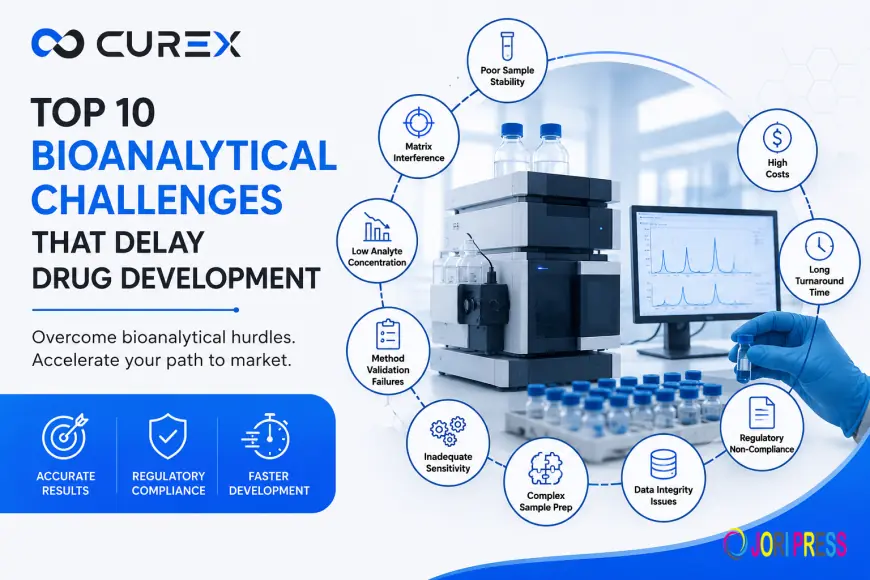
1. Matrix Effects: Why Biological Samples Can Interfere with Results
Biological matrices such as plasma, serum, or whole blood contain proteins, lipids, salts, and endogenous compounds that may interfere with analyte detection. These interferences can suppress or enhance instrument responses, leading to inaccurate quantification.
How to overcome it:
- Optimize sample preparation techniques.
- Use stable isotope-labeled internal standards.
- Validate methods across multiple matrices.
- Conduct matrix effect evaluations during method validation.
2. Low Drug Concentrations in Early Clinical Studies
Many investigational drugs, particularly biologics and highly potent compounds, circulate at extremely low concentrations. Measuring these analytes requires highly sensitive analytical methods.
Best practices:
- Employ LC-MS/MS or ultrasensitive ligand-binding assays.
- Optimize extraction recovery.
- Use advanced calibration strategies.
- Implement rigorous quality controls.
3. Sample Stability Issues
Improper sample handling can degrade analytes before analysis, compromising study outcomes.
Common causes include:
- Temperature fluctuations
- Freeze-thaw cycles
- Extended storage times
- Improper transport conditions
Solutions:
- Perform comprehensive stability studies.
- Use validated storage protocols.
- Implement continuous temperature monitoring.
- Train clinical site personnel in sample handling.
4. High Sample Volumes During Phase III Studies
Large multicenter clinical trials often generate tens of thousands of biological samples, requiring scalable laboratory operations.
Modern bioanalytical laboratories address this challenge through:
- Automated sample tracking
- High-throughput instrumentation
- Laboratory Information Management Systems (LIMS)
- Dedicated project management teams
5. Method Transfer Between Laboratories
Global clinical trials may require analytical methods to be transferred between regional laboratories. Without proper planning, variability can occur.
Successful method transfer requires:
- Detailed transfer protocols
- Cross-laboratory validation
- Comparative testing
- Standardized operating procedures (SOPs)
6. Data Integrity and Audit Readiness
Regulatory agencies increasingly focus on the integrity of electronic records and analytical data.
Essential elements include:
- Complete audit trails
- Secure electronic records
- Controlled user access
- Change management
- Documentation accuracy
7. Regulatory Compliance Across Global Markets
Sponsors frequently submit applications to multiple regulatory authorities, each with specific expectations.
A globally experienced bioanalytical partner helps ensure that analytical data aligns with international regulatory standards while maintaining consistency across submissions.
8. Tight Development Timelines
Competitive markets demand shorter development cycles without compromising quality.
Bioanalytical laboratories accelerate timelines by:
- Using validated methods
- Running parallel workflows
- Increasing automation
- Providing rapid reporting
- Maintaining dedicated project teams
9. Complex Biologics and Advanced Therapies
Cell therapies, gene therapies, RNA therapeutics, and antibody-drug conjugates require highly specialized analytical expertise.
These products often demand:
- Customized assay development
- Multiplex biomarker analysis
- Immunogenicity testing
- Cell-based functional assays
10. Communication Gaps Between Sponsors and CROs
Even scientifically sound projects can suffer when communication is inconsistent.
Successful collaborations depend on:
- Regular project meetings
- Transparent reporting
- Defined escalation procedures
- Dedicated scientific contacts
Top Bioanalytical Challenges
How to Choose the Right Bioanalytical CRO for Your Drug Development Program
Selecting a bioanalytical CRO is one of the most important strategic decisions in drug development. While cost is an important consideration, factors such as scientific expertise, quality systems, regulatory experience, and scalability often have a much greater impact on project success.
10 Questions Every Sponsor Should Ask
- Does the CRO have experience with your therapeutic area?
- Are analytical methods fully validated?
- Which technologies are available (LC-MS/MS, ELISA, LBA)?
- Can the laboratory manage large global studies?
- What quality management systems are in place?
- How is data integrity maintained?
- What is the average turnaround time?
- Does the CRO provide regulatory support?
- Is there a dedicated project management team?
- Can services scale as your clinical program grows?
A strong bioanalytical partner should function as an extension of your internal research team, providing scientific guidance as well as analytical support.
Why Pharmaceutical and Biotechnology Companies Outsource Bioanalytical Services
Outsourcing has become a standard strategy for companies seeking to reduce operational complexity while accelerating development timelines.
Key Benefits of Outsourcing
Access to Specialized Expertise
Experienced scientists bring extensive knowledge of assay development, method validation, pharmacokinetics, and regulatory requirements.
Faster Project Timelines
Established laboratories can begin work immediately without the delays associated with building internal capabilities.
Cost Efficiency
Sponsors avoid major capital investments in:
- Laboratory infrastructure
- Advanced instrumentation
- Software systems
- Personnel training
- Ongoing maintenance
Regulatory Confidence
Experienced CROs maintain validated quality systems designed to support inspections and regulatory submissions.
Operational Flexibility
Outsourcing allows organizations to scale analytical capacity according to project needs without long-term infrastructure commitments.
In-House Laboratory vs. Bioanalytical CRO
What Role Does Regulatory Compliance Play in Bioanalytical Services?
High-quality analytical data alone is not enough. Regulatory authorities expect that data to be generated, documented, reviewed, and reported under robust quality systems.
A compliant bioanalytical program should include:
- Validated analytical methods
- Standard operating procedures (SOPs)
- Controlled documentation
- Electronic data integrity
- Quality assurance oversight
- Instrument qualification
- Analyst training records
- Corrective and preventive action (CAPA) processes
Strong compliance practices help reduce regulatory questions, inspection findings, and submission delays.
How Artificial Intelligence Is Transforming Bioanalytical Services
Artificial intelligence (AI) is beginning to reshape bioanalytical workflows by improving efficiency and enabling faster data-driven decision-making.
Emerging AI Applications
- Automated chromatogram review
- Intelligent quality control monitoring
- Predictive maintenance of laboratory instruments
- Data anomaly detection
- Workflow optimization
- Trend analysis across large datasets
Importantly, AI complements—not replaces—the expertise of scientists. Human oversight remains essential for interpreting results, ensuring compliance, and making critical scientific decisions.
The Future of Bioanalysis
Future Trends Shaping Bioanalytical Services
The next decade will see continued innovation in analytical science, driven by increasingly complex therapies and personalized medicine.
High-Impact Trends
Precision Medicine
Patient-specific treatments will require increasingly sophisticated biomarker and pharmacokinetic analyses.
Cell and Gene Therapy
Advanced therapies demand specialized analytical approaches capable of evaluating complex biological mechanisms.
High-Resolution Mass Spectrometry
Improved sensitivity will enable detection of trace analytes that were previously difficult to quantify.
Multiplex Biomarker Assays
Analyzing multiple biomarkers simultaneously will improve efficiency and generate richer datasets.
Decentralized Clinical Trials
Remote sample collection and digital technologies will reshape bioanalytical logistics and patient participation.
Laboratory Automation
Automation will reduce manual errors, increase throughput, and shorten study timelines.
Real-World Evidence
Post-marketing bioanalytical studies will increasingly integrate real-world data to support ongoing safety and effectiveness evaluations.
Why Choose CurexBio for Bioanalytical Services?
At CurexBio, we understand that every analytical result influences critical development decisions. Our bioanalytical team combines scientific expertise, validated methodologies, and a quality-first mindset to support pharmaceutical, biotechnology, and healthcare innovators across every stage of development.
Our Bioanalytical Capabilities
- Bioanalytical Method Development
- Method Validation
- Pharmacokinetic (PK) Analysis
- Biomarker Analysis
- Bioequivalence Study Support
- Immunogenicity Testing Coordination
- Clinical Sample Management
- Regulatory Documentation Support
- Quality Assurance and Compliance
- Project Management
By partnering with CurexBio, sponsors gain access to experienced scientists committed to delivering accurate, reproducible, and regulatory-ready data that helps accelerate development programs with confidence.
Conclusion
Bioanalytical services are no longer just a laboratory function—they are a strategic enabler of successful drug development. From selecting the most promising drug candidates to supporting pivotal clinical trials and regulatory submissions, bioanalytical testing provides the scientific evidence that drives informed decision-making at every stage.
Organizations that invest in robust bioanalytical capabilitllabies—or coorate with an experienced CRO such as CurexBio—can reduce development risks, improve operational efficiency, strengthen regulatory readiness, and bring innovative therapies to patients faster.
As pharmaceutical research continues to evolve toward precision medicine, biologics, and advanced therapies, the importance of high-quality bioanalytical services will only continue to grow.
Ready to Accelerate Your Drug Development?
Whether you are developing a small molecule, biologic, biosimilar, vaccine, or next-generation therapy, CurexBio provides end-to-end bioanalytical support tailored to your program's unique requirements.
Partner with CurexBio to:
- Accelerate development timelines
- Generate high-quality, regulatory-ready data
- Strengthen clinical and regulatory decision-making
- Access experienced bioanalytical scientists
- Enhance confidence in every phase of your drug development journey
Contact CurexBio today to discuss your upcoming project and discover how our bioanalytical expertise can help transform promising research into successful therapies.
Read Full Article Here:
curexbio.com/top-10-bioanalytical-challenges-that-delay-drug-development/
What's Your Reaction?
 Like
0
Like
0
 Dislike
0
Dislike
0
 Love
0
Love
0
 Funny
0
Funny
0
 Angry
0
Angry
0
 Sad
0
Sad
0
 Wow
0
Wow
0