








































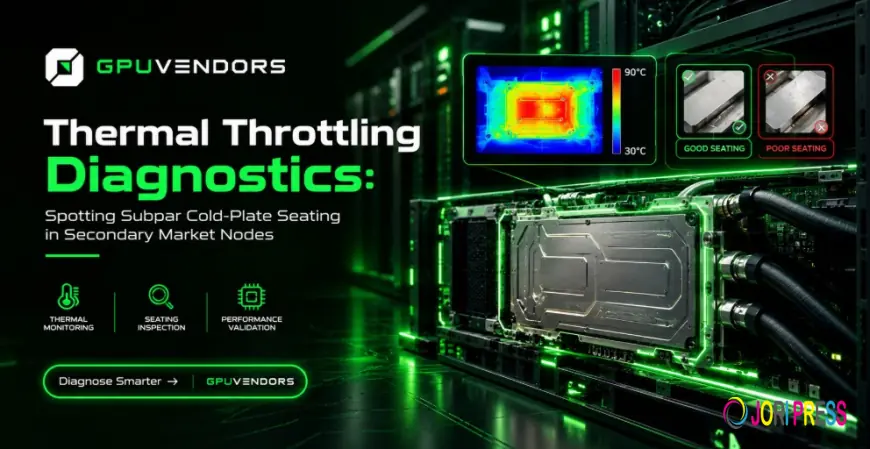
Thermal Throttling Diagnostics: Spotting Subpar Cold-Plate Seating in Secondary Market Nodes
Spot subpar cold plate seating and fix secondary market GPU thermal throttling using tools from the best gpu marketplace today.
Deploying high-density enterprise accelerators sourced through decentralized channels introduces unique hardware maintenance challenges. When engineering teams acquire multi-node server hardware or secondary market accelerators to accelerate deep learning workflows, thermal integrity becomes a primary determinant of cluster reliability. Subpar cold-plate seating, uneven thermal paste spread, and micro-warp damage on enterprise server nodes frequently trigger premature thermal throttling under sustained load. Traditional primary vendors guarantee uniform factory assembly, but secondary market acquisition requires rigorous physical inspection and telemetry diagnostics. To ensure transparent pricing, verified hardware pedigree, and reliable component stock when expanding compute clusters, finding the
Understanding Thermal Throttling Mechanisms in High-Density Silicon
High-performance accelerators like enterprise tensor cores dissipate massive thermal energy within tight physical boundaries. When a cold plate fails to make complete microscopic contact with the silicon die or heat spreader, localized hot spots develop immediately. Internal sensor arrays detect critical temperature thresholds and force clock speeds downward to prevent thermal destruction. Distinguishing normal operating thermal gradients from hardware seating failures requires monitoring delta temperatures across junction and board sensors. For foundational context on operating tolerances, reviewing
Root Causes of Cold-Plate Misalignment in Secondary Market Hardware
Secondary market server nodes frequently change hands through liquidation, corporate restructuring, or regional redeployment. During uninstallation and re-installation cycles, mounting pressure unevenly distributes across spring-loaded cold-plate assemblies. Manual torquing errors, degraded phase-change thermal interface materials, and warped PCB substrates create microscopic air gaps. Air exhibits abysmal thermal conductivity compared to copper or aluminum cold plates, causing delta spikes where core temperatures max out while exhaust air feels deceptively cool. Technical leads inspecting off-market inventory must treat thermal interface integrity as a variable requiring physical re-seating rather than trusting legacy factory torque marks.
Step-by-Step Diagnostic Protocol for Seating Inspection
Isolating a cold-plate seating defect requires combining software telemetry with physical teardown validation. First, run a multi-node stress benchmark while logging per-core clock frequency degradation alongside package temperature deltas. If specific physical accelerators throttle 15 to 20 percent lower than sibling nodes under identical ambient airflow and power limits, suspect thermal interface resistance. Next, perform a controlled visual audit of the cold-plate impression pattern using high-clarity pressure-sensitive film or thermal paste spread symmetry. A complete, uniform squeeze-out pattern indicates proper contact, whereas crescent-shaped voids or dry spots confirm asymmetric mounting pressure or warp-induced lift-off.
Remediation and Recalibration Standards for Enterprise Rigs
Resolving seating deficiencies in enterprise server nodes demands methodical surface preparation and precision torque application. Technicians must strip legacy thermal interface material using industrial solvent wipes, inspect the copper block for micro-pitting or scratching, and apply high-viscosity phase change material or liquid metal alternatives strictly rated for enterprise thermal cycles. Fasteners must follow a crisscross torque sequence specified by the server chassis OEM using a calibrated digital screwdriver. Skipping torque calibration or reusing deformed retention springs reproduces the exact thermal asymmetry you sought to eliminate.
Financial Impact of Thermal Inefficiency on Cluster TCO
Thermal throttling quietly destroys cluster economics by reducing effective floating-point operations per second per rack. When 20 percent of your accelerator fleet operates under thermal throttling, your effective compute capacity plummets while baseline electricity and facility cooling overhead remain 100 percent active. Infrastructure planners must calculate whether remediation labor costs outweigh long-term efficiency decay or if selective hardware replacement via verified channels is more rational. Evaluating whether to repair aging nodes or re-allocate capital toward fresh inventory becomes straightforward when running simulations through the
Long-Term Maintenance Playbooks for Decentralized Fleets
Sustaining high cluster utilization across mixed-provenance hardware fleets requires institutionalizing thermal audits into routine preventive maintenance schedules. Engineering organizations should mandate thermal baseline fingerprinting upon receiving any off-market server node batch. Automated telemetry alerting should flag abnormal delta-T variance between identical accelerators within the same chassis before catastrophic throttling degrades production schedules. Maintaining documentation on torque specs, thermal interface material batches, and cold-plate replacement logs transforms thermal troubleshooting from an emergency firefighting exercise into a predictable operational routine.
Conclusion and Operational Summary for Hardware Leads
Spotting subpar cold-plate seating in secondary market nodes separates resilient enterprise AI operations from fragile prototyping setups. Thermal throttling is rarely a mysterious silicon defect; it is usually a physical contact failure born of improper re-assembly or shipping stress. By implementing structured telemetry audits, enforcing strict torque and thermal interface re-application protocols, and leveraging transparent sourcing networks, technical leaders protect their compute density and financial ROI. Proactive thermal validation ensures that every watt consumed translates directly into accelerated deep learning production.
What's Your Reaction?
 Like
0
Like
0
 Dislike
0
Dislike
0
 Love
0
Love
0
 Funny
0
Funny
0
 Angry
0
Angry
0
 Sad
0
Sad
0
 Wow
0
Wow
0