





































The Art of Building a Brand People Actually Trust
Ashish Somvanshi shares real insights on what it actually takes to build a brand people trust — from consistent messaging to how you handle problems when things go wrong.
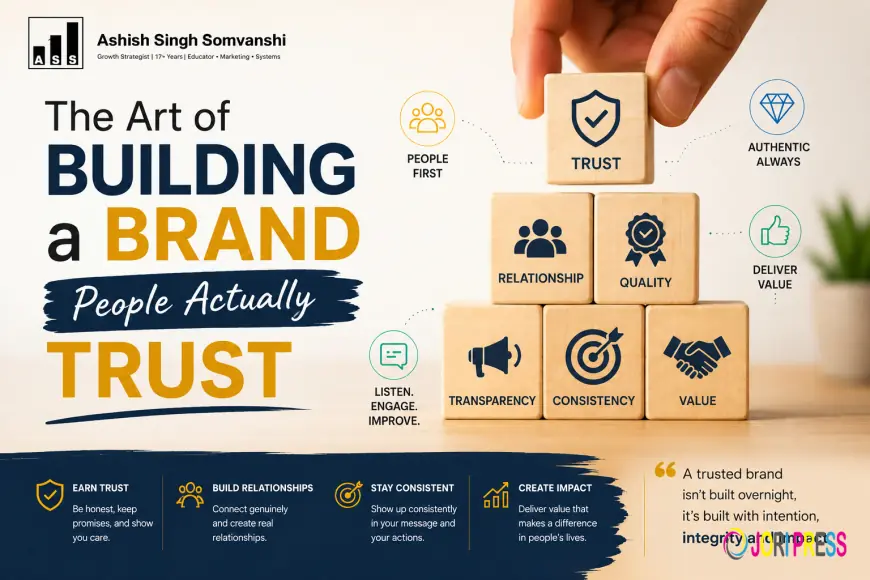
Trust is the most underrated metric in marketing.
Everyone talks about reach, impressions, click-through rates, cost-per-lead. And those things matter — I've spent seventeen years measuring them. But the brands that have consistently outperformed everything around them, in my experience, aren't the ones with the biggest budgets or the most creative campaigns. They're the ones people trust.
And trust, it turns out, is one of the hardest things to build and one of the easiest things to lose.
What Trust Actually Means in a Brand Context
When I talk about brand trust, I don't mean the kind that comes from a slick logo or a well-produced brand film. Those things can create attention. They can create a first impression. But they don't create trust.
Trust is what happens when someone has interacted with your brand multiple times — seen your ads, visited your website, maybe talked to your team — and walked away each time feeling like you delivered exactly what you promised. No gap between expectation and experience. No sense of being oversold to. No fine print that changed the deal at the last minute.
It sounds simple. Most brands make it complicated.
The Gap Between Perception and Reality
Early in my career I worked with a consumer brand that had a genuinely good product. Strong quality, competitive pricing, a real reason to exist in the market. But their marketing was built entirely around aspiration — big claims, premium imagery, a brand voice that suggested they were something slightly beyond what they actually were.
For a while it worked. The campaigns generated interest. People came in. But the repeat purchase numbers were poor, and word of mouth was almost nonexistent. When I dug into why, the answer was uncomfortable — customers felt mildly let down. Not because the product was bad, but because the marketing had set expectations slightly higher than the product could meet.
That gap, even a small one, is where trust erodes.
The fix wasn't better marketing. It was honest marketing. Campaigns that said exactly what the product was, for exactly who it was made for, with exactly what you could expect from using it. The reach numbers went down. The conversion rates and repeat purchase numbers went up significantly. Because the people who bought were the right people, and they got what they were promised.
Consistency Is the Foundation
I've worked with enough brands now to know that trust isn't built in a single campaign or a single interaction. It's built through repetition — through showing up the same way, with the same values, across every touchpoint over a long period of time.
This is harder than it sounds because most organizations are not set up for consistency. Marketing teams change. Agencies rotate. Leadership priorities shift. And every time those things happen, there's a pull to refresh the brand, change the messaging, try a new angle. Sometimes that's necessary. Often it's just restlessness dressed up as strategy.
The brands people trust most are the ones that have stayed fundamentally the same even as they've evolved. Their tone of voice is recognizable. Their values are visible in how they handle problems, not just how they present themselves when things are going well. Their customers know what to expect — and that predictability is itself a form of value.
How You Handle Problems Says Everything
If I had to point to one thing that separates brands people genuinely trust from brands that just have good marketing, it would be this — how they behave when something goes wrong.
Every brand makes mistakes. Products fail. Deliveries are late. Customer service drops the ball. What happens next is what determines whether you lose that customer forever or earn their loyalty for life.
I've seen brands respond to problems by going quiet, burying the issue in terms and conditions, or offering a half-hearted apology that made it clear they were managing optics rather than actually caring. And I've seen brands respond by owning the mistake completely, fixing it without being asked twice, and following up to make sure the customer was genuinely satisfied.
The second type of brand doesn't just retain that customer. They earn an advocate. Someone who will tell other people about how the brand handled a difficult situation — which is a far more powerful testimonial than anything a marketing team could create.
Building Trust at Scale
The challenge most growing brands face is that the behaviors that build trust — genuine care, consistent follow-through, honest communication — are easy to maintain when you're small and hard to maintain when you're big.
This is where systems matter. When trust-building is dependent on the right person doing the right thing at the right moment, it doesn't scale. When it's built into processes — how your team responds to complaints, how your onboarding works, what happens when a customer doesn't hear from you for too long — it does.
I've seen this play out in education marketing especially. Universities that invest in the post-enrollment experience — in making sure students feel supported from the day they pay their fee, not just the day they inquire — build the kind of institutional trust that generates referrals, strong alumni networks, and word of mouth that no campaign budget can replicate.
The ones that treat enrollment as the finish line, rather than the starting line, keep fighting for every new student from scratch.
The Long Game
Building a brand people trust is not a quarter-to-quarter initiative. It's a long game that requires patience, consistency, and a willingness to prioritize the right thing over the convenient thing — often repeatedly, over years.
But the brands that play that game successfully end up with something no competitor can easily copy. Not a product feature, not a price point, not a distribution advantage. Just a deep, durable sense among their customers that this is a brand that means what it says.
In a world full of noise, that's rarer than most people think. And worth far more than most marketing budgets can buy.
Ashish Singh Somvanshi is a Growth Architect and Founder with 17+ years of experience in digital marketing and EdTech. Founder of Connective9 Media Labs, Campuswalkin, and Edustack360 CRM. Learn more at ashishsinghsomvanshi.com
What's Your Reaction?
 Like
0
Like
0
 Dislike
0
Dislike
0
 Love
0
Love
0
 Funny
0
Funny
0
 Angry
0
Angry
0
 Sad
0
Sad
0
 Wow
0
Wow
0