




































Swag Box and Kitting Programs: Selling Them Online With Real-Time Pricing

Swag boxes and corporate gifting kits have become popular ways for businesses to connect with employees, customers, and business partners. From new-hire welcome kits to holiday gifts and event merchandise, companies are increasingly looking for customized branded products that can be ordered and delivered conveniently.
However, selling swag boxes online involves more than selecting a few promotional products and packing them together. Businesses need to manage multiple suppliers, calculate accurate kit pricing, monitor inventory, handle product customization, and coordinate fulfillment.
The U.S. promotional products industry reached $27.1 billion in sales in 2025, although growth slowed to 1.3% due to tariffs, increasing freight costs, compliance expenses, and tighter customer budgets.
In this competitive environment, promotional product distributors need an efficient way to manage their kitting programs while maintaining healthy profit margins.
This is where promotional products software becomes useful. With the right platform and a promotional product designer tool, businesses can allow customers to customize their swag boxes, preview branded products, calculate prices, and complete orders online.
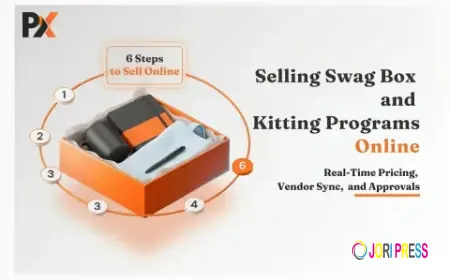
Let's explore six important steps to build and sell a successful swag box and kitting program online.
What Do You Need Before Selling Swag Boxes Online?
A swag box is not simply one product with a single price. It is a collection of different branded items bundled together and sold as one package.
Each item may have its own supplier, product cost, decoration method, and fulfillment requirements.
For example, a corporate welcome kit might contain:
-
A customized coffee mug.
-
An embroidered tote bag.
-
A branded notebook.
-
A personalized pen.
-
Custom packaging and a welcome card.
Before listing these kits in an online store, businesses need three essential elements:
-
Clearly defined kit categories and pricing tiers.
-
Updated supplier pricing and inventory information.
-
An online ordering experience that allows customers to customize and purchase kits without contacting a sales representative.
Once these elements are in place, distributors can create a more organized and scalable kitting program.
Step 1: Decide What Goes Into Each Swag Box Kit Tier
The first step is deciding which products customers can purchase together.
Rather than allowing every customer to build a completely customized package from scratch, many successful promotional product businesses offer three or four predefined kit tiers.
For example:
Employee Welcome Kit: Designed for new employees and may include a branded notebook, mug, tote bag, and welcome card.
Corporate Gift Kit: Suitable for clients and business partners, particularly during holidays and special occasions.
Event Swag Kit: Contains promotional merchandise such as pens, bags, water bottles, and other branded products for conferences and trade shows.
Premium Gift Kit: Includes higher-value merchandise with additional customization and premium packaging.
Each tier should have its own product selection, price range, and approval requirements.
Fixed kit categories also make purchasing and inventory management easier. When a distributor regularly purchases the same products for welcome kits, it becomes easier to negotiate better supplier pricing and maintain consistent availability.
However, some customers may want small changes to their packages.
For these situations, offering one semi-custom tier can be helpful. You can keep the logo placement and basic kit structure fixed while allowing customers to replace two or three selected items.
This provides customization without turning every order into a completely new project.
Step 2: Calculate the Real Cost of Each Kit, Not Just the Product Cost
Pricing is one of the most important parts of running a profitable kitting program.
A common mistake is calculating the selling price using only the combined cost of the products.
However, the actual cost of a swag box includes several additional expenses:
-
Product purchasing costs.
-
Printing, embroidery, or decoration charges.
-
Pick-and-pack fees.
-
Additional kitting labor.
-
Packaging materials.
-
Personalized inserts and branded cards.
-
Fulfillment and shipping expenses.

These costs need to be considered before deciding the final selling price.
Example: Calculating the Actual Cost of a Swag Box
Consider a kit containing three promotional products:
|
Item |
Cost |
|
Coffee mug |
$12.00 |
|
Embroidered tote bag |
$3.00 |
|
Notebook |
$4.00 |
|
Total product cost |
$19.00 |
|
Pick-and-pack |
$2.50 |
|
Kitting labor |
$2.00 |
|
Packaging |
$1.50 |
|
Total actual cost |
$25.00 |
The total cost of preparing this kit is $25, even though the products themselves cost only $19.
If the distributor sells the package for $28, the remaining amount is only $3 before considering other applicable expenses, such as additional shipping charges or overhead.
However, selling the same kit for $38 provides more room to cover operational expenses and maintain a healthier margin.
This example demonstrates why distributors should include every relevant expense when calculating their online kit prices.
A promotional products software platform with dynamic quantity-based pricing can simplify this calculation.
It can combine supplier costs, decoration charges, setup fees, and other pricing components into one amount when customers select their preferred kit.
This eliminates the need to manually rebuild pricing calculations in spreadsheets for every customer quotation.
Step 3: Synchronize Supplier Inventory to Keep Your Online Catalog Updated
Inventory management becomes more complicated when a swag box contains products from multiple suppliers.
For example, a corporate gift package may include a mug from one vendor, a tote bag from another, and a notebook from a third supplier.
If even one product becomes unavailable, the complete kit may no longer be available in its original configuration.

Without updated supplier inventory information, customers might purchase a kit online only to discover later that one of its products is out of stock.
This can lead to delayed shipments, product substitutions, customer dissatisfaction, and additional work for the sales team.
Why Real-Time Vendor Synchronization Matters
A connected supplier network helps distributors maintain accurate product availability across their online catalogs.
For example, PrintXpand Connect supports vendor connections with suppliers such as:
-
SanMar
-
S&S Activewear
-
MidOcean
-
PF Concept
With supplier synchronization, distributors can keep product information and inventory availability updated.
The system can also trigger an automated purchase order when a kit is sold, helping streamline the purchasing process.
Another option is maintaining inventory directly in your own warehouse. This removes the dependency on supplier stock synchronization, but it also increases inventory investment and storage requirements.
For distributors selling multi-vendor kits, connected supplier inventory and drop-shipping workflows can be a practical alternative to maintaining stock from several vendors.
The main objective is to ensure that customers only see products that can actually be fulfilled.
Step 4: Create a Self-Service Online Ordering and Customization Experience
Customers should be able to explore available swag boxes, select products, customize branding, check prices, and complete their purchases without waiting for a sales representative.
A self-service ordering experience should include:
-
Clear kit descriptions and product details.
-
Predefined customization options.
-
Logo upload functionality.
-
Live product previews.
-
Automatic pricing calculations.
-
A simple checkout process.
A promotional product designer tool can make this experience more interactive.
For example, a customer purchasing a corporate welcome kit should be able to upload their company logo and preview how it will appear on the mug, tote bag, and notebook.
The tool should support different decoration methods, including screen printing, embroidery, Direct-to-Garment (DTG), Direct-to-Film (DTF), and heat transfer.
Why Live Product Previews Are Important
A product preview helps customers understand what they are ordering before making a purchase.
It also reduces the possibility of artwork-related mistakes.
For example, an automatic resolution check can identify a blurry or low-quality logo before checkout rather than allowing the customer to discover the problem after production.
According to PrintXpand, moving logo placement and artwork proofing into the same browser-based workflow can save up to 60% of prepress time.
The platform also offers a library of more than 1,000 templates, giving customers a starting point when they do not want to create their designs from scratch.
Use White-Label Branding for Corporate Customers
Another important consideration is the appearance of the ordering portal.
Corporate customers and procurement managers generally prefer a branded purchasing experience that reflects their own company's identity.
A white-label B2B portal allows businesses to display their own logo, branding, and approved product catalog instead of presenting customers with a generic marketplace.
This creates a more professional buying experience and makes repeat ordering easier.
Step 5: Set Up Approval Workflows for Corporate Accounts
Corporate kitting programs often involve recurring orders.
For example, an HR department may need to order welcome kits every time a new employee joins the company.
Similarly, a marketing department may regularly purchase branded merchandise for events, conferences, and promotional campaigns.
These repeat purchases require more than a basic online checkout process.
Businesses may need budget restrictions, approved product catalogs, and multiple levels of authorization.
Without these controls, every reorder may require a sales representative to manually review the request and obtain approval.
This defeats the purpose of creating a self-service ordering portal.
Important Approval Features for Corporate Kitting Programs
Budget Controls: Allow corporate buyers to place orders within predefined spending limits.
Brand-Locked Templates: Keep company logos, colors, and approved branding elements consistent across all merchandise.
Multi-Level Approvals: Route orders to the appropriate managers or department heads before they are processed.
Pre-Approved Product Catalogs: Allow employees to select only the products and kits authorized by their organization.
For example, an HR manager can order a welcome kit using a predefined budget and an approved template. If additional approval is required, the order can be routed to the designated authority before fulfillment begins.
A connected promotional products software setup can bring these processes together within the same ordering environment.
This makes repeat corporate purchases easier to manage while maintaining control over spending and brand consistency.
Step 6: Plan Fulfillment, Order Accuracy, and Multi-Address Shipping
Even a well-designed online store cannot deliver a successful kitting program without an efficient fulfillment process.
Once a customer places an order, the distributor must ensure that every kit contains the correct products, branding, packaging, and delivery information.
Kit accuracy is especially important for corporate welcome kits and event merchandise.
A missing item or incorrect logo can affect the customer's experience and create additional fulfillment costs.
Manage Multi-Address Shipping
Multi-address shipping is particularly important for businesses with distributed teams.
For example, a company may order 50 employee welcome kits but require each kit to be delivered to a different employee's home address.
Instead of creating 50 separate orders, customers should be able to submit one order containing multiple delivery addresses.
This functionality should be included directly in the checkout process.
Exporting order information into a separate shipping spreadsheet and manually assigning addresses can introduce errors and unnecessary work.
Prepare for Seasonal Demand
Kitting programs often experience higher order volumes during specific periods, including:
-
Holiday gifting seasons.
-
Corporate conferences and trade shows.
-
Employee onboarding periods.
-
End-of-quarter marketing campaigns.
-
Company anniversaries and special events.
A fulfillment process designed only for regular order volumes may struggle during these busy periods.
Businesses should plan their supplier availability, packaging materials, warehouse capacity, and shipping arrangements in advance.
Proper preparation helps maintain delivery accuracy even when order volumes increase significantly.
Common Mistakes to Avoid When Selling Swag Boxes Online
Building an online kitting program requires coordination between pricing, suppliers, customization, and fulfillment.
Here are some common mistakes that promotional product distributors should avoid.
1. Pricing Kits Based Only on Product Costs
A kit's actual cost includes decoration, kitting labor, packaging, and personalization expenses. Ignoring these costs can reduce profit margins even when sales volumes increase.
2. Not Synchronizing Supplier Inventory
If the online catalog does not reflect actual vendor availability, customers may order products that cannot be fulfilled as configured. Updated inventory information helps prevent this problem.
3. Ignoring Corporate Approval Requirements
Corporate purchasing often involves predefined budgets and multiple approval levels. Without built-in approval workflows, repeat orders may continue to depend on manual sales assistance.
4. Underestimating Seasonal Order Volumes
Holiday gifting and conference seasons can create sudden increases in demand. Businesses that do not prepare their fulfillment operations may experience delays and order inaccuracies.
5. Making Every Kit Completely Custom
Allowing unlimited customization can make sourcing, pricing, and fulfillment unnecessarily complicated. Predefined kit tiers with limited customization options offer a more manageable approach.
Frequently Asked Questions About Swag Box and Kitting Programs
1. What Does a Swag Box Really Cost Beyond the Products Inside It?
The total cost includes product purchasing, decoration, pick-and-pack charges, kitting labor, packaging, and personalization.
For example, three products costing $19 in total can have an actual fulfillment cost of $25 after adding pick-and-pack, kitting labor, and packaging expenses.
2. How Many Kit Tiers Should a Swag Box Program Offer?
Most programs can start with three or four fixed tiers, such as employee welcome kits, corporate gifts, event swag, and premium gift packages.
Fixed tiers simplify purchasing and pricing, while one semi-custom option can accommodate customers who need small changes.
3. Why Does Vendor Inventory Synchronization Matter When Selling Kits Online?
A kit containing products from multiple vendors has several potential inventory-related issues.
If one supplier runs out of stock, the complete package may become unavailable. Real-time inventory synchronization with suppliers such as SanMar, S&S Activewear, MidOcean, and PF Concept helps maintain accurate product availability.
4. What Do Corporate Accounts Need Before a Kitting Program Becomes Self-Service?
Corporate accounts generally need budget controls, approved product catalogs, brand-locked templates, and multi-level approval workflows.
These features allow employees and departments to place repeat orders while following the company's purchasing and branding policies.
Conclusion
Selling swag boxes and kitting programs online creates new opportunities for promotional product distributors, but managing these programs manually can become difficult as order volumes increase.
Accurate kit pricing, supplier inventory synchronization, online product customization, corporate approval workflows, and reliable fulfillment are all essential for building a scalable operation.
A connected promotional products software platform helps bring these activities together, reducing manual work and making it easier to manage multiple products and suppliers.
PrintXpand combines vendor synchronization, quantity-based kit pricing, a self-service product design experience, and corporate approval workflows within one platform.
With its promotional product designer tool, customers can customize their merchandise, preview their branding, and place orders through an online experience.
Instead of managing every quotation and reorder manually, distributors can create a more organized system that supports repeat purchases and business growth.
Want to sell swag boxes online without managing every order manually? Request a Demo and explore how PrintXpand can help streamline your promotional products and kitting operations.
Original Article :- click here
What's Your Reaction?
 Like
0
 Dislike
0
 Love
0
 Funny
0
 Angry
0
 Sad
0
 Wow
0