






































Prop Firm Ads Agency: What to Fix Before Scaling Google Ads
Learn what a prop firm ads agency should fix before scaling Google Ads, including keyword targeting, landing pages, conversion tracking, and acquisition costs.

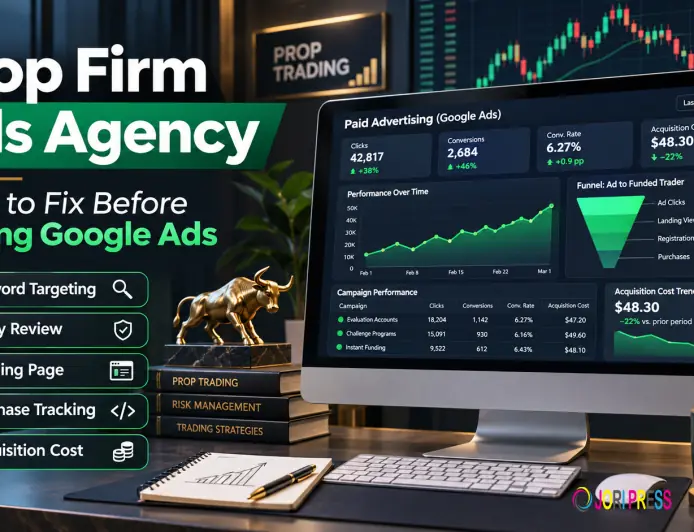
prop firm's advertising campaign can look successful until someone checks the actual evaluation purchases. The account shows rising traffic, new registrations, and improving click costs, but the number of paying customers tells a different story. This gap is precisely what a specialized prop firm ads agency should investigate before recommending a larger budget. Poor keyword targeting, unclear evaluation rules, or incomplete conversion tracking can make an otherwise promising campaign unnecessarily expensive.
For proprietary trading businesses, advertising decisions require an understanding of how traders compare evaluation products, what influences their purchasing decisions, and which customer actions deserve measurement.
Your Keywords May Be Attracting the Wrong Audience
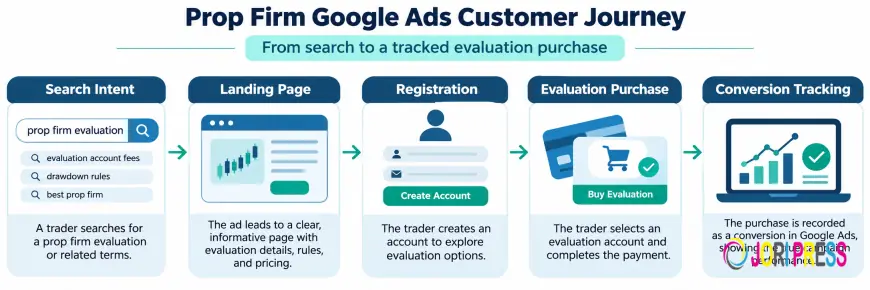
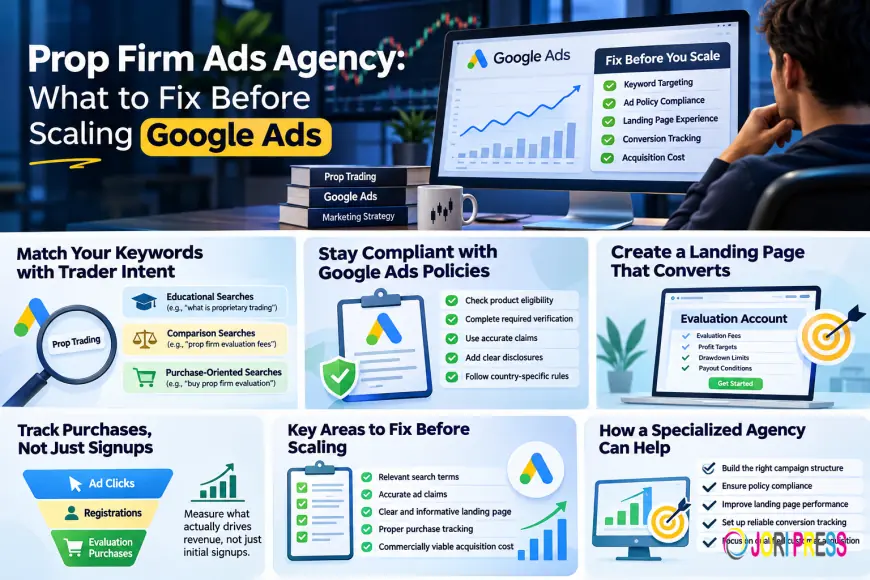
Search intent has a direct influence on advertising quality. Someone researching "what is proprietary trading" may be learning about the industry, while another person comparing evaluation fees could be considering a purchase.
Combining these audiences without examining their intentions can increase traffic without improving customer acquisition.
A practical Google Ads strategy separates searches into three categories:
-
Educational searches: General questions about trading, evaluation models, and industry terminology.
-
Comparison searches: Queries involving account conditions, fees, drawdown limits, and competing providers.
-
Purchase-oriented searches: Searches suggesting interest in a specific evaluation product or its requirements.
Campaign managers should also review negative keywords. Employment-related searches and unrelated trading tutorials can consume advertising budgets when they do not match the firm's offering.
The objective is to reach relevant prospective customers rather than collect visitors who have no immediate interest in purchasing.
Check Advertising Eligibility Before Increasing Spending
Advertising trading-related products requires attention to Google's financial products and services policies. Requirements may differ according to the actual business model, the advertised product, and the country being targeted.
A proprietary trading evaluation should not automatically be treated as identical to brokerage services or financial education.
Before launching or expanding campaigns, review product eligibility, applicable verification requirements, promotional claims, and landing-page disclosures.
Advertisements should accurately describe evaluation conditions without suggesting guaranteed profits or misleading financial outcomes.
Google's Financial Products and Services Policy provides the relevant starting point for checking these requirements.
Your Landing Page Might Be Losing Potential Buyers
A trader clicks an advertisement promoting an evaluation account, expecting to compare fees, profit targets, and trading conditions. Instead, the destination page focuses heavily on promotions while leaving important rules difficult to locate.
Even relevant visitors may abandon the purchase process when they cannot find the information they need.
A useful evaluation landing page should clearly present:
-
Evaluation fees and available account options.
-
Profit targets and maximum drawdown conditions.
-
Permitted trading strategies and restrictions.
-
Payout requirements and applicable limitations.
-
Eligibility conditions and purchasing steps.
Mobile usability also deserves attention because complicated forms and unclear navigation can create additional difficulties during checkout.
Improving these elements may be more useful than increasing advertising expenditure before understanding why visitors leave.
Measure Purchases, Not Just Registrations
A low cost per registration can conceal an expensive customer acquisition process.
Consider two hypothetical campaigns, each spending $2,000. The first generates 200 registrations and ten purchases, while the second produces 100 registrations and twenty purchases.
Campaign A costs $10 per registration but $200 per purchase. Campaign B costs $20 per registration yet only $100 per purchase.
The second campaign produces fewer initial conversions but acquires paying customers more efficiently.
These figures are illustrative, but the lesson is relevant to prop firm marketing: the event used to judge performance should match the business objective.
Conversion tracking should distinguish account creation from completed evaluation purchases. Where relevant, reporting can also consider transaction values, refunds, and repeat purchases.
Google Ads conversion tracking, CRM integrations, and appropriately configured first-party measurement can help connect advertising expenditure with these outcomes.
How a Specialized Marketing Agency Can Help
Managing prop firm advertising involves several connected responsibilities. Search targeting determines who sees an advertisement, landing-page content influences purchasing decisions, and analytics reveals what happens after a visitor arrives.
When these activities are managed separately, problems can go unnoticed.
Propaxio provides marketing services to proprietary trading businesses, brokers, and trading educators. Its work includes Google Ads, Meta Ads, Microsoft Advertising, SEO, conversion optimization, and marketing analytics.
As a specialist marketing agency, Propaxio focuses on connecting advertising activities with qualified customer acquisition. Its role is to support the businesses offering trading-related services, not to operate funded trading accounts or act as a proprietary trading firm.
An agency's value should be assessed through the quality of its recommendations, reporting transparency, understanding of advertising policies, and ability to identify weaknesses in the customer journey.
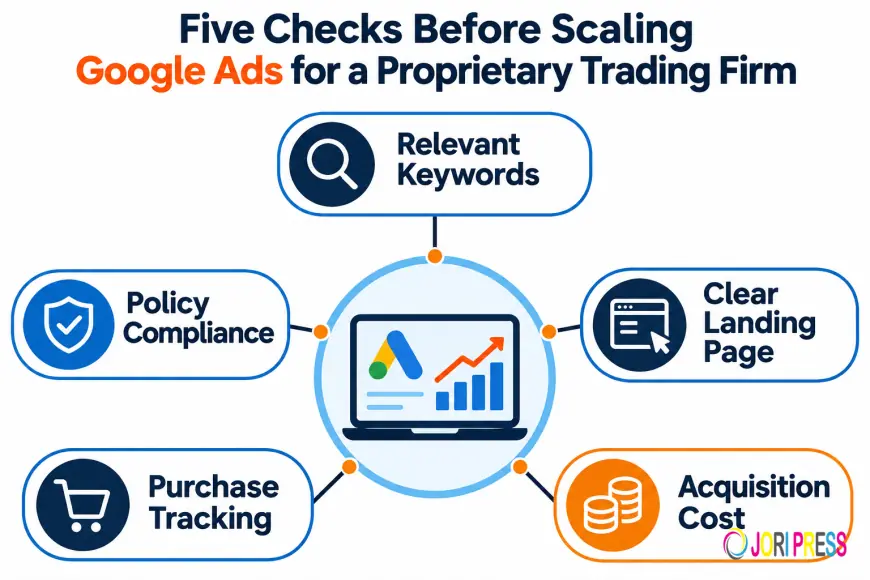
Five Questions to Ask Before Scaling Google Ads
A larger advertising budget should follow a review of existing performance rather than an assumption that more traffic will produce more customers.
Before increasing expenditure, consider these questions:
-
Are search terms relevant? Identify which queries attract people interested in actual evaluation products.
-
Are advertising claims accurate? Confirm that advertisements reflect the product and applicable platform requirements.
-
Is the landing page clear? Check whether fees, conditions, and purchasing information are accessible.
-
Are purchases tracked correctly? Separate registrations from completed transactions and check for duplicate events.
-
Is acquisition commercially reasonable? Compare advertising costs with purchase revenue, refunds, and relevant operating expenses.
These checks help identify whether additional investment belongs in advertising, landing-page improvements, or more reliable measurement.
Final Thoughts
Scaling Google Ads without understanding existing acquisition problems can increase spending without improving results.
For proprietary trading businesses, effective advertising depends on relevant search targeting, accurate product information, reliable purchase tracking, and commercially sensible acquisition costs.
A capable marketing partner should explain where prospective customers are being lost and which changes are worth making before additional budget is committed.
What's Your Reaction?
 Like
0
 Dislike
0
 Love
0
 Funny
0
 Angry
0
 Sad
0
 Wow
0