







































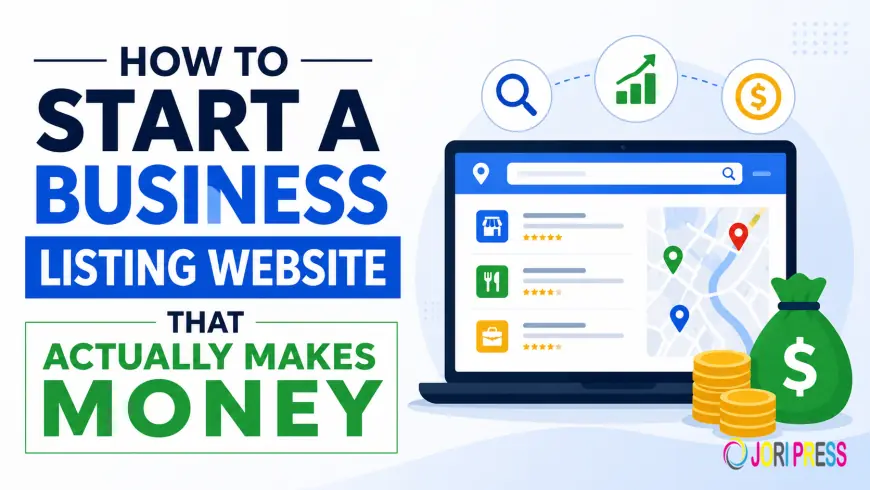
How to Start a Business Listing Website That Actually Makes Money
This article guides first-time founders through building a profitable business listing website — covering how to solve the chicken-and-egg problem at launch, which revenue models actually work, what features to build first, and why a ready-made directory script beats custom development for unvalidated ideas.
Most people who decide to build a business listing website spend the first three months designing it. They pick colours, debate fonts, and argue about whether the search bar should sit above or below the hero image. Then they launch, wait for businesses to sign up, and hear nothing.
The silence is predictable. A business listing website lives or dies on a problem that has nothing to do with design — the chicken-and-egg problem. Businesses won't pay to list on a directory with no users. Users won't visit a directory with no listings. Founders who don't solve this problem first usually abandon the project within six months.
This guide is about solving that problem, and the ones that follow it.
What Makes a Business Listing Website Worth Building?
A business listing website is a platform where businesses register their information — name, address, contact details, category, hours, services — and users search or browse to find them. Think of the older formats: Yellow Pages, Yelp, Justdial, Sulekha. The model is not new. What is new is the availability of niche-specific demand.
General directories are already saturated. Nobody needs another Yelp. But a business directory for independent veterinary clinics in a specific region? A listing site for verified halal restaurants in a city? A B2B directory for industrial suppliers in a single trade category? Those have real, addressable demand and almost no competition.
The question to ask before building anything is not "what features should my directory have?" It is "which group of businesses is genuinely hard to find, and which group of people genuinely needs to find them?" Answer that honestly and the rest of the product decisions become much clearer.
Why Do Most Directory Sites Fail Before They Find Traction?
The single most common failure mode is launching with no listings and expecting organic traffic to do the work.
Search engines reward directories that already have content — detailed, verified business profiles across multiple categories. An empty directory is invisible to search engines and useless to visitors. The founders who built it spent their budget on development and have nothing left for the slow, manual work of populating the platform.
The second failure is charging businesses too early. A new directory with no proven traffic has no leverage to ask for money. Businesses that pay for a listing and get zero enquiries don't renew. They also leave negative impressions in their networks. Getting money in early feels like traction; it often accelerates the death spiral.
The third failure is scope creep. A directory for "all businesses in the city" sounds ambitious. In practice, it means the founder cannot become a credible resource for any single type of business or user. Directories that dominate their space almost always started with a narrow category and expanded only after owning that niche.
How Do You Solve the Chicken-and-Egg Problem?
This is the practical question most guides avoid.
The most reliable approach is what some operators call the "concierge phase" — manually building the initial set of listings yourself, before any business signs up. Research the category, collect publicly available business information, and populate the directory with 200 to 500 basic listings before launch. Businesses can then "claim" their own profile for free. This gives early visitors something to search through, and it gives businesses a reason to engage without paying anything upfront.
Claiming creates a relationship. A business that claims its free profile has already invested attention. From that relationship, upgrades and premium features become a natural conversation, not a cold pitch.
The second technique is geographic compression. Instead of building a directory for an entire country or large city, launch for a single neighbourhood, town, or district. Own it completely. Every business in that area should be on the platform. That concentration makes the directory genuinely useful to local users and easy to find for local businesses. Once the model is proven, expanding to adjacent areas is straightforward.
A third approach that works well is partnerships with associations, chambers of commerce, or trade groups. These organisations already have trust with their members and are often looking for tools to offer them. A directory that gives member businesses a free enhanced profile in exchange for an introduction to the association's full list can add hundreds of verified listings in weeks, not months.
What Revenue Models Actually Work for a Business Listing Website?
The most common working model is tiered listings. Free basic listings are available to all businesses. Enhanced or featured listings, which offer better placement, more photos, a longer description, review highlights, or a contact form, are paid.
The pricing for featured listings varies widely depending on niche and geography, but most directories that survive charge in the range of a few hundred to a few thousand rupees or dollars per year. The key is not the price point — it is the proof of value. Businesses will pay if they can see enquiries, clicks, or profile views attributed to the directory. Build that measurement in early.
A second revenue model that works alongside tiered listings is lead generation. Rather than selling a listing, the directory sells verified leads — a business pays only when a user makes a confirmed enquiry through the platform. This model removes the upfront risk for businesses and aligns the directory's incentives with actual results. It works best in high-intent categories like home services, legal, healthcare, or trades.
Banner advertising and sponsored placement work at scale, once the directory has consistent traffic. For an early-stage platform, these are distractions. Focus on one revenue model first, prove it works, then layer in others.
What Features Does a Business Listing Website Actually Need at Launch?
Less than most founders think.
The core set is: a search bar with category and location filters, individual business profile pages with structured fields (name, address, phone, hours, description, photos), a user-facing review or rating system, and a simple dashboard for business owners to manage their own listings.
That is it. The directory that launches with those five things and a specific niche will consistently outperform a more feature-heavy platform that launches unfocused.
Features that can wait include: messaging systems between users and businesses, booking or appointment integration, advanced analytics, loyalty programmes, and mobile applications. Each of these adds development time and maintenance overhead. A directory with two hundred good listings in a tight niche and a clean search interface will get more traction than a feature-rich platform with twenty listings and no clear audience.
Mobile-friendliness is not optional, even at launch. More than sixty percent of local business searches happen on mobile. The listing pages and search results must be readable and usable on a phone without zooming or horizontal scrolling.
Is It Worth Building Custom or Starting With a Ready-Made Solution?
For most founders, custom development is the wrong starting point. The risk is spending eight to twelve months and a significant budget building infrastructure that already exists — user authentication, listing management, category hierarchies, search filters, review systems, payment gateways. All of it.
The smarter approach for validating a directory idea is to start with a ready-made directory platform and spend the freed time on the harder problems: finding the niche, populating listings, building relationships with local businesses, and proving that users actually search for what the platform offers.
Once the model is proven and revenue is consistent, a custom build or major platform modification becomes justifiable. Before that, it is an expensive bet on an unvalidated idea.
Teams building in this space often look at business directory script options — ready-made software that provides the full listing infrastructure out of the box. The business directory script from Best Classified Script is one option worth evaluating for founders who want a functional, customisable base without building from scratch.
The Work That Actually Determines Success
A business listing website is not a passive product. The directories that build real traffic and real revenue have someone actively managing them — reaching out to businesses, verifying listings, improving category coverage, and responding to business owner feedback.
The technology is the easy part. Any functional directory platform, whether custom-built or ready-made, can handle listings and search. What it cannot do is build the trust of local businesses or earn the habit of local users. That is relationship work, done manually, one business at a time, until the directory becomes the obvious place to go.
Start narrow. Focus relentlessly on one category or one geography. Build the listings before you ask anyone to pay. Prove the traffic before you pitch advertisers. These are slow steps. They are also the only steps that actually work.
What's Your Reaction?
 Like
0
Like
0
 Dislike
0
Dislike
0
 Love
0
Love
0
 Funny
0
Funny
0
 Angry
0
Angry
0
 Sad
0
Sad
0
 Wow
0
Wow
0