




































Social Media Marketing: The Game Has Changed. Have You?
Social media marketing is evolving rapidly. Discover the essential trends, AI-powered techniques, types of content, and engagement methods in social media that marketers and creators need to be aware of to remain relevant in the digital world.

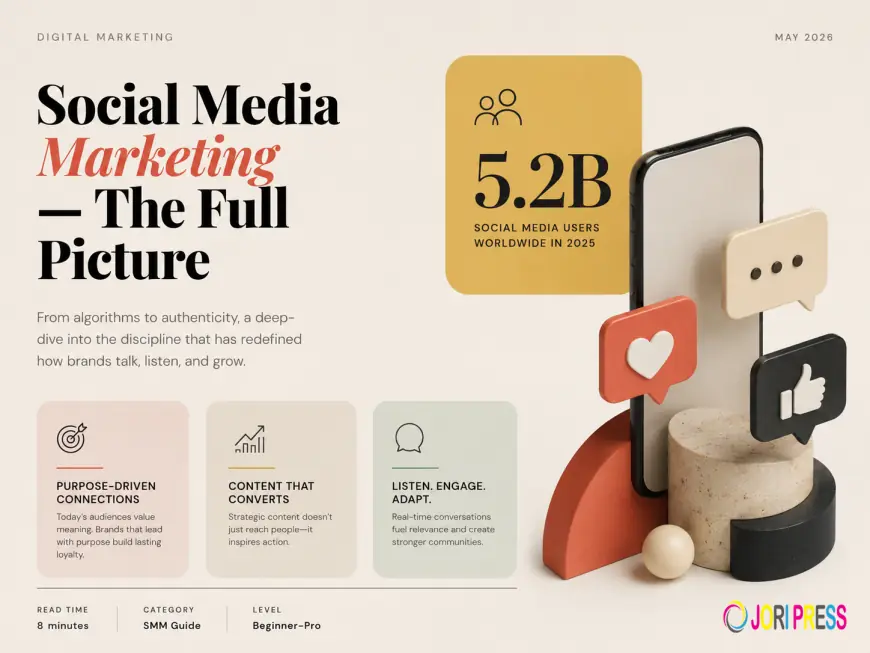
Imagine the mid-2010s and brands considering whether Facebook was even “worth it.” In today’s terms, that question looks ridiculous. Now, social media is a $220 billion advertising industry, and the impact of its presence on consumers, from product awareness to point-of-sale decision-making, cannot be underestimated.
However, with such an evolution, the issue becomes more complicated. The technology used changes, as does the environment, and, at times, the consumer base itself. This guide aims to help you understand all aspects of Social Media Marketing (SMM), from the basics of its benefits to best practices.
What is Social Media Marketing?
Fundamentally, SMM consists of leveraging the power of social platforms such as Instagram, LinkedIn, TikTok, X (formerly Twitter), Facebook, YouTube, Pinterest, and others to reach out to people, create awareness of your brand, attract traffic, and finally achieve commercial success.
However, excellent social media marketing is not just about posting nice photos. Rather, SMM involves an integrated approach that combines strategy, creative content, analytics, community management, and advertising to accomplish business objectives.
The most successful social media marketers have the mindset of publishers, behave as community managers, and operate as data scientists.
The Platforms: Where the Action Happens
However, platforms are not all the same; some platforms simply do not suit certain brands. Deciding which platform to choose will be among the most important choices you will make in your social media strategy.
The Four Pillars of Effective SMM
1. Strategy first, then content. The biggest mistake a brand can make is going for the video shot without answering the critical questions: Who am I talking to? What feeling should my target audience get? What call-to-action do I want to trigger from my viewers? Building a content calendar on top of a poor strategic framework is worthless.
2. Content worth engaging with. Social media feed is one of the most competitive spaces in the world. With every bit of content you upload, competing against your direct and indirect competitors, along with friends and family posts, breaking news, and funny cat videos, you have to offer some value in return — entertainment, usefulness, or emotions.
3. Community building, not broadcasting. Successful social brands engage with the users rather than broadcast messages at them. Commenting, asking questions, and amplifying user-generated content are the keys to building a strong online community around your brand. This process takes time and requires effort, however.
4. Iteration driven by data. Social media gives you an incredible amount of immediate feedback, from reach and impressions to engagement rate, saves, shares, clicks to your website, and conversions. The best social media teams operate all accounts as a series of experiments.
Organic vs. Paid: The Eternal Debate
Organic reach — the ability to reach your audience without having to pay — has been steadily reduced over the last decade on almost all major social networks. The cold truth about social media: it’s an advertising company. And because of that, it always has very good reasons for steering brands into paid media efforts.
With that in mind, don’t assume organic social marketing is dead. It still has vital roles to play — establishing brand voice, nurturing community relations, pre-testing creative before spending media money, and proving authenticity. Paid social, on the other hand, brings unparalleled levels of targeting and scalability.
The best brands use both sides of the equation as one.
Influencer Marketing: Borrowed Trust
Among the key transformations that have taken place in SMM over the last decade is the advent of influencer marketing. Instead of brand-to-consumer communication, marketers now look to influential creators who have dedicated and engaged audiences.
This is a lucrative venture for both parties. While one may expect little interaction from a macro-influencer who has 1 million followers, a micro-influencer who has a loyal following of only 20,000 within a specialised niche would most likely perform better. The current trend leans towards authenticity rather than mass appeal.
The secret to effective influencer marketing? Allow the influencer to be creative. Micromanaging a message would kill off any sense of authenticity, which made the influencer unique.
The Future of SMM: What’s Coming
In 2026 and later, social media marketing will evolve based on many factors converging at once. The creation of high-quality content through the use of AI is now reducing costs and timelines, enabling even small teams to access content that was previously cost-prohibitive. Social commerce is advancing quickly, streamlining the sales process down to essentially zero.
Expect the demand for authenticity to grow further. As more AI-driven content makes its way into the feeds, it’s the authenticity of human input that becomes rare. The brands able to establish themselves as experts in their niches, with human personalities and real values, will have an edge.
Meanwhile, community platforms — whether Discord servers or other privately owned communities — will take on increasing importance as brands work to create their own audiences rather than relying on algorithms to provide them.
What's Your Reaction?
 Like
0
Like
0
 Dislike
0
Dislike
0
 Love
0
Love
0
 Funny
0
Funny
0
 Angry
0
Angry
0
 Sad
0
Sad
0
 Wow
0
Wow
0