





































Why Your Content Marketing Is Not Working in India
Most Indian brands create content but see zero results. Discover why content marketing fails without a proper strategy and what actually drives real business growth in 2026.
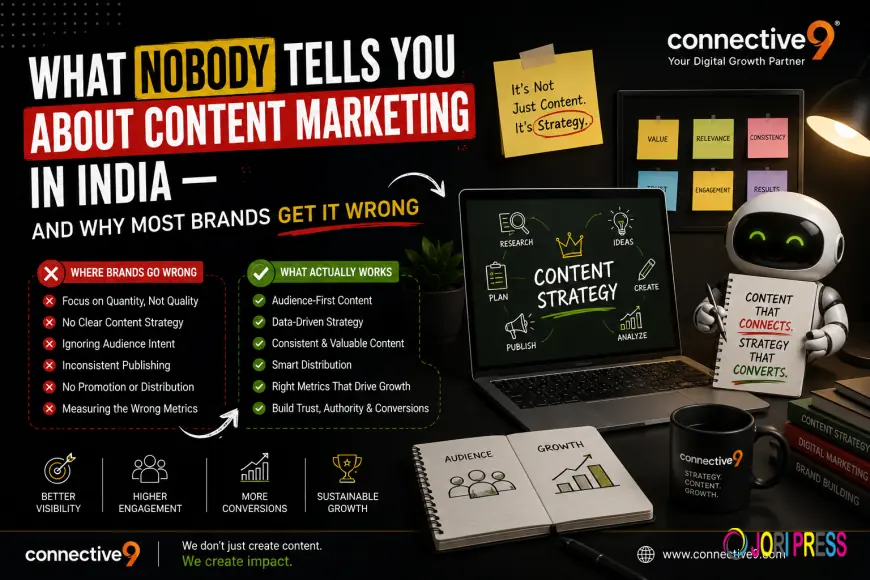
Every marketing consultant in India will tell you that content is king.
They are not wrong. But they are not entirely right either.
Because if content alone were the answer, every brand that publishes blog posts, makes videos, and posts on Instagram would be growing. Most are not. Most are producing content consistently, spending real money on writers, designers, and videographers — and seeing almost no return on that investment.
The problem is not the content. The problem is the strategy — or the complete absence of one.
Why Most Content Marketing in India Does Not Work
Walk into any mid-sized Indian business and ask them about their content marketing strategy. You will almost always hear one of two answers.
The first is "we post on social media regularly." The second is "we have a blog on our website."
Neither of these is a content marketing strategy. They are content activities. And there is a significant difference.
A content activity is publishing without a clear objective. A content strategy is creating specific content for specific audiences at specific stages of their buying journey — with a measurable outcome attached to each piece.
Most Indian brands are doing the first. Almost none are doing the second.
The Three Stages Most Brands Ignore
Every potential customer goes through three stages before they buy — awareness, consideration, and decision.
Awareness is when they first realise they have a problem or a need. Consideration is when they are actively researching solutions. Decision is when they are evaluating specific providers and choosing one.
Most content marketing in India targets only one of these stages — usually awareness — and ignores the other two entirely.
A brand publishes informational blog posts and educational social media content. This builds awareness. But when that same audience moves into the consideration and decision stage — when they are ready to compare options and choose a provider — the brand has nothing to offer them. No case studies. No comparison content. No detailed service explanations. No proof that they can deliver results.
The audience built through awareness content has nowhere to go. So they find a competitor who does have that content and choose them instead.
The Content That Actually Converts
The content that moves people from awareness to paying customers is not the content most brands prioritise. It is not the viral Instagram reel or the trending blog post. It is the unglamorous, specific, trust-building content that speaks directly to someone who is almost ready to buy.
Case studies that show real results with real numbers. Detailed service pages that answer every question a potential customer has before they need to ask it. Comparison content that honestly addresses why your approach is different from alternatives. FAQ content that removes the final objections standing between a prospect and a purchase decision.
This content does not go viral. It does not get thousands of likes. But it converts — consistently and predictably — because it meets the audience exactly where they are in their decision-making process.
Why Distribution Matters as Much as Creation
The second major failure in Indian content marketing is treating creation and distribution as separate efforts — and consistently underinvesting in distribution.
A brand spends three days writing a detailed, well-researched article. They publish it on their website and share it once on LinkedIn. Three people read it. The article sits quietly on page four of Google and generates no traffic, no leads, and no value.
The problem is not the article. The problem is that publishing is not distributing.
Distribution means actively getting your content in front of the audience it was created for. It means SEO optimisation so the article ranks for the queries your audience is searching. It means repurposing the article into a LinkedIn post, a short video, an email newsletter, and a series of social media graphics. It means building backlinks to the article so Google treats it as authoritative. It means promoting it through paid amplification to the exact audience most likely to find it valuable.
Most brands create. Very few brands distribute. The ones that do both consistently are the ones that build compounding organic traffic over time.
The Consistency Problem
Content marketing is a long-term investment. The results compound over months and years, not days and weeks.
This creates a specific problem for Indian businesses — they start with enthusiasm, publish consistently for six to eight weeks, see no immediate results, and stop. The content sits there, never accumulating the authority needed to rank and convert.
The brands that win with content marketing are not necessarily the ones with the best writers or the biggest budgets. They are the ones that show up consistently, month after month, building topical authority in their niche until Google and their audience both recognise them as the definitive source of information in their category.
Consistency is not exciting. But it is the single most important factor in whether content marketing delivers results or not.
What a Real Content Strategy Looks Like
If you want content marketing to actually drive business growth in India in 2026, here is what it needs:
A clear audience definition — not "businesses in India" but a specific type of business, at a specific stage, with a specific problem you can solve.
Content mapped to all three buying stages — awareness content to attract, consideration content to educate, decision content to convert.
An SEO foundation — every piece of content should be built around a keyword your audience actually searches for, with proper on-page optimisation.
A distribution plan — for every piece of content you create, decide in advance how you will get it in front of your audience across at least three channels.
A measurement framework — track not just traffic but time on page, scroll depth, lead form completions from content pages, and ultimately revenue attributed to content-driven traffic.
A twelve-month commitment — decide before you start that you will publish consistently for at least a year before evaluating whether content marketing is working for your business.
The Shift That Changes Everything
The brands that treat content marketing as a long-term asset — something they are building over years, not weeks — are the ones that eventually dominate their category organically.
Every piece of content you publish is a permanent asset. A well-optimised article that ranks on page one of Google will drive traffic and leads every single day without any additional spend. Unlike paid advertising, which stops the moment your budget runs out, content compounds.
The question is not whether content marketing works. It does — for businesses that approach it with strategy, consistency, and patience.
The question is whether you are willing to invest in an asset that will pay dividends for years, rather than a campaign that delivers results this month and nothing next month.
Start building the asset.
The author works in digital marketing and content strategy in Delhi NCR.
What's Your Reaction?
 Like
0
Like
0
 Dislike
0
Dislike
0
 Love
0
Love
0
 Funny
0
Funny
0
 Angry
0
Angry
0
 Sad
0
Sad
0
 Wow
0
Wow
0