





































Sea Container OTA Chambers: Portable Testing for Flexible RF Validation

Aug 10, 2026 - 07:05
 0  622
Sea Container OTA Chambers: Portable Testing for Flexible RF Validation
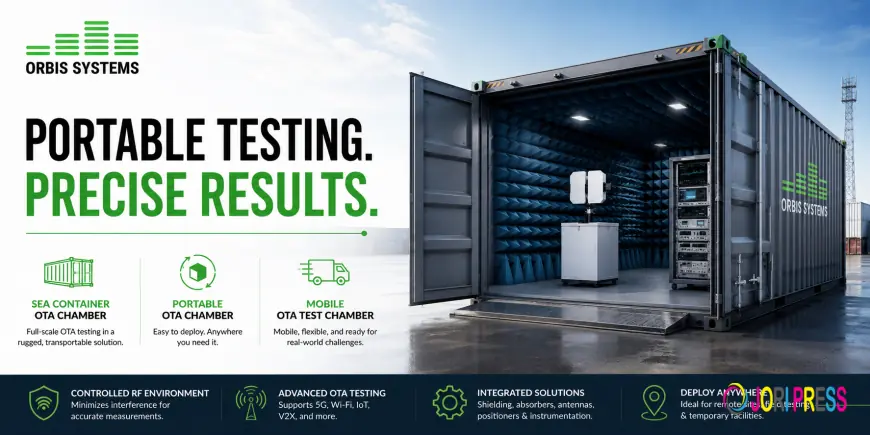
Modern wireless testing is no longer limited to permanent laboratory environments. As 5G, connected vehicles, IoT, and advanced wireless technologies continue to develop, engineering teams increasingly need testing environments that can be deployed where and when they are required. A sea container OTA chamber provides a practical way to create a controlled over-the-air testing environment while offering the flexibility of a transportable platform.

By combining RF shielding, absorber technology, test instrumentation, and positioning systems within a modified container structure, these solutions can provide a dedicated environment for wireless device validation. A portable OTA chamber can be particularly useful for organizations that need testing capabilities at different facilities, while a mobile OTA test chamber can support projects where relocation and deployment flexibility are important.

Key Takeaways

  • Provides a transportable environment for OTA testing
  • Supports controlled RF measurements outside conventional laboratories
  • Can be configured for different wireless testing requirements
  • Offers flexibility for remote and temporary test locations
  • Integrates testing equipment, shielding, absorbers, and positioning technologies
  • Supports evolving wireless and automotive applications

What Is a Sea Container OTA Chamber?

A sea container OTA chamber is an OTA testing environment built around a standard shipping-container structure. The container is engineered internally to create a controlled RF environment suitable for wireless testing.

Instead of constructing a permanent laboratory chamber, organizations can use the container format to create a dedicated test facility that can be transported or deployed at different locations.

Depending on the application, the chamber can incorporate:

  • RF shielding
  • RF absorber materials
  • Antenna systems
  • Test instrumentation
  • Positioning equipment
  • Control and automation systems
  • Power and communication infrastructure
  • Environmental and safety features

This makes the concept suitable for both specialized development environments and applications requiring greater deployment flexibility.

Why Use a Portable OTA Chamber?

A portable OTA chamber provides an alternative to permanently installed testing infrastructure. For organizations working across multiple sites or operating in locations where conventional laboratory construction is difficult, portability can be a significant advantage.

The chamber can be designed around the required testing equipment and workflow rather than forcing engineers to adapt their procedures to a fixed laboratory configuration.

Flexible Deployment

Portable solutions can be installed where testing activities are required, helping organizations reduce dependence on a single testing location.

Controlled Testing Environment

Shielding and absorber materials help minimize unwanted RF signals and reflections, supporting consistent measurement conditions.

Equipment Integration

A portable chamber can accommodate measurement instruments, antennas, positioning systems, and automation technologies within one coordinated environment.

Scalable Configuration

The internal arrangement can be developed according to the required device size, frequency range, measurement process, and testing workflow.

How Does a Mobile OTA Test Chamber Work?

A mobile OTA test chamber follows the same fundamental OTA testing principles as a conventional chamber. The device under test communicates with test antennas without requiring a direct RF cable connection.

Inside the chamber, the testing environment is controlled to reduce external interference and unwanted reflections. Measurement equipment can then evaluate the wireless performance of the device under controlled conditions.

A typical testing sequence may involve:

  1. Placing the device under test in the required position.
  2. Establishing communication between the device and test equipment.
  3. Configuring the required RF conditions.
  4. Moving the device or antenna through predefined positions when required.
  5. Recording RF performance data.
  6. Repeating measurements for different test scenarios.
  7. Comparing results against defined performance requirements.

Automation can further improve repeatability by coordinating instruments, positioning equipment, and measurement software.

Where Can Sea Container OTA Chambers Be Used?

The flexibility of a sea container OTA chamber makes it suitable for applications across several industries.

Automotive Testing

Connected vehicles, V2X technologies, automotive antennas, telematics, and wireless communication systems can require extensive OTA validation.

Telecommunications

Wireless communication equipment can be evaluated under controlled conditions during research, development, and validation.

Consumer Electronics

Devices such as connected electronics, IoT products, and wireless equipment can benefit from repeatable OTA measurements.

Aerospace and Defence

Portable testing environments can support specialized RF applications where a permanent chamber may not be practical.

Remote Test Sites

A container-based solution can be particularly useful when testing needs to take place away from established laboratory infrastructure.

Advantages of Container-Based OTA Testing

One of the main benefits of a container-based approach is the combination of testing capability and deployment flexibility.

A well-engineered system can provide:

  • Dedicated OTA testing infrastructure
  • Reduced dependence on permanent buildings
  • Flexible deployment possibilities
  • Integrated RF measurement equipment
  • Repeatable test conditions
  • Efficient use of available space
  • Potential for future system upgrades

The container format can also simplify the physical deployment of a complete testing environment compared with developing a new permanent facility from the ground up.

What Should Be Considered When Designing a Portable OTA Chamber?

Designing a portable chamber requires more than placing RF absorbers inside a container. The entire testing environment must be considered.

Important factors include:

Chamber Dimensions

The available internal space must accommodate the device under test, antennas, positioning equipment, and required measurement distances.

RF Performance

Shielding effectiveness, absorber configuration, and internal reflections need to be considered according to the intended application.

Equipment Integration

Test instruments and supporting systems should be positioned to maintain an efficient and accessible workflow.

Positioning Accuracy

Applications requiring antenna or device movement may require integrated positioning systems for repeatable measurements.

Power and Connectivity

The chamber should provide appropriate electrical power, communication interfaces, and connections for the complete test system.

Transport and Deployment

A mobile system must also account for transportation, installation, access, and site requirements.

Portable OTA Testing for Future Wireless Technologies

Wireless technologies are becoming increasingly complex. Higher frequencies, advanced antenna architectures, beamforming, connected vehicles, and new communication standards are creating more demanding validation requirements.

A mobile OTA test chamber can provide the flexibility needed to adapt testing infrastructure as projects evolve. Instead of being limited to one permanent testing environment, organizations can develop a system around their current requirements while maintaining the possibility of future upgrades.

This makes container-based OTA testing an interesting option for companies looking for flexible and scalable RF validation infrastructure.

Building a Flexible OTA Testing Environment

A successful OTA chamber is not defined only by its enclosure. The effectiveness of the overall system depends on how shielding, absorber technology, antennas, positioning equipment, instrumentation, automation, and control systems work together.

A sea container OTA chamber brings these elements into a transportable platform, creating an opportunity to deploy advanced testing capabilities in locations where a conventional permanent chamber may not be suitable.

For organizations working on automotive, telecommunications, IoT, or other wireless technologies, this approach can provide a practical balance between controlled RF testing and deployment flexibility.

Frequently Asked Questions

What is a sea container OTA chamber?

A sea container OTA chamber is a transportable RF testing environment built inside a modified shipping container and configured for controlled over-the-air measurements.

What is a portable OTA chamber used for?

A portable OTA chamber is used to perform wireless device testing in a controlled RF environment while providing greater flexibility in deployment and location.

How is a mobile OTA test chamber different from a permanent chamber?

The main difference is deployment flexibility. A mobile OTA test chamber is designed around a transportable platform, while a permanent chamber is generally integrated into a fixed building or laboratory.

Which industries can use container-based OTA chambers?

Automotive, telecommunications, consumer electronics, aerospace, defence, IoT, and research organizations can use container-based OTA testing environments.

Can a portable OTA chamber be automated?

Yes. Depending on the system configuration, automation can coordinate measurement instruments, positioning systems, test sequences, and data collection to improve testing repeatability and efficiency.

What's Your Reaction?

Like Like 0
Dislike Dislike 0
Love Love 0
Funny Funny 0
Angry Angry 0
Sad Sad 0
Wow Wow 0
Orbis Systems Orbis Systems provides quality control and functional testing solutions for the telecommunications and electronics industries. They specialize in 5G, RF, and OTA testing technologies, offering engineering and maintenance services to support R&D and production globally.
\