


































Who Offers Safe Blood Sample Collection at Home in South Kolkata?
Several diagnostic labs and home healthcare providers in South Kolkata now send trained phlebotomists to your home. What separates a safe service from a risky one is how the sample is collected, handled and reported, not how fast the visit happens. This guide explains what safe collection looks like and what to check before you book.
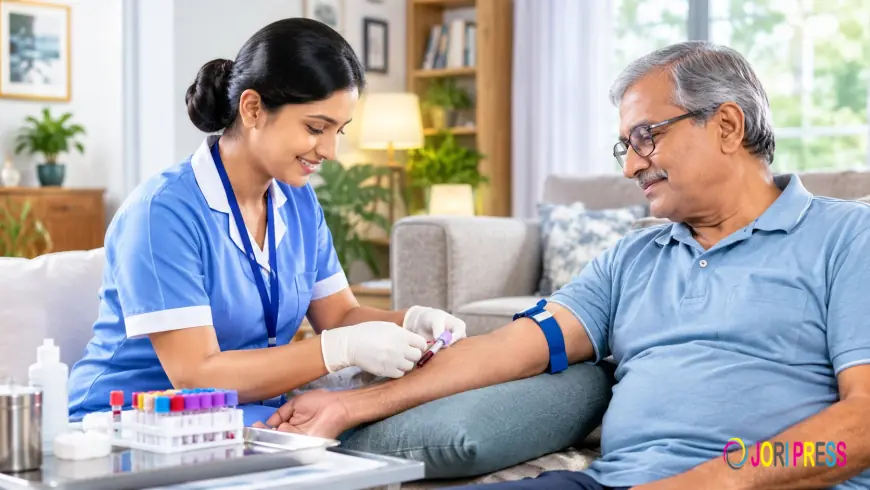
Why Families in South Kolkata Choose Home Blood Collection
Travelling to a lab in Behala, Tollygunge, Joka, Thakurpukur or New Alipore can mean traffic, long waits and a tiring morning. That is hard on:
• Elderly parents with limited mobility
• Patients recovering from surgery
• People with chronic conditions such as diabetes, thyroid problems or heart disease who need regular tests
• Bedridden patients and those on oxygen support
• Working adults who cannot take time off for a fasting-test appointment
Home collection removes the travel and the waiting room. It also lowers exposure to infections for people with weak immunity.
What "Safe" Blood Sample Collection Actually Means
Convenience matters, but a safe service gets these basics right.
1. A trained, qualified phlebotomist Drawing blood is a skill. A trained professional finds the vein faster, causes less pain and bruising, and avoids repeated needle pricks, which matters most for older adults with fragile veins.
2. Sterile, single-use equipment Needles, syringes, lancets and collection tubes must be new, sealed and opened in front of you. Used equipment should be disposed of safely and never left behind.
3. Hygiene at every step The phlebotomist should wash or sanitise their hands, wear fresh gloves for each patient, and clean the puncture site with an antiseptic swab before drawing blood.
4. Correct labelling at your doorstep Each tube should be labelled with your name, age, test details and collection time in front of you. Wrong or late labelling is one of the commonest causes of reporting errors.
5. Proper transport and storage Blood samples are sensitive to temperature and time. A reliable provider carries samples in a cold-chain or temperature-controlled container and delivers them to the lab within the right window.
6. Accurate processing in a quality-checked lab A safe collection is only half the job. The lab that analyses the sample should follow quality-control practices and run tests on calibrated equipment.
How a Home Blood Collection Visit Usually Works
1. Booking: You share the tests required, your address and a preferred time slot, usually by phone or WhatsApp.
2. Preparation instructions: You are told whether fasting is needed and for how many hours.
3. Home visit: The phlebotomist arrives at the agreed time, confirms your identity and the tests ordered, and explains the process.
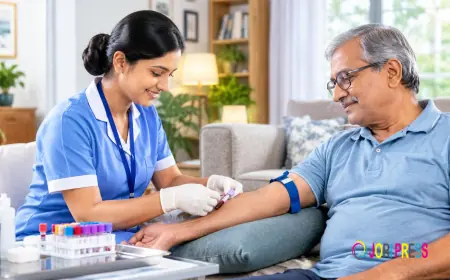
4. Sample collection: The blood is drawn using sterile equipment, usually within a few minutes.
5. Labelling and transport: Tubes are labelled in front of you and carried to the lab in proper storage.
6. Report delivery: Reports are shared digitally, often within 24 to 48 hours for routine tests, though some tests take longer.
Common Tests Available for Home Collection
Most routine tests can be done from a home sample, including:
• Complete blood count (CBC)
• Fasting and post-meal blood sugar, HbA1c
• Lipid profile (cholesterol)
• Thyroid profile (T3, T4, TSH)
• Liver function and kidney function tests
• Vitamin D and Vitamin B12
• Uric acid, electrolytes, and inflammatory markers
• Dengue, malaria, typhoid and other infection-related tests, which are especially relevant during monsoon and post-monsoon months
Some tests, such as certain imaging or procedure-based diagnostics, still need a visit to a centre. A good provider will tell you which is which.
Simple Tips to Prepare for Your Home Blood Test
• Follow fasting instructions exactly. For most fasting tests, this means 8 to 12 hours with only water allowed.
• Drink water. Staying hydrated makes veins easier to find.
• Keep your medicines list ready. Some medicines can affect results, so tell the phlebotomist about anything you take regularly. Never stop a prescribed medicine without your doctor's advice.
• Keep your doctor's prescription handy. This helps confirm the correct tests.
• Avoid heavy exercise before the test. It can temporarily change some blood values.
• Rest for a few minutes after the sample is drawn, especially if you tend to feel dizzy.
Questions to Ask Before You Book a Home Collection Service
Use this checklist to compare providers:
• Are the phlebotomists trained and experienced?
• Is all equipment sterile and single-use?
• How are samples transported and how soon do they reach the lab?
• Which lab processes the tests, and how are quality checks handled?
• How and when will I receive the report?
• Can someone help me understand the report or share it with my doctor?
• Are there any extra charges for home visits, or for early-morning and weekend slots?
• Do you cover my area, such as Behala, Tollygunge, Joka, Thakurpukur or New Alipore?
Clear, confident answers to these questions are a good sign.
Special Care for Elderly and Bedridden Patients
Older patients need a gentler approach. Look for a provider that will:
• Take extra time to find a suitable vein
• Explain each step in simple language to the patient and family
• Be patient with patients who have hearing difficulty, dementia or anxiety
• Allow a family member to stay present throughout
• Handle repeat tests on a regular schedule so reports can be compared over time
Continuity matters here. Comparing results over months gives a more reliable picture of health than a single test.
Frequently Asked Questions
Is blood collection at home as accurate as at a lab? Yes, when the sample is collected correctly and reaches a quality-controlled lab promptly. Accuracy depends on collection technique, labelling, temperature control and processing time.
Do I need a doctor's prescription? Many routine tests can be booked without one, but a prescription helps ensure you get the right tests. Some tests may require it.
How long does it take? The visit itself usually takes 10 to 15 minutes. Report timing depends on the test.
Is it painful? You may feel a brief pinch. A skilled phlebotomist keeps discomfort and bruising to a minimum.
Who should avoid home collection? Most people can use it. If you have a condition that makes blood collection risky, such as a severe bleeding disorder, speak to your doctor first.
Final Thoughts
Safe blood sample collection at home comes down to trained staff, sterile practice, careful handling and reliable reporting. For families in South Kolkata, it makes regular health monitoring far easier, especially for elderly members and people managing long-term conditions.
If you are looking for a provider in the area, Medilink Healthcare Services offers lab tests and diagnostics at home in South Kolkata, with sample collection done at your doorstep so you can get the tests you need without travelling.
What's Your Reaction?
 Like
0
 Dislike
0
 Love
0
 Funny
0
 Angry
0
 Sad
0
 Wow
0