



























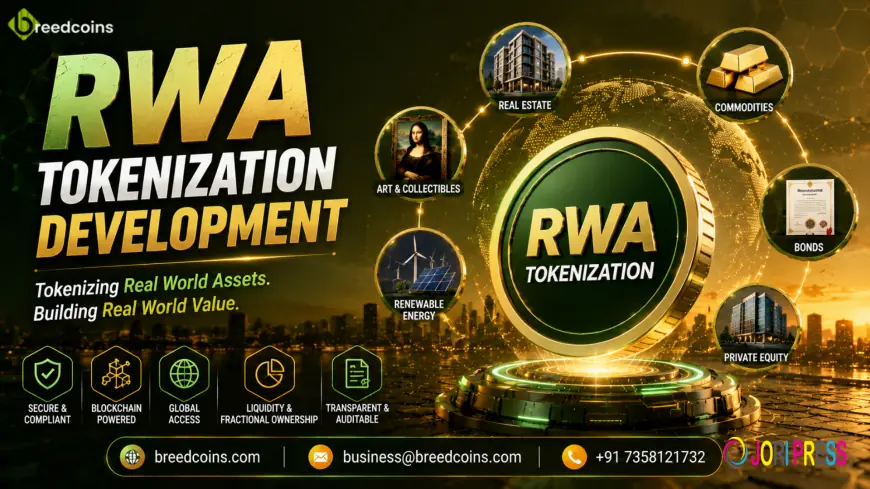
RWA Tokenization Development: A New Model for Digital Asset Ownership
Breedcoins is a top-notch Real World Asset Tokenization Platform Development Company that offers the best and reliable Asset Tokenization Services

Ownership of valuable assets has traditionally involved paperwork, legal documents, banks, brokers, and several other parties. Real estate, gold, artwork, private investments, and other assets can take time to buy, sell, or divide between multiple owners. Blockchain technology has opened up another way to represent these assets digitally.
RWA Tokenization Development is about creating digital tokens that represent an asset or a specific ownership right connected to it. The physical asset does not disappear or become digital. Instead, information about its ownership or related rights can be represented through tokens and recorded on a blockchain.
What RWA Tokenization Means
Tokenization connects a real world asset with a digital representation. Before creating a token, the business needs to identify the asset, establish its value, decide what the token represents, and determine how ownership will be handled.
For example, a property can be divided into defined ownership interests and represented through digital tokens. A person holding a token may have a specific right or share in the underlying asset, depending on the legal structure.
This makes the legal side just as important as the technology. The token needs to represent something clearly understood by the business and its users.
Real Estate Tokenization
Real estate is one of the areas where tokenization can have a practical use. Property is usually expensive and ownership can involve several legal and financial processes.
With Real Estate Tokenization, a property can be represented through multiple digital units when the legal structure permits it. This can support fractional ownership, where eligible participants hold a defined share rather than purchasing the entire property.
The same concept can be considered for commercial properties, rental assets, and selected real estate investment models. However, the rights attached to each token must be clearly established before the platform is developed.
Other Assets Suitable for Tokenization
Tokenization is not limited to property. Gold tokenization, commodities, artwork, investment interests, invoices, and certain financial assets can also be considered.
The suitability of an asset depends on several factors, including ownership records, valuation, transfer rules, legal requirements, and the market in which the asset will be offered.
A business should therefore decide on the asset first and then design the token model around it rather than creating a token without a clear purpose.
Asset Tokenization Platform
An Asset Tokenization Platform provides the digital environment for managing tokenized assets. Depending on the business model, it may include asset listings, user registration, identity verification, token issuance, wallet connections, transaction records, and an administration panel.
The marketplace feature can also be introduced where users would like a place for buying and selling the appropriate tokenized assets.
The information can be displayed in the form of a description of the asset, valuation, the available number of units owned by users, as well as transaction details. All this information needs to be lucid, as users would be dealing with an asset that has monetary importance.
Smart Contracts and Blockchain
Smart contracts can automate selected actions within a tokenization platform. Smart Contract Development may cover token creation, transfers, ownership records, distribution rules, and other predefined activities.
The blockchain network is responsible for recording relevant transactions and ownership changes. The right network depends on factors such as transaction costs, speed, available development tools, wallet support, and the type of asset being tokenized.
Blockchain Asset Tokenization should be planned around the actual requirements of the project. There is no need to put every piece of information on-chain when conventional databases can handle certain data more effectively.
Security Token Development
Some tokenized assets may fall under financial or investment regulations. In such cases, Security Token Development requires particular attention to the rights represented by the token and the rules that apply to its issuance and transfer.
Identity verification, investor eligibility, transaction monitoring, access controls, and proper record-keeping may become important parts of the platform.
The exact requirements depend on the asset, jurisdiction, and business model. Legal professionals should be involved alongside the development team when regulated assets are being considered.
Security and Compliance
A tokenization platform needs more than blockchain integration. Wallets, user accounts, smart contracts, APIs, and administrative access all need appropriate protection.
Smart contracts should be tested before deployment, and transaction flows should be checked carefully. User verification and monitoring systems can also be added based on the requirements of the platform.
Compliance should be considered from the beginning rather than treated as something to address after the platform has already been built.
Business Opportunities
Tokenization can give asset businesses another way to organize ownership and manage digital transactions. Fractional NFT ownership can make certain high-value assets easier to divide into defined interests, while blockchain records can provide a consistent history of transactions.
Businesses can also create platforms around specific asset categories instead of trying to support every possible asset. A focused approach can make the product easier to manage and explain to its users.
Conclusion
RWA Tokenization Development connects traditional assets with blockchain-based digital systems. Real estate, commodities, artwork, and other assets can potentially be tokenized when the underlying ownership structure and regulations support the model.
The technology is only one part of the project. Legal rights, asset valuation, smart contracts, blockchain selection, security, and user management all need to work together.
A well-planned tokenization platform can give businesses a practical way to represent real-world assets digitally while creating new possibilities for ownership, management, and asset-based markets.
What's Your Reaction?
 Like
0
Like
0
 Dislike
0
Dislike
0
 Love
0
Love
0
 Funny
0
Funny
0
 Angry
0
Angry
0
 Sad
0
Sad
0
 Wow
0
Wow
0