









































Robotics Training Data: How to Build Datasets for Intelligent Robots
Learn how robotics training data is collected, annotated, and validated to support intelligent robots, Physical AI, and real-world task learning.
Robotics is entering a new phase in which machines are expected to do more than follow fixed instructions. Intelligent robots need to recognize objects, understand their surroundings, interact with people, and adapt when conditions change.
These capabilities depend on robotics training data. A robot learning to pick up an object, navigate a warehouse, or assist a person needs examples that represent the physical tasks it may encounter. The quality and diversity of these examples can influence how well the robot learns and performs.
Robotics training data includes visual recordings, sensor measurements, human demonstrations, robot actions, and annotations that describe what is happening during a task. Building a useful dataset requires a planned collection process, consistent labeling, and quality validation.
What Is Robotics Training Data?
Robotics training data is information used to develop, train, and evaluate machine learning models for robotic systems.
Depending on the application, datasets may contain:
-
Images and videos of objects and environments
-
Egocentric recordings from a human or robot's point of view
-
3D sensor data, including LiDAR and depth information
-
Human demonstrations of physical tasks
-
Robot movement and interaction records
-
Labels describing objects, actions, positions, and task stages
A robot working in a controlled industrial environment may require different data from a humanoid robot designed to interact with people. Therefore, dataset design should begin with the intended application.
Why Robotics Training Data Matters
1. Helps Robots Understand Their Environment
Robots need to recognize objects, surfaces, obstacles, and spatial relationships. Visual and sensor datasets can help perception models learn to identify relevant information from their surroundings.
2. Supports Learning from Demonstrations
Human demonstrations can show how a task is performed. For example, a person may demonstrate how to grasp a cup, open a drawer, or place an object on a shelf.
These recordings can provide examples of movement, object interaction, and task sequencing.
3. Improves Adaptability
A robot may encounter objects in different positions, lighting conditions, or environments. Diverse training examples can help developers prepare models for variation rather than relying on a single ideal scenario.
4. Enables Better Evaluation
Training data alone is not enough. Separate validation and test datasets help teams assess whether a model performs consistently on examples it has not previously encountered.
Common Types of Robotics Training Data
Image and Video Data
Images and videos help robotic systems identify objects, recognize scenes, and understand movement over time. Video is especially useful when a task involves several actions or interactions.
Egocentric Data
Egocentric data captures activities from a first-person perspective. It can show hand movements, object handling, and the sequence of actions involved in completing a task.
Sensor Data
Robots may use cameras, depth sensors, LiDAR, radar, and other sensors to understand physical environments. These data streams can provide complementary information about objects and their locations.
Human Demonstration Data
Demonstration datasets record how people perform specific tasks. They may support imitation learning, task understanding, and embodied AI development.
How to Build a Robotics Training Dataset
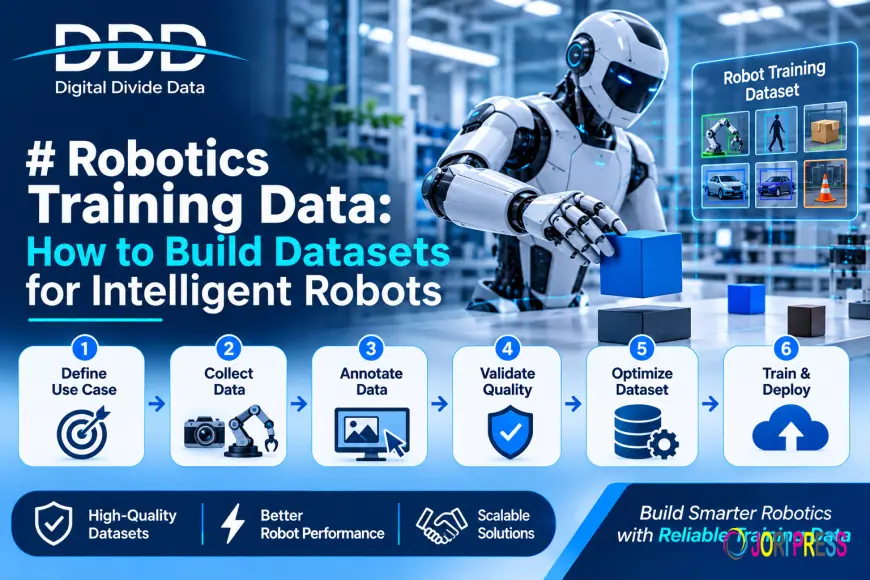
Step 1: Define the Training Objective
Start by identifying what the robot needs to learn. Is the goal object recognition, navigation, manipulation, human interaction, or task execution?
The objective determines the required data types and annotation structure.
Step 2: Design the Collection Protocol
A collection protocol should define the tasks, environments, equipment, recording instructions, and required metadata.
For egocentric collection, teams should also consider camera placement, synchronization, calibration, and demonstrator instructions.
Step 3: Capture Diverse Examples
A useful dataset should represent variation relevant to the application. This may include different objects, environments, task variations, and interaction patterns.
Step 4: Annotate the Data
Annotations may identify objects, actions, task phases, positions, or movement. Clear guidelines help different annotators label the same type of event consistently.
Step 5: Review and Validate
Quality checks can identify missing frames, incorrect labels, inconsistent timestamps, and unsuitable recordings. A pilot dataset should be reviewed before collection expands.
Step 6: Prepare Data for Model Training
The final dataset should be organized in the format required by the development team. Documentation should explain the collection process, labels, limitations, and intended use.
Challenges in Robotics Data Collection
Robotics data collection can be more demanding than collecting ordinary images. Physical tasks involve movement, timing, spatial relationships, and interactions that may be difficult to reproduce.
Common challenges include:
-
Capturing synchronized data from multiple sensors
-
Maintaining consistent task instructions
-
Representing different environments and object variations
-
Managing privacy in first-person recordings
-
Preventing annotation inconsistencies
-
Ensuring that collected data matches the intended model objective
Planning these requirements before collection can reduce the amount of unusable data.
How Digital Divide Data Supports Robotics Training Data
Digital Divide Data (DDD) provides data collection and AI data services for Physical AI and robotics programs. Its published capabilities include multimodal data preparation, egocentric data collection, annotation, and quality review.
For robotics projects, these workflows can support the process from collection design and data capture to annotation and validation. DDD's robotics-related work also addresses human demonstrations and data that captures physical interactions.
Conclusion
Robotics training data is a foundation for developing intelligent systems that can understand and act in physical environments. A well-designed dataset combines relevant examples, clear collection protocols, consistent annotation, and structured quality checks.
Robotics teams should focus not only on collecting large volumes of data but also on ensuring that each dataset reflects the tasks and conditions the robot is expected to handle.
What's Your Reaction?
 Like
0
 Dislike
0
 Love
0
 Funny
0
 Angry
0
 Sad
0
 Wow
0