






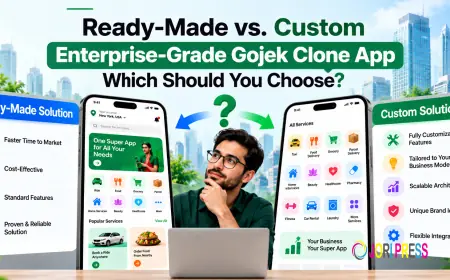




























Ready-Made vs. Custom Enterprise-Grade Gojek Clone App: Which Should You Choose?
Compare ready-made and custom enterprise-grade Gojek clone apps to evaluate development time, flexibility, scalability, and the right fit for your business.

Introduction
Businesses looking to enter the on-demand service market need a digital platform that can manage multiple services, connect customers with providers, and support long-term growth. A Gojek-style super app offers a practical way to bring services such as ride-hailing, food delivery, grocery shopping, and home services together in one application.
However, choosing the right development approach is an important business decision. Some companies prefer a ready-made Gojek Clone App that can be customized and launched quickly, while others choose a fully custom solution designed around their operational requirements and long-term objectives.
Both approaches offer distinct advantages. A ready-made solution provides an established foundation for launching a business, whereas custom development offers greater control over features, workflows, and future expansion.
The right choice depends on your business model, target audience, service categories, operational complexity, and growth strategy. This guide compares ready-made and custom enterprise-grade solutions to help startups, agencies, and established businesses make an informed decision.
What Is a Gojek Clone App?
A gojek clone app is a multi-service digital platform inspired by the super app business model. It allows businesses to offer several on-demand services through a single branded application rather than operating separate apps for every service.
Depending on business requirements, the platform can include ride-hailing, food delivery, grocery delivery, courier services, beauty services, home maintenance, and other local marketplace offerings.
A typical platform connects four key groups:
- Customers who browse services, place orders, and make payments.
- Service providers who receive requests and manage their availability.
- Delivery partners or drivers who fulfill transportation and delivery requests.
- Administrators who manage users, services, transactions, commissions, and daily operations.
Businesses can launch a platform using a ready-made Gojek Clone Script or invest in custom super app development to create a solution tailored to their requirements.
The objective is to establish a connected service ecosystem that improves customer convenience while helping businesses manage multiple revenue-generating services.
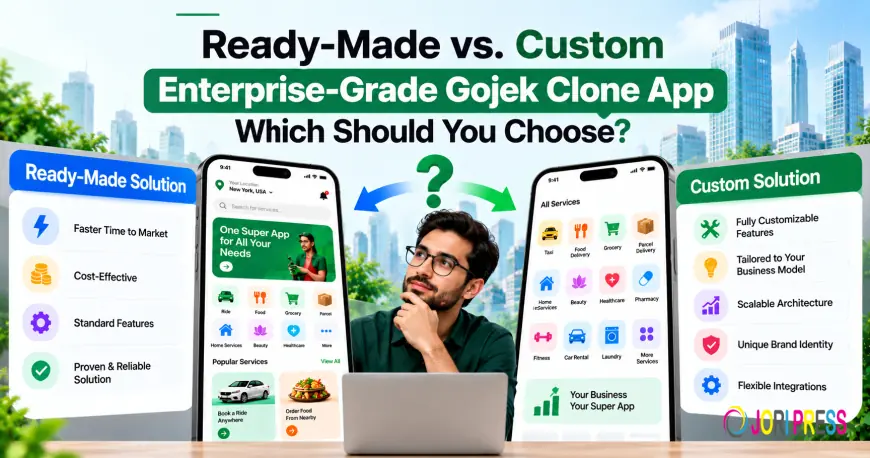
Ready-Made vs. Custom Enterprise-Grade Gojek Clone App
The main difference between these approaches is the balance between speed, flexibility, and business-specific requirements.
What Is a Ready-Made Gojek Clone Script?
A ready-made Gojek Clone Script is a pre-built application solution that businesses can customize with their brand identity, selected services, and business rules.
Instead of starting the entire development process from scratch, companies begin with an existing set of application features and operational tools. Depending on the provider, the package may include customer apps, service provider apps, driver apps, and an administration panel.
This approach is suitable for startups and businesses that want to validate their business model, enter a new market, or expand their service portfolio without managing an entirely new development initiative.
A ready-made gojek clone app can support essential operations such as customer registration, service booking, order management, payment processing, notifications, and service provider coordination.
However, the level of customization varies between providers. Businesses should verify whether the solution supports their required service categories, integrations, business rules, and future expansion plans.
What Is Custom Super App Development?
Custom super app development involves creating a platform around a company's specific business model, customer expectations, and operational processes.
Rather than adapting existing features, businesses define the capabilities they need and shape the product accordingly. This can include specialized service workflows, enterprise reporting, regional business rules, third-party integrations, and advanced administrative controls.
Custom development is particularly relevant for established companies with complex operations, multiple business units, or requirements that existing solutions cannot adequately support.
For businesses planning to build a super app like gojek, this approach provides greater control over the product roadmap and the ability to prioritize features according to changing business needs.
The trade-off is that the business must manage a more extensive planning, development, testing, and ongoing maintenance process.
Key Differences Between Ready-Made and Custom Solutions
1. Time to Market
Ready-made solutions generally provide a faster route to market because many essential features are already available. Businesses can focus on branding, configuration, service selection, and launch preparation.
Custom development requires more planning and implementation before the platform is ready for customers.
For startups testing demand in a specific market, a ready-made solution may be the more practical choice. Enterprises working toward a larger digital transformation may prefer a custom approach when their requirements justify the additional implementation effort.
2. Customization and Business Flexibility
A ready-made platform offers customization within the capabilities supported by its provider. This may include branding, service categories, commission settings, payment options, and selected workflows.
Custom development offers more flexibility when a company needs unique operational processes or specialized customer experiences.
For example, a business operating across multiple regions may require different service availability rules, provider verification procedures, or approval processes. A custom solution may be better suited to these requirements if a ready-made platform cannot accommodate them.
3. Enterprise Operations and Management
Enterprise-grade platforms must support clear operational controls as the business expands. These may include role-based permissions, service-level monitoring, provider management, transaction records, and consolidated reporting.
A ready-made gojek clone app can meet these needs when the provider has included the necessary capabilities. However, businesses should not assume that every pre-built solution offers enterprise-level administration.
Custom solutions allow organizations to define operational controls around their internal processes, reporting requirements, and management structure.
The decision should be based on verified capabilities rather than the product label alone.
4. Scalability and Future Expansion
Scalability involves more than supporting additional users. Businesses must also consider new service categories, geographic expansion, operational complexity, and increasing transaction volumes.
A suitable ready-made solution should have a clear roadmap for supporting these changes. Businesses should ask how new services can be added, whether integrations are supported, and what limitations may affect expansion.
Custom development allows the platform to evolve according to a company's long-term plans. It may be preferable when expansion depends on specialized functionality that cannot be accommodated by an existing product.
5. Maintenance and Ongoing Support
With a ready-made solution, the provider may supply product updates, bug fixes, documentation, and technical assistance. The exact responsibilities depend on the service agreement.
Custom development gives businesses greater control over maintenance priorities, provided they have access to the appropriate development and support resources.
Before choosing either approach, clarify who handles updates, security improvements, compatibility changes, issue resolution, and future enhancements.
Essential Features of an Enterprise-Grade Super App
Regardless of the development approach, a successful super app should provide a reliable experience for customers, service providers, and administrators.
Customer Application
The customer app should make it easy to discover services, compare available options, book appointments or rides, place orders, and complete payments.
Useful features include:
- Simple registration and secure account access.
- Service discovery, search, and filters.
- Real-time booking or order status updates.
- Multiple payment methods where supported.
- Ratings, reviews, and customer feedback.
- Notifications, promotions, and booking history.
- Customer support and issue reporting.
These capabilities help businesses provide a consistent experience across different service categories.
Service Provider and Delivery Applications
Service providers need tools to manage incoming requests, update availability, review job details, and track their earnings.
For transportation and delivery services, relevant capabilities may include navigation, location tracking, delivery status updates, and trip or order history.
A well-planned App Like Gojek should make provider operations straightforward while giving the business appropriate visibility into service fulfillment.
Centralized Administration
A centralized administration panel helps businesses manage users, providers, service categories, commissions, promotions, complaints, and transactions.
Enterprise requirements may also include role-based access control, consolidated reporting, audit records, and operational monitoring.
These capabilities become increasingly important when the company manages multiple service categories or operates across different locations.
Business Opportunities and Use Cases
A multi-service platform can support several business models, depending on local demand and operational capabilities.
Startups Entering the On-Demand Market
Startups can use a ready-made solution to launch selected services and evaluate customer demand. Starting with a focused service portfolio can help the business understand its audience before expanding into additional categories.
For founders who want to build a super app, this approach offers a way to establish initial operations before committing to a broader product strategy.
Enterprises Expanding Their Digital Ecosystem
Established businesses may want to combine existing services into a single customer experience. For example, a company operating transportation and logistics services could explore additional offerings such as courier delivery or local business services.
A custom platform may be more appropriate when integration with existing systems and internal workflows is essential.
Agencies Offering White-Label Solutions
Digital agencies and technology consultants can use white-label platforms to offer branded on-demand applications to their clients.
Working with a reliable Super app development company can help agencies identify suitable solutions, understand customization limits, and coordinate ongoing product support.
Regional Service Marketplaces
Businesses can use Multi service app development to connect local customers with transportation providers, restaurants, grocery stores, and home service professionals.
The service mix can be adapted to local demand, customer preferences, provider availability, and regional operating requirements.
Why Businesses Choose a Gojek-Style Super App
A super app like gojek can help businesses bring multiple services under one brand, simplify service discovery, and create opportunities for repeat customer engagement.
Instead of maintaining separate customer experiences for every service, companies can establish a shared platform for accounts, support, promotions, and selected payment functions.
The model also creates opportunities for cross-selling. A customer who initially uses a transportation service may later discover grocery delivery or home maintenance through the same platform.
However, combining services does not automatically create a successful business. Each category needs reliable providers, clear operating procedures, consistent service quality, and sufficient customer demand.
Businesses should expand based on market validation rather than adding services simply to increase the number of available features.
How to Choose the Right Development Approach
Before selecting a solution for Gojek like app development, evaluate the following factors:
Choose a ready-made solution when:
- You want to launch quickly using established features.
- Your business model fits the platform's existing capabilities.
- You need to validate demand before expanding the product.
- You prefer a defined product offering with provider-led support.
Choose custom development when:
- Your operations require specialized business workflows.
- You need integrations that existing solutions cannot support.
- Your enterprise has complex reporting or access-control requirements.
- You need greater control over product development and future changes.
Evaluate a hybrid approach when:
Your business needs a ready-made foundation but also requires selected customizations. A hybrid approach can combine existing functionality with targeted enhancements, provided the provider supports them and the resulting product meets your operational requirements.
Before making a commitment, review a live product demonstration, test the major user journeys, confirm source code and intellectual property rights, examine documentation, and verify support commitments. Also, confirm how the provider handles security updates, integrations, and future product changes.
These checks help businesses choose a solution based on actual capabilities rather than assumptions.
Conclusion
Choosing between ready-made and custom development depends on your business priorities, operational complexity, and long-term expansion plans.
A ready-made gojek clone app can be a practical option for businesses that want to enter the market quickly with established functionality. Custom development is more suitable when the business requires specialized workflows, deeper integrations, or greater control over its product roadmap.
For organizations exploring super app development, the best decision is to evaluate the platform against real business requirements, not simply the number of features it offers.
Partnering with an experienced clone app development company can help you assess both approaches, identify customization requirements, and select a platform that supports your business objectives. The goal is to launch a reliable service ecosystem that meets customer needs today and remains adaptable as the business grows.
Frequently Asked Questions
1. What is the difference between a ready-made Gojek Clone Script and custom development?
A ready-made Gojek Clone Script provides existing application features that can be configured and customized. Custom development creates a solution around specific business requirements, workflows, and expansion plans.
2. Is a ready-made gojek clone app suitable for enterprise businesses?
Yes, if the solution supports the enterprise's operational requirements, security expectations, integrations, reporting needs, and expansion plans. Businesses should verify these capabilities before selecting a provider.
3. Can I build a super app like gojek with multiple service categories?
Yes. Depending on the platform's capabilities, businesses can combine services such as ride-hailing, food delivery, grocery delivery, courier services, and home maintenance in one application.
4. What features should an enterprise-grade multi-service app include?
Important features include customer registration, service discovery, booking management, payments, provider management, notifications, centralized administration, reporting, access controls, and customer support.
5. How do I choose a Super app development company?
Evaluate its product demonstration, customization capabilities, industry experience, documentation, intellectual property terms, integration support, maintenance policies, and ability to meet your business requirements.
What's Your Reaction?
 Like
0
Like
0
 Dislike
0
Dislike
0
 Love
0
Love
0
 Funny
0
Funny
0
 Angry
0
Angry
0
 Sad
0
Sad
0
 Wow
0
Wow
0