































Off-road LED lights IP68 vs IP69K ingress protection explained

IP69K gives you stronger protection against high-pressure, high-temperature water jets than IP68. That difference makes IP69K the better fit for extreme off-road use and commercial washdown routines. IP68 excels at prolonged immersion, yet you cannot rate it for high-pressure washing. Your real driving and cleaning conditions should guide the choice. This IP68 vs IP69K LED work light rating explained guide comes from Shenzhen Aurora Technology Limited (brand Aurora).
Key Takeaways
· IP68 protects against long water immersion. IP69K protects against high-pressure, hot water jets.
· Choose the IP rating that matches your driving and cleaning conditions. IP68 is good for water crossings. IP69K is good for pressure washing.
· IP ratings only cover dust and water. Check other specs like impact resistance and heat management for overall quality.
What an IP Rating Actually Means
An IP rating follows IEC 60529, the international standard for enclosure protection. Two digits tell you how well a light resists solids and water. You read each digit on its own scale.
The First Digit: Solids and Dust
The first digit covers solid objects and dust. The scale runs from 0 to 6:
· 0 means no protection.
· 1 through 4 block objects larger than 50 mm, 12.5 mm, 2.5 mm, and 1 mm.
· 5 means dust protected, with limited ingress that causes no harm.
· 6 means dust-tight, with no ingress at all.
A level 6 test circulates fine talcum powder at a concentration of 2 kg/m³ for at least 8 hours. Your light must stay clean through that full cycle.
The Second Digit: Water
The second digit rates water exposure. Levels 1 through 4 cover dripping and splashing water. Level 5 handles water jets from a 6.3 mm nozzle. Level 6 adds powerful jets from a 12.5 mm nozzle. Level 7 covers temporary immersion up to 1 m. Level 8 covers continuous immersion beyond 1 m, with depth and time set by the manufacturer.
What the "K" Adds
The "K" ties the rating to ISO 20653, the standard for road vehicles. IP69K confirms resistance to high-pressure, high-temperature water jets. The "K" adds a vehicle-specific test basis, not a stronger-versus-weaker rank. Check the certified test standard behind any claim.
IP68 vs IP69K LED Work Light Rating Explained
You now know what the two digits mean. The next step is understanding how labs actually test each rating. The test conditions reveal why IP68 and IP69K suit different jobs. This part of the IP68 vs IP69K LED work light rating explained guide walks you through both procedures.
Test Conditions for IP68
An IP68 test places the light in a water tank. The manufacturer defines the depth and the duration, so the standard sets no fixed numbers. A common test submerges the light at 1.5 m for 30 minutes. Many manufacturers push deeper and longer to prove real durability. The light must stay dry inside through the entire soak. No pressure requirement applies here. The water sits still, and the seal faces a steady, gentle load. A light that passes this test handles flooded trails, deep puddles, and river crossings with confidence.
Test Conditions for IP69K
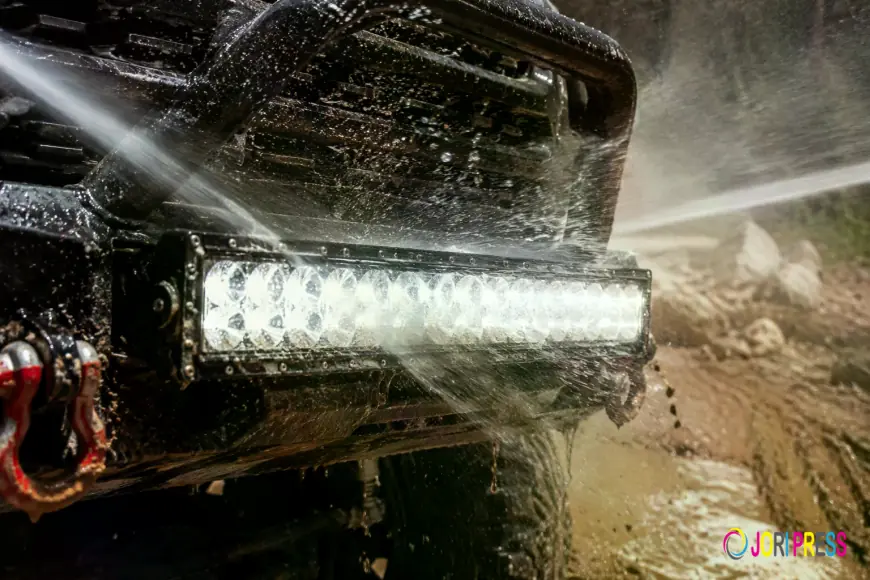
An IP69K test takes the opposite approach. A nozzle blasts the light with high-pressure, high-temperature water. ISO 20653 defines the procedure. The water reaches about 80 °C and 80–100 bar. The nozzle sits 10–15 cm from the light and delivers 14–16 L/min. The light rotates on a turntable, and the jet hits it from four angles. Each angle gets 30 seconds of spray, so one full cycle runs about two minutes. This test mimics a commercial pressure washer at full power. A light that passes it survives steam cleaning, washdown bays, and mud-blasting routines.
Pressure, Temperature, and Duration Compared
The two tests stress a light in completely different ways. IP68 applies steady immersion with no pressure and no heat requirement. IP69K applies violent, hot, focused force for a short burst. The table below sets the parameters side by side.
Parameter
IP68 (immersion)
IP69K (high-pressure jet)
Pressure
Not specified — no pressure requirement in the immersion test
80–100 bar (8,000–10,000 kPa)
Temperature
Not specified — ambient/agreed conditions, no hot-water requirement
80 °C water
Duration
Manufacturer-defined, e.g. 1.5 m for 30 min
30 s at each of four angles, ~2 min total per cycle
Other conditions
Continuous immersion under agreed conditions
14–16 L/min, nozzle 100–150 mm away, rotating turntable, four angles
The comparison shows a key point. Neither rating covers the other's territory. A light can carry both ratings when it must survive flooding and pressure washing. Many Aurora work lights do exactly that, and the dual rating gives you coverage for both scenarios.
Common Misconceptions
Plenty of buyers misread these ratings. The table below clears up the most frequent errors.
Misconception
Clarification
IP69K always supersedes IP68
Neither rating is universally superior; they test different conditions. IP68 covers continuous water immersion, while IP69K covers resistance to high-pressure, high-temperature water jets.
IP69K guarantees a better-quality light
No. IP69K only measures ingress protection. Light quality also depends on optical design, beam distribution, thermal management, materials, electronics, and manufacturing quality.
IP67/IP68 lights are fully waterproof for all conditions
IP67 only withstands temporary immersion (~1 m for ~30 min) and is not designed for high-pressure washing or prolonged demanding exposure.
One rating fits all off-road use
Suitability depends on use: water-crossing drivers may prefer IP68; those who pressure-wash regularly may prefer IP69K; overlanding and weekend use can rely on IP67/IP68.
A few practical takeaways follow from this table. For overlanding and weekend off-road trips, IP67 and IP68 both offer reliable protection. Drivers who frequently encounter water crossings may benefit from an IP68 rating. Those who regularly pressure wash their vehicles may prefer the added protection of IP69K. Agriculture, construction, and commercial fleets exposed to mud, dust, and debris benefit from IP69K's high-pressure, high-temperature cleaning resistance. Beyond the IP rating, consider beam pattern, optical design, mounting location, heat management, and build quality. The IP68 vs IP69K LED work light rating explained comparison above should guide your shortlist, not decide it alone.
Choosing the Right Rating for Your Off-Road Use
You have the test data. Now you need to match a rating to the life your light will actually live. A trail toy and a fleet service truck face very different water loads. The right answer for one can be overkill or undersized for the other. This part of the IP68 vs IP69K LED work light rating explained guide maps four common use profiles to practical rating choices.
Daily Driving and Weekend Trails
Your truck sees rain, road spray, and the occasional muddy two-track. It rarely sits in deep water. It almost never meets a pressure washer at close range. An IP67 or IP68 light covers this duty well. Both ratings keep dust out and survive wet conditions. IP68 adds continuous submersion, which gives you margin at water crossings and deep puddles. You gain real peace of mind from that extra headroom. You do not gain much from IP69K here. A weekend trail rig rarely faces an 80 °C jet at 80–100 bar. Spend your budget on beam pattern and housing quality instead. Those factors shape your night vision far more than the water digit does.
Overlanding and Expedition Builds
Expedition rigs cross rivers, ford flooded tracks, and sit in camp through days of rain. They also carry gear that must work far from any service bay. Reliability matters more than peak specs. An IP68 rating with a declared depth and duration gives you the strongest assurance for submersion. Ask the supplier for those numbers in writing. A bare "IP68" label tells you little without them. Many overland builds also face dust for weeks on end. Confirm the first digit is 6, which means dust-tight. A 5 only means dust-protected. Pair the rating with a sealed connector and a protected cable entry. Water usually enters a lamp at the cable, not through the lens. A dual-rated IP68 and IP69K light gives you the widest coverage for mixed terrain and occasional washdowns.
Commercial Fleets and Work Trucks
Fleet duty splits into positions, and each position carries its own water load. A cab headlamp sees rain and road dirt. A chassis work light sits in puddles and wet film all day. A tanker lamp may go under water during a wash. Match the rating to the mounting point, not to the whole truck.
Position or operating condition
Recommended minimum IP
Rationale
Cab headlamps, front position lamps
IP67
Rain, spray, road dirt; higher rarely needed
Chassis and underbody work lights
IP67, IP68 preferred
Deep puddles and prolonged wet road film
Trailer rear and marker lamps
IP67 minimum
Most dead LED complaints trace to water at the cable entry
Roof-mounted light bars
IP67
Wind-driven rain at speed stresses seals more than static water
Tankers, wash bays, submersible lamps
IP68 with declared depth and duration
IP68 alone is not a specification
Fleets that steam-clean or pressure-wash daily
IP69K, plus IP68 if also submerged
Thermal shock is the failure mode, not depth
Plant and agricultural machinery
IP69K or IP67 plus IP68 per washdown practice
Dust matters too, so confirm the first digit is 6
Fleet buyers should lock the rating into the purchase order. Follow a short procurement routine:
1. State the full IP code, such as IP67, IP68, or IP6K9K. Never accept "waterproof" or a loose "IP68/IP69K" label.
2. For IP68, require the declared depth and duration in the PO, for example IP68 at 2 m for 30 minutes. A supplier who cannot fill the blank was selling marketing.
3. For IP69K, confirm the full test ran with four spray angles and 80 °C water. Request the test report.
4. Specify the cable entry as part of the rating. Ask how the enclosure was sealed at entry during testing and whether the supplied connector is the same component.
5. Add a defined operating temperature range and chemical resistance for your cleaning agents. These details catch more real-world failures than a higher water digit.
Is IP69K better than IP68? Not better, just different. IP69K proves resistance to a close-range 80 °C, 80–100 bar jet for steam and pressure washdown. IP68 proves continuous immersion at a manufacturer-declared depth and duration. A fleet that both submerges and steam-cleans equipment needs both ratings stated on the datasheet.
For vehicles with regular washdowns, such as commercial vans and ambulances, insist on immersion-rated assemblies with robust sealing and corrosion-resistant contacts. Build the qualification requirements into your RFQs and POs so suppliers stay accountable. A layered inspection plan should include ingress tests per IEC 60529, thermal cycling per ISO 16750, salt spray for coastal routes, and vibration and connector retention checks. Ask for traceable lot testing and a certificate of conformity with each shipment.
Serious Off-Roading and Mud Running
Mud running punishes a light in ways that rain never does. Mud packs into seams, dries, and pulls at seals. A pressure wash then drives water and grit past any weak point. Off-roading exposes LED light bars to rain, mud, and dust, so water and dust resistance becomes essential. A high rating such as IP67 or IP68 means the bar can withstand heavy rain and dust. Labs verify these ratings under IEC 60529, and an IP68 light can survive underwater while staying dustproof. For water crossings, snow, heavy rain, and mud, the IP rating is decisive. Anything lower risks corrosion or internal fogging after a season, or even after a single hard run.
Serious mud runners should step up to IP69K. The rating proves the light survives a close-range, hot, high-pressure jet, which is exactly what a washdown bay delivers. One lighting manufacturer positions its IP67 series as adequate for routine off-road driving and reserves its IP69K Rugged Series for the toughest trail conditions. That split mirrors the logic here. Use IP67 or IP68 as your baseline for trail duty. Choose IP69K when your routine includes blasting mud off the rig at full pressure. A light rated for both gives you the strongest margin.
What IP Ratings Do Not Cover
An IP rating tells you how a light handles dust and water. It says nothing about the physical and thermal punishment a trail delivers. You need to read other specifications to judge the full picture.
Impact, Vibration, and Corrosion
A rock strike or a washboard road can crack a lens or loosen a mount. IP testing never simulates those forces. Impact resistance falls under the separate IK scale, so check for an IK number on the datasheet. Vibration follows its own standards, and the table below shows the main ones.
Standard
Test Type / Focus
Scope & Key Parameters
IEC 60068-2-6
Sinusoidal vibration test
Simulates rotation, pulsation, and oscillation vibrations in vehicles; severity depends on frequency range, amplitude, and duration
IEC 60068-2-64
Random vibration test
Companion standard focused on random vibration testing
ANSI C136.31
Vibration resistance for road/area lighting
Bridge luminaires must withstand 3.0G, other locations 1.5G; 100,000-cycle testing across X, Y, Z axes
IEC 60598-1
Rough service luminaires
Requirements specific to rough service luminaires
Corrosion is another blind spot. Salt spray, road brine, and fertilizer attack housings and contacts. Ask about salt-spray testing for coastal or winter fleet duty.
Heat, Wiring, and Lens Performance
Heat shortens LED life faster than water ever will. Elevated junction temperatures accelerate lumen depreciation and color shift. A sealed housing that passes IP68 can still trap heat and cook its own electronics. Look for thermal management details such as aluminum heat sinks and validated case-temperature data.
Wiring quality decides output consistency and long-term stability. The driver regulates voltage and current, and its placement matters as much as its rating.
The LED driver sits between the grid and the LED array, and its quality determines output consistency, dimming support, and protection from surges and fluctuations. Key electrical metrics — power factor above 0.90, THD below 15%, and surge immunity rated at 4kV–10kV — keep the system efficient and stable. Driver lifespan depends heavily on thermal management, so good designs thermally decouple the driver from the LED board while still cooling it by conduction or convection.
Lens material and optical coating also fall outside the IP scope. UV exposure yellows cheap polycarbonate and cuts light output over time. Confirm UV testing alongside the ingress rating.
Factors Beyond IP Rating That Affect Performance
A rating on a datasheet means little if the physical build cannot hold up. Housing materials, seal design, and installation quality decide whether your light keeps its protection after a season of hard use.
Housing Materials and Sealing Quality
The housing material sets the foundation for durability. Die-cast aluminum such as 6063 aircraft-grade alloy resists impact and manages heat well. Cheaper plastics crack under rock strikes and warp under thermal cycling. Seal quality matters just as much. A single molded gasket outperforms glued seams every time. Look for a lens bonded with a continuous seal and a housing machined to tight tolerances. These details keep dust and water out long after the factory test ends.
Mounting, Wiring, and Connector Protection
Water usually enters a lamp at the cable entry, not through the lens. Your installation practices therefore protect the rating as much as the factory seal does. Follow these practices to keep moisture out and current stable.
Category
Recommended Practice
Purpose
Wiring
Use the correct wire gauge (typically 12-gauge for multiple or high-power lights) and a dedicated relay
Prevents overheating and protects factory circuits from high amperage
Wiring
Split multiple lights across at least two separate circuits
Retains partial lighting if a fuse blows on the trail
Connector protection
Weatherproof every connection with adhesive-lined heat shrink tubing
Blocks moisture intrusion, a leading cause of shorts
Connector protection
Use waterproof connectors, apply dielectric grease, and add strain relief
Maintains moisture resistance under vibration
Mounting
Secure the harness with cable ties and clamps away from sharp edges and heat sources
Prevents insulation damage and vibration wear
Mounting
Inspect hardware tightness and confirm seals remain intact
Preserves the IP rating over time
Build a simple inspection routine into your maintenance schedule:
1. Check wiring and connectors after harsh weather or off-road use for corrosion, cracked insulation, or loose connections.
2. Clean connectors with electrical contact cleaner and reapply fresh dielectric grease.
3. Troubleshoot flickering or dim lights immediately to prevent wider harness damage.
4. Replace worn connectors with high-quality waterproof replacements rather than temporary patches.
IP69K suits high-pressure washdown and extreme conditions. IP68 suits prolonged immersion and general off-road duty. Match the rating to your real-world use, not the highest number. A coastal study of 4,200 luminaires found IP65 fixtures failed at 14.7% annually versus 7.9% for IP66, so fit matters. Build quality and installation count as much as the rating. Shenzhen Aurora Technology Limited (brand Aurora) builds both. Assess your driving conditions, then choose with this IP68 vs IP69K LED work light rating explained guide.
About the manufacturer
Shenzhen Aurora Technology Limited (brand name Aurora) was founded in 2011. The company operates a 35,000 m² factory with more than 400 employees and over 200 patents. It holds IATF 16949 certification. Minimum order quantities are 50 pcs for catalogue stock items, 100 pcs for OEM branding, and 500 pcs for custom tooling. Products carry stated IP ratings such as IP68 and IP69K.
FAQ
Does IP69K beat IP68 in every situation?
No. Each rating proves a different capability. IP69K handles hot, high-pressure jets. IP68 handles continuous immersion. Your cleaning routine and water exposure decide which rating matters more.
Can one light carry both IP68 and IP69K?
Yes. Many Aurora work lights hold both ratings. You then gain coverage for flooded crossings and pressure-wash routines. Check the datasheet for both codes before you buy.
Does a higher IP rating guarantee a longer-lasting light?
No. The rating covers dust and water only. Housing material, seal quality, thermal design, and your installation decide real-world lifespan. Treat the rating as one filter among several.
See Also
Avoid Making The Wrong Aluminum Casting Process Choice Ever Again
What's Your Reaction?
 Like
0
 Dislike
0
 Love
0
 Funny
0
 Angry
0
 Sad
0
 Wow
0
\