





























Non Woven Machine: Complete Guide to Modern Nonwoven Fabric Manufacturing
Discover how a Non Woven Machine supports modern nonwoven fabric manufacturing. Learn about the production process, machine types, key features, applications, and benefits for efficient, high-quality fabric production.

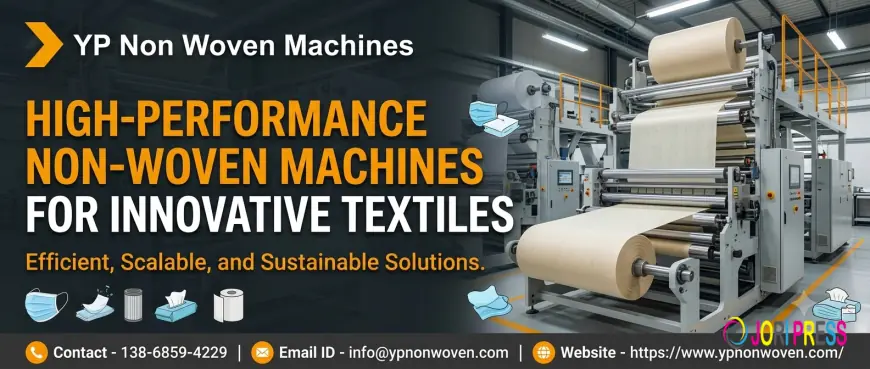
A non woven machine is an industrial manufacturing system used to convert polymers or fibers into nonwoven fabrics without traditional weaving or knitting. Modern equipment can support processes such as spunbond, meltblown, and spunmelt production, enabling manufacturers to produce lightweight, durable, breathable, and application-specific materials for hygiene, medical, agricultural, packaging, filtration, and industrial markets. YPNONWOVEN specializes in customized nonwoven production solutions designed around different materials, production capacities, fabric specifications, and end-use requirements.
What Is a Non Woven Machine?
A non woven machine is a combination of precision-engineered equipment that forms fibers into a continuous web and then bonds that web into finished fabric. Unlike conventional textile machinery, it does not require yarn interlacing. In a typical PP spunbond system, polypropylene pellets are melted, filtered, extruded through spinnerets, drawn into continuous filaments, distributed into a web, and thermally bonded through a calendar system.
This continuous manufacturing approach makes nonwoven production suitable for high-volume applications where consistent fabric weight, strength, width, softness, and appearance are important.
How Does a Non Woven Machine Work?
The exact process depends on the technology and raw material, but a modern spunbond production system generally follows these stages:
-
Raw material feeding: PP or another suitable polymer is introduced into the feeding system.
-
Extrusion: The polymer is heated and melted inside the extruder.
-
Filtration: Melt filtration removes unwanted impurities before spinning.
-
Spinning: The molten polymer passes through spinnerets to create continuous filaments.
-
Drawing: Airflow stretches and cools the filaments while controlling their fineness.
-
Web formation: Filaments are distributed onto a moving forming surface.
-
Thermal bonding: A heated calendar consolidates the web into stable fabric.
-
Winding: The finished nonwoven material is wound into rolls for storage, conversion, or further processing.
This integrated workflow allows manufacturers to control important characteristics such as fabric GSM, tensile strength, elongation, width, and surface uniformity.
Main Types of Non Woven Machines
Different products require different technologies. Selecting the correct machine therefore starts with understanding the target fabric.
1. PP Spunbond Machine
PP spunbond equipment uses polypropylene to create continuous filaments. It is widely used because PP provides a useful combination of low weight, chemical resistance, durability, and processing efficiency.
YPNONWOVEN offers single-beam, double-beam, and three-beam spunbond configurations for different production requirements.
2. Meltblown Machine
Meltblown technology produces extremely fine fibers using high-velocity hot air. The resulting material can provide specialized filtration and barrier characteristics, making meltblown technology important for selected medical, hygiene, and filtration applications.
3. SMS and Spunmelt Production Line
SMS combines spunbond, meltblown, and spunbond layers into a composite material. This structure can provide a combination of strength, filtration, and barrier performance. YPNONWOVEN's SMS systems are offered in configurations ranging from 1,600 mm to 3,200 mm product widths, with listed speeds up to 350 m/min depending on configuration.
4. PET Spunbond Machine
PET spunbond equipment uses polyester as the primary polymer. PET-based nonwovens are useful where higher temperature resistance, strength, dimensional stability, or recycled-material options are important.
Comparison of Nonwoven Machine Technologies
|
Technology |
Main Material |
Key Characteristic |
Typical Applications |
|
PP Spunbond |
Polypropylene |
Strength and versatility |
Bags, agriculture, hygiene, packaging |
|
Meltblown |
PP and selected polymers |
Fine fibers and filtration |
Filtration and specialized barrier materials |
|
SMS |
PP |
Strength plus filtration/barrier |
Hygiene and medical applications |
|
PET Spunbond |
Polyester |
Strength and temperature resistance |
Automotive, construction, filtration |
|
RPET Spunbond |
Recycled PET |
Recycled-material potential |
Sustainable industrial applications |
The appropriate technology should be selected according to fabric specifications, target market, raw material availability, required output, and investment plan rather than simply choosing the highest-capacity equipment.
Key Components of a Modern Nonwoven Production System
A reliable production line normally integrates several major systems:
-
Automatic raw-material feeding system
-
Extruder and polymer melting unit
-
Melt filtration equipment
-
Spinning system and spinnerets
-
Quenching and drawing system
-
Web-forming system
-
Thermal calendar
-
Edge trimming equipment
-
Fabric winding system
-
PLC-based control system
Automation is particularly important because stable process control can improve production consistency and simplify machine operation. YPNONWOVEN states that its production solutions use PLC control, touchscreen operation, customized configurations, and independently developed core components.
What Should You Consider Before Buying a Non Woven Machine?
Buying equipment is a major capital decision, so manufacturers should evaluate the complete production requirement rather than focusing only on machine price.
1. Determine the Target Fabric
Define the required GSM range, width, color, strength, softness, hydrophilicity, and other performance requirements before requesting a quotation.
2. Select the Right Raw Material
PP is common for spunbond applications, while PET may be preferred for applications requiring different thermal or mechanical characteristics.
3. Evaluate Production Capacity
Compare expected annual output with actual market demand. An oversized line can increase capital and operating costs, while insufficient capacity can restrict business growth.
4. Examine Automation
PLC controls, touchscreen interfaces, automatic tension management, alarms, and process monitoring can reduce manual intervention and improve operational consistency.
5. Check Technical Support
Installation, commissioning, operator training, spare parts, maintenance guidance, and after-sales support can significantly affect the long-term value of the investment.
Why Choose YPNONWOVEN?
YPNONWOVEN focuses on nonwoven machinery and customized production-line solutions for international manufacturers. Its product portfolio includes PP spunbond, spunmelt, PET spunbond, and other specialized nonwoven production technologies. The company states that it has focused on nonwoven production lines since 2008 and has supplied customized single-S, double-S, and triple-S spunbond configurations as well as SMS, SMMS, SSMS, and SSMMS systems.
For manufacturers, the advantage of working with an experienced machinery supplier is not simply access to equipment. Proper engineering support can help match the line configuration with raw materials, production targets, fabric specifications, factory conditions, and future expansion plans.
Common Applications of Nonwoven Fabric
Fabric manufactured using modern nonwoven equipment is used across numerous industries, including:
-
Hygiene products
-
Medical and protective materials
-
Agricultural crop covers
-
Nonwoven shopping bags
-
Packaging materials
-
Filtration media
-
Construction materials
-
Automotive components
-
Home textiles
-
Furniture and mattress materials
The broad application range is one reason nonwoven manufacturing remains an attractive option for manufacturers looking to serve multiple market segments.
Maintenance Tips for Better Machine Performance
Regular maintenance is essential for production stability and equipment longevity.
Recommended Practices
-
Inspect extrusion and spinning components regularly.
-
Keep filters and polymer-flow systems properly maintained.
-
Monitor calendar temperature and pressure.
-
Check belts, bearings, motors, and moving components.
-
Inspect electrical and PLC systems periodically.
-
Maintain a planned spare-parts inventory.
-
Record production parameters and recurring faults.
-
Train operators to identify abnormal vibration, temperature, pressure, or fabric defects.
Preventive maintenance is generally more effective than waiting for an unexpected breakdown to interrupt production.
Frequently Asked Questions
1. What is a non woven machine?
It is industrial equipment used to manufacture fabric by forming and bonding fibers or polymer filaments without traditional weaving or knitting.
2. What materials can be used?
Common materials include polypropylene (PP) and polyester (PET), while specialized lines can support additional polymer or recycled-material options depending on machine design.
3. What is a PP spunbond machine?
It is a production system that melts polypropylene and converts it into continuous filaments before forming and thermally bonding them into nonwoven fabric.
4. What is the difference between spunbond and meltblown?
Spunbond generally produces stronger continuous filaments, while meltblown technology creates much finer fibers using high-velocity hot air.
5. What is an SMS nonwoven line?
SMS stands for spunbond-meltblown-spunbond. It combines three layers to provide a balance of strength, filtration, and barrier properties.
6. Is nonwoven fabric suitable for packaging?
Yes. PP spunbond fabric is commonly used for reusable bags, packaging components, and other lightweight applications where durability and flexibility are required.
7. Can a machine be customized?
Yes. Production lines can be configured according to requirements such as fabric width, raw material, output, GSM range, automation level, and intended application.
8. How important is machine automation?
Automation helps operators maintain process parameters consistently and can improve production efficiency, monitoring, and ease of operation.
9. What should I check before purchasing equipment?
Consider production capacity, fabric specifications, raw material, energy consumption, automation, installation requirements, spare parts, technical support, and expected return on investment.
10. Why is supplier experience important?
Experienced suppliers can provide more than machinery. Engineering design, installation, commissioning, training, troubleshooting, and after-sales support can reduce operational risks.
Contact - 138-6859-4229
What's Your Reaction?
 Like
0
Like
0
 Dislike
0
Dislike
0
 Love
0
Love
0
 Funny
0
Funny
0
 Angry
0
Angry
0
 Sad
0
Sad
0
 Wow
0
Wow
0