







































Mole Removal: When Is It Recommended?
Learn when mole removal is recommended, warning signs to watch for, available treatment options, and how professional mole removal treatment can help.
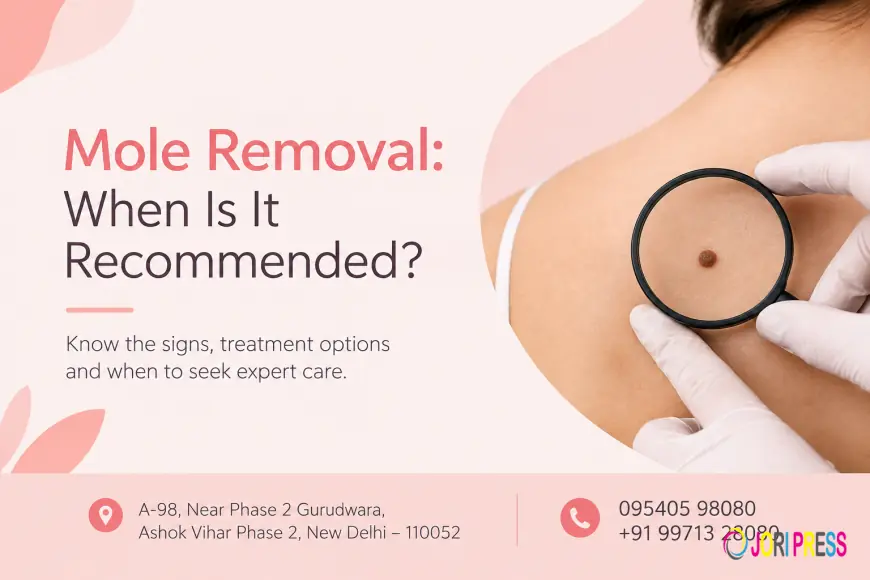
Moles are common skin growths that can appear anywhere on the body. Most moles are harmless and do not require treatment. However, some may change in appearance, become irritated, or cause cosmetic concerns. In such situations, consulting a qualified dermatologist can help determine whether mole removal is appropriate.
What Is a Mole?
A mole, medically known as a nevus, is a cluster of pigment-producing cells that creates a darker spot or raised growth on the skin. Moles can vary in size, shape, texture, and color. Some are present from birth, while others develop during childhood or adulthood.
Although most moles are benign, it is important to monitor them for noticeable changes.
When Is Mole Removal Recommended?
A dermatologist may recommend removal for several reasons.
1. Suspicious Changes
A mole that changes in size, shape, color, or texture should be evaluated by a dermatologist. Other warning signs can include bleeding, persistent itching, crusting, or an unusual appearance.
The ABCDE approach can help identify changes that deserve professional evaluation:
- A – Asymmetry: One half looks different from the other.
- B – Border: The edges are irregular, uneven, or poorly defined.
- C – Color: The mole has multiple or unusual colors.
- D – Diameter: The mole is increasing in size, particularly beyond about 6 mm.
- E – Evolving: The mole changes over time.
These signs do not automatically mean that a mole is cancerous, but they are reasons to seek medical assessment.
2. Repeated Irritation
Moles located on areas that experience frequent friction, such as the neck, waistline, or areas exposed to shaving, may repeatedly become irritated. A dermatologist can assess whether removal would be beneficial.
3. Cosmetic Concerns
Some people choose to have benign moles removed because they are prominent or affect their appearance. In these situations, a dermatologist can discuss suitable treatment options based on the mole's size, location, depth, and characteristics.
How Is Mole Removal Performed?
The appropriate technique depends on the type and characteristics of the mole. Common approaches may include surgical excision or shave removal. The dermatologist first examines the lesion and determines the safest method.
If there is any concern that the mole could be abnormal, the removed tissue may be sent for laboratory examination. This helps determine its nature and ensures that important changes are not overlooked.
Is Mole Removal Safe?
Mole removal is generally considered a routine dermatological procedure when performed by a qualified medical professional. However, as with any procedure, there can be risks such as infection, bleeding, scarring, pigmentation changes, or recurrence depending on the technique and individual factors.
A professional assessment is therefore important before deciding on treatment.
Why Professional Evaluation Matters
It is not advisable to remove a mole at home using creams, cutting tools, or other unverified methods. Attempting self-removal can cause infection, scarring, bleeding, and may delay the diagnosis of a potentially concerning skin lesion.
A dermatologist can examine the mole, identify warning signs, discuss available options, and recommend an appropriate treatment plan.
Finding Mole Removal Treatment in Delhi
People looking for Mole Removal Treatment in Delhi should consider a clinic where the procedure begins with a proper dermatological evaluation rather than treating every mole in the same way.
The right treatment depends on factors such as the mole's appearance, size, location, depth, and whether there are any suspicious changes. A personalized assessment can help determine whether removal is medically necessary or primarily cosmetic.
For professional Mole Removal Treatment, consult a qualified dermatologist who can examine the lesion and recommend an appropriate approach based on your individual needs.
Final Thoughts
Most moles are harmless, but changes in an existing mole should never be ignored. Whether the concern is a changing mole, repeated irritation, or appearance, professional evaluation is the safest first step.
If you notice a mole that is changing, bleeding, itching persistently, or developing an unusual appearance, schedule a dermatology consultation rather than attempting to remove it yourself.
What's Your Reaction?
 Like
0
Like
0
 Dislike
0
Dislike
0
 Love
0
Love
0
 Funny
0
Funny
0
 Angry
0
Angry
0
 Sad
0
Sad
0
 Wow
0
Wow
0