



































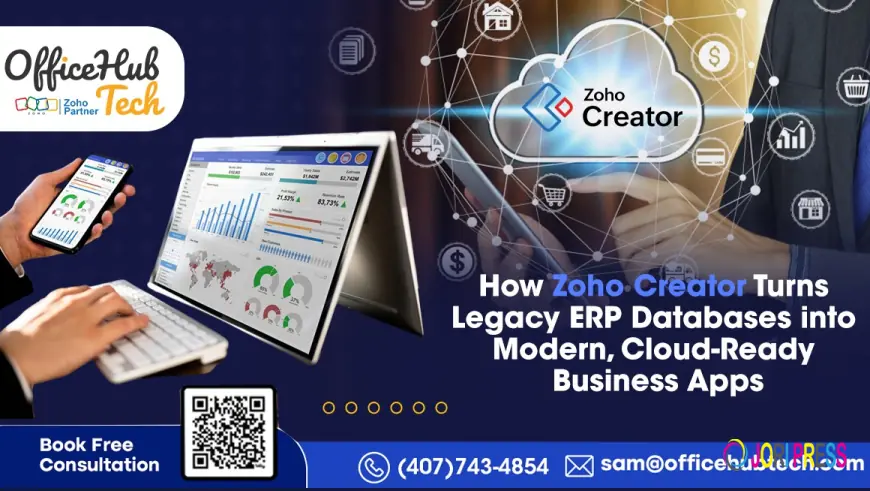
How Zoho Creator Turns Legacy ERP Databases into Modern, Cloud-Ready Business Apps
Discover how Zoho Creator enables legacy ERP database transformation, helping businesses modernize ERP systems with cloud apps, automation, and AI.

Why Legacy ERP Databases Are Slowing Down Modern Businesses
Enterprise Resource Planning (ERP) systems have traditionally been the core of business operations. For many years, solutions like SAP, Infor, and Acumatica have supported critical functions such as finance, supply chain management, procurement, inventory control, and overall operational processes in organizations worldwide.
However, the underlying design of many legacy ERP systems belongs to an earlier technological era. These platforms were created for centralized setups where factors like scalability, real-time integration, and automation were not considered essential.
In contrast, today’s business environment demands agility. Organizations need to react quickly to market changes, connect multiple digital tools seamlessly, and use artificial intelligence to gain predictive insights. Unfortunately, older ERP databases often lack the adaptability required to meet these modern demands.
Because of this limitation, many businesses are now looking for ways to upgrade their existing systems without going through the expensive and complex process of completely replacing their ERP. This is where Zoho Creator for Legacy ERP offers a practical solution for modernizing legacy ERP databases.
By leveraging low-code development, API integration, and cloud-based architecture, Zoho Creator helps organizations transform legacy ERP systems into cloud-enabled applications, enhance their functionality, and develop smarter business solutions on top of their existing ERP framework.
The Current State of Legacy ERP Systems in Modern Enterprises
Why Businesses Continue Using ERP Platforms like SAP, Infor, and Acumatica
Even with their drawbacks, legacy ERP systems continue to play a vital role in many organizations. Businesses depend on these platforms to manage essential operations, including:
financial accounting
inventory management
supply chain operations
order processing
production planning
Over time, companies have invested heavily in customizing these systems to meet their specific needs. Replacing them entirely would involve substantial costs, extended timelines, and considerable operational risks, making a complete transition challenging.
Strong Operational Reliance on Legacy ERP Databases
Across most enterprises, departments are closely tied to ERP databases for their daily activities. These systems store large volumes of structured business data collected over many years.
However, efficiently accessing and utilizing this data can be difficult due to outdated user interfaces and limited integration capabilities.
As a result, many organizations rely on workarounds, such as exporting data into spreadsheets or third-party tools, simply to carry out basic analysis or automation. This approach not only reduces efficiency but also increases the risk of data inconsistencies.
Key Challenges of Legacy ERP Databases
Data Silos and Inflexible Structure
Legacy ERP systems are often built on rigid frameworks that limit adaptability. Their data resides in highly structured databases that are not easy to modify or expand.
As a result, different departments frequently develop separate tools or systems to handle processes that the ERP cannot support. Over time, this creates disconnected data environments, where information is spread across multiple platforms instead of being unified.
Restricted Integration Capabilities
Today’s organizations depend on a wide range of digital solutions, including CRM platforms, analytics software, automation tools, and cloud-based applications.
However, many older ERP systems were not designed to integrate smoothly with such technologies. Linking them to modern applications often involves custom coding and the use of complex middleware.
This lack of seamless integration slows down digital transformation efforts and adds to operational challenges.
Slow Innovation and High Customization Costs
A major limitation of traditional ERP systems is the time and expense involved in making changes.
Adjusting workflows or adding new features usually requires skilled development teams and lengthy testing processes. Even minor updates can consume considerable resources, making it difficult for businesses to innovate quickly.
Organizations that depend entirely on legacy ERP platforms often find it hard to respond swiftly to changing market conditions.
The Move Toward Cloud-Ready Business Applications
Digital Transformation and Flexible Infrastructure
Today’s organizations need systems that can quickly adapt to changing business requirements. Cloud-based platforms allow companies to launch applications faster, scale their operations with ease, and support distributed teams working across different locations.
Additionally, cloud-ready solutions promote real-time collaboration and provide instant access to business data from virtually any device.
Demand for Intelligent Enterprise Systems
Beyond just scalability, modern businesses are looking for smarter systems that can interpret data, streamline processes, and deliver predictive insights.
To meet these expectations, organizations must move past traditional, static ERP databases and embrace platforms that support artificial intelligence, advanced analytics, and automation capabilities.
Zoho Creator: A Strategic Approach to ERP Modernization
Exploring Zoho Creator for Legacy ERP Systems
Zoho Creator is a robust low-code development platform that enables businesses to quickly create customized applications tailored to their needs.
Instead of replacing existing ERP systems, it allows organizations to enhance and modernize them. By directly connecting to ERP databases, businesses can convert traditional data structures into intuitive, modern applications that are easier to use.
This method supports ERP modernization while maintaining the stability of existing operational systems.
How Low-Code ERP Modernization is Reshaping Enterprise IT
Low-code platforms speed up application development by minimizing the need for complex programming.
With visual development tools, organizations can design and deploy advanced business applications with relatively little coding effort.
Through low-code ERP modernization, businesses can:
- transform legacy ERP systems into cloud-based applications
- automate key business processes
- build mobile-friendly enterprise solutions
- develop real-time dashboards and analytics capabilities
Ultimately, this approach creates a modern digital environment while continuing to leverage the value of existing ERP databases.
How Zoho Creator Integrates with Legacy ERP Systems
Connecting with SAP, Infor, Acumatica, and Other Platforms
A key strength of Zoho Creator lies in its ability to seamlessly integrate with existing ERP systems.
Businesses can connect Zoho Creator with leading enterprise platforms such as SAP, Infor, Acumatica, Oracle ERP, and Microsoft Dynamics.
By using secure APIs and pre-built connectors, Zoho Creator retrieves and utilizes ERP data to build modern applications—without interfering with core business operations.
API Orchestration for Smooth Data Flow
API orchestration allows different systems to interact and exchange data efficiently. Zoho Creator supports advanced API capabilities that help synchronize ERP data with other business applications.
This ensures data consistency across all platforms while allowing organizations to expand ERP functionality through modern digital tools and solutions.
Transforming Legacy ERP Databases with Zoho Creator
Turning Legacy Databases into Cloud-Enabled Applications
Legacy ERP databases hold vast amounts of valuable business data, but accessing this information often requires technical knowledge and navigating complex interfaces.
With ERP database transformation, Zoho Creator converts these rigid data structures into dynamic, user-friendly applications.
This allows employees to interact with business data through mobile apps, real-time dashboards, and automated workflows, making information more accessible and actionable.
Creating Modern Enterprise Applications from Existing ERP Data
Businesses can build tailored applications that extend ERP capabilities across various functions, including:
- supply chain monitoring
- inventory tracking
- project management
- customer support operations
- procurement processes
These applications pull data directly from ERP systems, maintaining data accuracy while delivering a more modern and intuitive user experience.
Enhancing Legacy ERP Systems with Zoho Creator
Completely replacing an ERP system can be both costly and high-risk. For this reason, many organizations choose to extend their existing ERP capabilities using Zoho Creator.
This strategy allows businesses to build new applications that work alongside their current ERP systems, improving functionality without modifying the core infrastructure.
When integrated with the wider Zoho ecosystem, companies can establish a connected digital environment that streamlines operations across various departments.
For instance:
- Zoho CRM links sales and customer data with ERP systems
- Zoho Analytics provides deeper business insights through advanced analytics
- Zoho Books improves financial management processes
- Zoho Flow simplifies integrations between multiple enterprise applications
Together, these tools form a unified and efficient enterprise platform.
AI-Driven ERP Extensions and Smart Automation
Artificial intelligence is becoming an essential element of modern enterprise solutions.
Zoho Creator allows businesses to incorporate AI-powered automation into their ERP modernization efforts.
AI-driven tools can handle tasks such as:
- forecasting demand
- identifying anomalies in financial data
- routing workflows intelligently
- predicting inventory requirements
These capabilities elevate ERP systems from simple data storage tools to intelligent, decision-support platforms.
Workflow Automation Using APIs and n8n
Modern enterprises often rely on numerous digital tools operating simultaneously. Managing these systems effectively requires advanced workflow coordination.
With n8n-based automation, organizations can design workflows that seamlessly connect ERP systems with other applications.
Automated processes can handle activities like:
- syncing order data between ERP and CRM platforms
- updating inventory across multiple sales channels
- generating reports automatically
- triggering alerts for key operational events
When combined with Zoho Creator applications, these automated workflows help build highly efficient, connected, and intelligent business ecosystems.
Enterprise Applications: Transforming Legacy ERP into Cloud-Based Solutions
Manufacturing and Distribution
Manufacturing organizations depend extensively on ERP systems to manage production schedules and oversee supply chain activities.
By leveraging Zoho Creator for manufacturing and distribution, businesses can develop applications that offer real-time insights into inventory, track production progress, and streamline logistics operations.
Finance, Procurement, and Operations
Finance teams often need more advanced reporting and insights than what traditional ERP systems can provide.
Zoho Creator allows organizations to design custom applications that automate financial reporting, optimize procurement processes, and improve overall operational visibility.
Advantages of Modernizing ERP with Zoho Creator
Businesses that implement Zoho Creator for ERP modernization benefit in several ways.
To begin with, low-code development significantly reduces the time required to build and deploy applications.
Additionally, cloud-based solutions enhance accessibility and enable better collaboration among teams working across different locations.
Organizations also gain the flexibility to incorporate advanced technologies such as artificial intelligence, automation, and data analytics.
Most importantly, this approach empowers businesses to innovate continuously without being limited by outdated ERP systems.
Conclusion
To stay competitive, modern enterprises must move beyond the constraints of traditional ERP architectures. By transforming legacy ERP databases with Zoho Creator, organizations can turn static systems into dynamic, cloud-enabled applications that support automation, analytics, and smarter decision-making.
Through low-code development, API integration, AI-driven workflows, and seamless connectivity, Zoho Creator helps businesses modernize their ERP environments without disrupting existing processes.
Companies looking for expert support in ERP transformation can partner with OfficeHub Tech, a leading provider of ERP legacy modernization and extension services across the USA, India, UAE, and KSA. With deep expertise in enterprise system transformation, OfficeHub Tech is also recognized as a Top Certified Zoho Creator Developer and Zoho Consultation Company, helping organizations enhance and extend their ERP systems with scalable and future-ready solutions.
As a trusted Zoho and n8n partner, OfficeHub Tech delivers advanced integration, automation, and modernization services, enabling businesses to fully unlock the value of their legacy ERP investments.
What's Your Reaction?
 Like
0
Like
0
 Dislike
0
Dislike
0
 Love
0
Love
0
 Funny
0
Funny
0
 Angry
0
Angry
0
 Sad
0
Sad
0
 Wow
0
Wow
0