































How to Build a Car Marketplace Website: Features, Costs, and What Most Builders Get Wrong
This article is a practical guide for entrepreneurs who want to build a car classified marketplace website, covering everything from must-have launch features and realistic cost comparisons between custom builds and ready-made scripts, to common mistakes that sink projects early and the technology decisions that affect long-term scalability — closing with a soft mention of Originate Soft as a development partner for those looking to build faster and smarter.
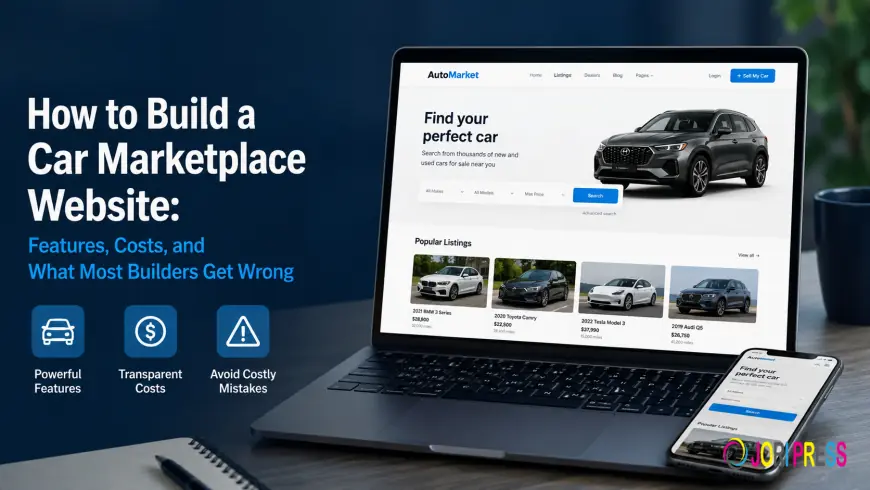
The online car buying and selling market has exploded across South and Southeast Asia. In India alone, used car transactions worth billions of rupees now happen through digital platforms every single month. Cities like Pune, Hyderabad, and Ahmedabad have seen double-digit growth in online auto listings year on year.
Yet the majority of entrepreneurs who want to build a car marketplace website start the process completely backwards. They focus on the front-end design before locking down their listing architecture. They budget for marketing before they have a working platform. And they try to code everything from scratch when proven scripts already exist.
This guide covers what a car marketplace website actually needs to function, what it typically costs to get one off the ground, and the specific mistakes that waste time and money at every stage.
What a Car Marketplace Website Actually Is (and What It Is Not)
A car marketplace is not a dealership website. It is not a single-vendor product catalogue. It is a platform where multiple sellers, whether individuals, used car dealers, or certified pre-owned operators, can list vehicles independently and where buyers can browse, filter, compare, and contact those sellers.
That distinction matters enormously when you start building. A dealership site is fundamentally a brochure. A marketplace is an ecosystem with two user types, each with different needs, different dashboards, and different trust requirements.
Confusing the two is the single most common reason early-stage car portal projects fail to scale. Founders build a site that works for their own inventory but cannot accommodate external sellers without a complete rebuild.
The Core Features You Cannot Launch Without
Before anything else, the following features must be functional on day one:
• Multi-seller registration and independent seller dashboards
• Vehicle listing creation with structured fields: make, model, year, fuel type, transmission, mileage, condition, and price
• Image upload with support for multiple photos per listing (minimum 8 to 10 per vehicle is the industry norm)
• Advanced search and filter by location, price range, vehicle type, year, fuel type, and body style
• Buyer-seller messaging system or WhatsApp redirect integration
• Listing expiry and renewal management
• Basic SEO URL structure for each listing page
• Mobile-responsive design, given that over 70 percent of Indian car marketplace traffic now comes from smartphones
These are not optional features to add later. They are the minimum viable product. A car marketplace launched without even one of these will struggle to retain either sellers or buyers.
Features That Drive Revenue After Launch
Once you have a functional platform, the next conversation is about monetisation. Car marketplaces in the Indian market typically monetise through a combination of the following mechanisms:
Featured and Sponsored Listings
Sellers pay to have their vehicles pinned to the top of search results or featured on the homepage. This is the most straightforward revenue stream and the quickest to implement. Pricing in Indian car portals for featured placement ranges broadly, and you have flexibility to set your own tiers based on listing duration and visibility level.
Subscription Plans for Dealers
Individual private sellers typically list for free or with a small per-listing fee. Used car dealers, who list in volume, are better served by monthly or quarterly subscription plans that bundle a set number of listings, featured slots, and analytics access. This recurring model is significantly more predictable than transactional listing fees.
Value-Added Services
Verified listing badges, vehicle inspection integration, RC transfer assistance, insurance lead generation, and EMI calculator partnerships are all monetisable add-ons that also increase trust for buyers. The platforms that have scaled successfully in this space, including CarDekho and Cars24, built their revenue not just on listings but on the surrounding services.
What Does It Actually Cost to Build a Car Marketplace?
This is where most planning conversations break down. The true cost of building a car marketplace website depends entirely on how you approach the build.
Building from scratch using a development agency or in-house team is the most expensive route. A reasonably functional car marketplace built custom typically requires several months of development time. Depending on the team and scope, costs can run from a few lakhs to well above twenty lakhs for the initial version, with ongoing maintenance on top of that.
Using a ready-made car classified script dramatically changes this equation. A pre-built classified marketplace script designed specifically for automotive listings gives you the core architecture out of the box: seller registration, listing management, search filters, buyer messaging, and admin controls. Your development team then customises the design, adds local payment integration, configures geolocation, and launches.
The realistic budget for a script-based car marketplace, including customisation, hosting setup, and basic SEO configuration, typically falls somewhere between two and eight lakhs for the initial build, depending on how much customisation you require. That is a significant cost reduction compared to a ground-up build, with a much shorter launch timeline.
The Mistakes That Kill Car Marketplace Projects Before They Launch
1. Over-building the Admin Panel Before the User Experience
A significant chunk of early development time often goes into the admin panel, approval workflows, and backend analytics. These matter, but buyers and sellers never see them. Over-investing in backend complexity at the expense of the listing creation flow and search experience is one of the most common build prioritisation errors.
2. Ignoring the Seller Onboarding Experience
A car marketplace is only as useful as its inventory. If the listing creation process is long, confusing, or requires too many mandatory fields upfront, sellers abandon it halfway through. The best car platforms allow sellers to publish a basic listing in under five minutes, with optional fields available for richer detail. Every friction point in seller onboarding directly reduces the volume of active listings.
3. Launching Without a Mobile-First Design
Designing the desktop version first and then adapting for mobile is a development pattern that consistently produces poor mobile experiences. In a market where the majority of car searches happen on Android phones with mid-range performance, a desktop-first design leads to slow load times, cramped layouts, and poor image display on mobile. Mobile-first is not a preference; it is a requirement.
4. Underestimating the Importance of Trust Signals
Buyers purchasing cars online face real uncertainty. They cannot physically inspect the vehicle. The platforms that convert best address this directly, with verified seller badges, listing completeness scores, buyer review systems, and inspection partnership integrations. Launching without any trust infrastructure is acceptable for a beta, but it needs to be planned and prioritised for the second sprint.
Choosing the Right Technology Foundation
Whether you are building from a script or from scratch, your technology choices at the foundation level will affect performance, scalability, and maintenance cost for years. A few things to keep in mind:
• Server-side rendering or static generation is important for SEO. Car listing pages need to be indexed by Google. If your listings are loaded entirely client-side via JavaScript, search engines may not index them properly.
• Database schema design for vehicle listings is non-trivial. Vehicles have a large and variable number of attributes. A poorly designed schema makes advanced filtering slow and difficult to extend.
• Image handling and CDN configuration matter significantly for page speed. A listing with ten car photos needs to serve those images fast across different network conditions.
• Geolocation and city-based listing filtering should be built into the architecture from the start, not retrofitted later.
These considerations apply whether you are customising a script or directing a development team for a custom build. The answers to these questions should be settled before a single line of production code is written.
How Long Does It Take to Launch?
Realistic timelines vary significantly based on build approach:
• Script-based build with moderate customisation: four to eight weeks from project kickoff to live platform
• Custom build with a focused development team: three to six months for a functional MVP
• Custom build with a larger scope including mobile apps, inspection integrations, and payment gateway: six to twelve months
The fastest path to a working platform is almost always a well-supported script foundation with targeted customisation. The business advantage of launching in six weeks versus six months in a competitive market is not trivial.
What Comes After Launch
Launching the platform is the beginning, not the finish line. The post-launch phase involves populating initial inventory by manually onboarding the first 50 to 100 sellers, configuring Google Search Console and setting up structured data markup for vehicle listings, building city-specific landing pages to capture localised search traffic, and running outreach to used car dealers in your target cities.
The car marketplace platforms that scale successfully treat the first three months post-launch as a separate project from the build itself. The technical work and the growth work require different skills, different focus, and different timelines.
Final Thoughts
Building a car marketplace website is not a simple project, but it is a very achievable one if you plan the right way. Start with a clear understanding of the two-sided nature of the platform. Design for mobile buyers and mobile sellers from day one. Budget realistically based on your chosen build approach. And prioritise the seller onboarding experience above almost everything else in the first release.
For entrepreneurs who want to reduce build time and cost without compromising on functionality, working with an experienced development partner who specialises in marketplace platforms is one of the most practical decisions you can make at the start. Originate Soft is one such team, building custom and script-based digital marketplace solutions for clients across India and internationally.
What's Your Reaction?
 Like
0
Like
0
 Dislike
0
Dislike
0
 Love
0
Love
0
 Funny
0
Funny
0
 Angry
0
Angry
0
 Sad
0
Sad
0
 Wow
0
Wow
0