









































How React Native Is Evolving for Enterprise Mobile App Development
Explore how React Native is evolving for enterprise mobile app development, including performance, security, AI integration, scalability, and cross-platform benefits for modern businesses.
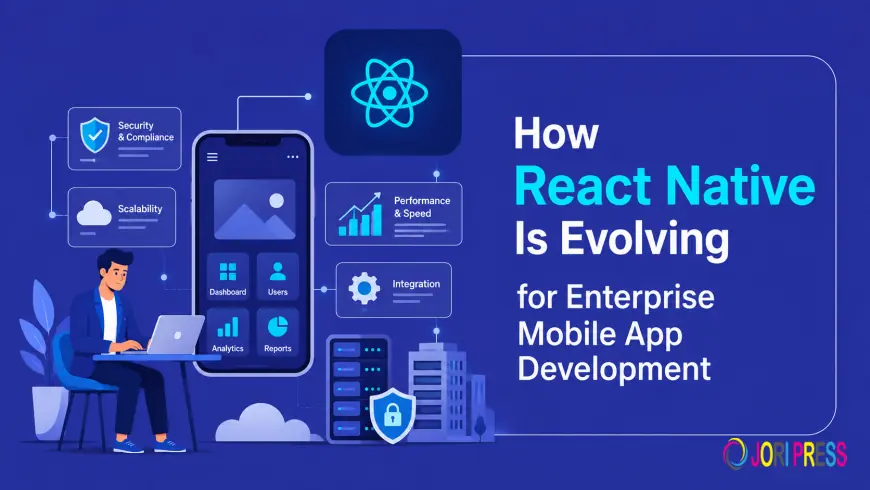
Enterprise mobile applications are no longer limited to simple internal tools or basic customer-facing applications. Businesses today expect mobile apps to support complex workflows, integrate with multiple systems, protect sensitive information, and deliver a smooth experience across different devices. As these expectations continue to grow, React Native is evolving to meet the needs of modern enterprise mobile app development.
Originally popular for helping businesses create cross-platform applications from a shared codebase, React Native has become much more capable of supporting large-scale digital products. Its development ecosystem, performance capabilities, integration options, and growing enterprise adoption make it an important technology for companies planning long-term mobile strategies.
Why Enterprises Are Looking at React Native
Enterprise development comes with challenges that are different from those faced by startups or small application projects. Large organizations may need to connect their mobile applications with CRM platforms, ERP systems, payment gateways, cloud services, analytics tools, authentication systems, and internal databases.
Building separate applications for iOS and Android can increase development time, maintenance requirements, and overall costs. React Native addresses part of this challenge by allowing organizations to share a significant portion of their application code across platforms.
This approach can help development teams maintain consistency while reducing duplicated development work. More importantly, businesses can establish a common development process while still delivering applications designed for different mobile platforms.
Better Performance Is Changing Enterprise Expectations
Performance has always been an important consideration when selecting a mobile development framework. Enterprise users expect applications to load quickly, respond smoothly, and remain reliable even when they handle complex operations.
Modern React Native development has continued to improve performance through advancements in its architecture and development ecosystem. Features such as the new architecture, improved rendering capabilities, and better communication between JavaScript and native components give developers more flexibility when building sophisticated applications.
For enterprise projects, performance optimization should not be treated as an afterthought. Developers need to consider application architecture, API performance, memory management, asset optimization, caching, and network conditions from the beginning.
React Native can provide the foundation, but experienced engineering practices remain essential for delivering a reliable enterprise application.
React Native and Enterprise-Level Integrations
Modern businesses rarely operate with isolated software systems. A mobile application may need to communicate with dozens of external services and internal platforms.
React Native can be integrated with native device capabilities, third-party APIs, cloud platforms, authentication services, analytics systems, and business applications. Developers can also use native modules when a project requires platform-specific functionality.
This flexibility makes React Native useful for enterprise applications involving features such as biometric authentication, location services, document management, push notifications, real-time communication, payments, and advanced reporting.
The key is designing the application architecture around the organization's existing technology ecosystem rather than treating the mobile application as a standalone product.
Security Is Becoming a Bigger Priority
Enterprise applications often deal with confidential business information and personal customer data. Security therefore needs to be considered throughout the development lifecycle.
React Native applications can be designed with enterprise security practices such as secure authentication, encrypted communication, protected local storage, role-based access control, secure API integration, and appropriate session management.
However, the framework alone does not make an application secure. Security depends on the entire technology stack, including backend infrastructure, APIs, databases, cloud environments, authentication systems, and development practices.
Organizations should conduct security assessments, dependency reviews, penetration testing, and regular updates to reduce potential risks.
The Role of AI in React Native Enterprise Applications
Artificial intelligence is another area influencing the evolution of enterprise mobile applications. Businesses are increasingly looking for ways to bring AI-powered capabilities directly into their employee and customer experiences.
React Native can serve as the mobile interface for applications that connect with AI and machine learning services. For example, enterprises can create mobile applications with intelligent search, automated recommendations, document analysis, conversational assistants, predictive insights, and personalized experiences.
AI can also improve internal operations. Employees could use mobile assistants to retrieve information, summarize documents, analyze business data, or automate repetitive tasks.
The important consideration is that AI should solve a meaningful business problem rather than simply being added because it is trending.
Enterprise Development Is Becoming More Modular
Large mobile applications can become difficult to maintain when all functionality is tightly connected. Modern enterprise development is moving toward modular architectures that allow teams to develop, test, and maintain different parts of an application more independently.
React Native can support modular development approaches that make it easier for large teams to organize application functionality. Businesses can structure features into reusable components and establish shared design systems to maintain consistency across products.
This can become particularly valuable for organizations managing multiple applications or product teams.
A well-planned architecture also makes it easier to introduce new features without unnecessarily affecting existing functionality.
React Native Supports Faster Product Iteration
Enterprise applications are increasingly expected to evolve continuously. Customer expectations change, competitors introduce new features, and organizations discover new operational requirements.
React Native's cross-platform development model can help teams release updates efficiently. Shared code can reduce duplicated implementation efforts, while reusable components can speed up the development of new functionality.
For businesses using agile development practices, this can support shorter development cycles and faster feedback.
Organizations looking for react native mobile app development services should therefore evaluate more than technical knowledge. They should look for a development partner that understands product strategy, enterprise architecture, security, testing, deployment, and long-term maintenance.
Hiring the Right Development Team
Technology alone cannot determine whether an enterprise mobile application succeeds. The expertise of the development team is equally important.
When organizations hire dedicated react native developer resources, they should evaluate experience with enterprise integrations, application architecture, testing, performance optimization, security, CI/CD pipelines, and app store deployment.
A strong development team should also understand how to communicate with product managers, designers, backend engineers, QA teams, and business stakeholders.
This collaborative approach helps ensure that technical decisions support actual business requirements instead of creating unnecessary complexity.
React Native for Canadian Businesses
Canadian organizations across industries are investing in digital products that can improve customer experiences and operational efficiency. Businesses in technology, healthcare, retail, logistics, finance, education, and professional services can use cross-platform development to create mobile experiences without maintaining completely separate development strategies.
For organizations exploring mobile app development calgary, React Native can be considered when the project requires applications for both major mobile platforms while maintaining a shared development approach.
Similarly, companies evaluating a mobile app development company edmonton may consider React Native when scalability, faster development, and cross-platform consistency are important project requirements.
Businesses searching for a mobile app development company in edmonton should also evaluate factors such as technical expertise, communication processes, portfolio quality, security practices, post-launch support, and experience with enterprise applications.
What the Future Looks Like for Enterprise React Native
React Native's evolution is moving beyond simply helping developers reuse code between platforms. The technology is becoming part of broader enterprise strategies involving cloud services, AI, automation, real-time systems, advanced security, and scalable application architectures.
For enterprises, the biggest advantage is not necessarily the framework itself. It is the ability to create a development strategy that balances speed, quality, scalability, maintainability, and user experience.
Businesses should still assess each project individually before selecting a technology. Applications with highly specialized platform requirements may require substantial native development, while many business applications can benefit significantly from a cross-platform approach.
Final Thoughts
React Native is evolving alongside the changing requirements of enterprise mobile development. Better architecture, improved performance, stronger integration capabilities, reusable components, AI opportunities, and modern development practices are making it increasingly relevant for large-scale applications.
For businesses, the goal should not simply be to adopt React Native because it is popular. The better approach is to determine whether its capabilities align with the organization's product goals, technical environment, budget, security requirements, and long-term growth plans.
When combined with experienced developers and a well-designed architecture, React Native can provide enterprises with a practical foundation for building and continuously improving modern mobile applications.
What's Your Reaction?
 Like
0
Like
0
 Dislike
0
Dislike
0
 Love
0
Love
0
 Funny
0
Funny
0
 Angry
0
Angry
0
 Sad
0
Sad
0
 Wow
0
Wow
0