






























How Proposal Automation Improves Win Rates Today
Discover how proposal automation improves win rates by enhancing speed, consistency, and collaboration in RFP responses. Learn how modern teams scale smarter and win more competitive bids.

How Proposal Automation Improves Win Rates Today
In today’s competitive bidding environment, winning proposals requires more than just effort it demands precision, speed, and strategic alignment. Organizations responding to RFPs (Request for Proposals) are under constant pressure to deliver high-quality submissions within tight deadlines while maintaining compliance and relevance. Yet, many teams still rely on manual processes that slow them down and introduce inconsistencies.
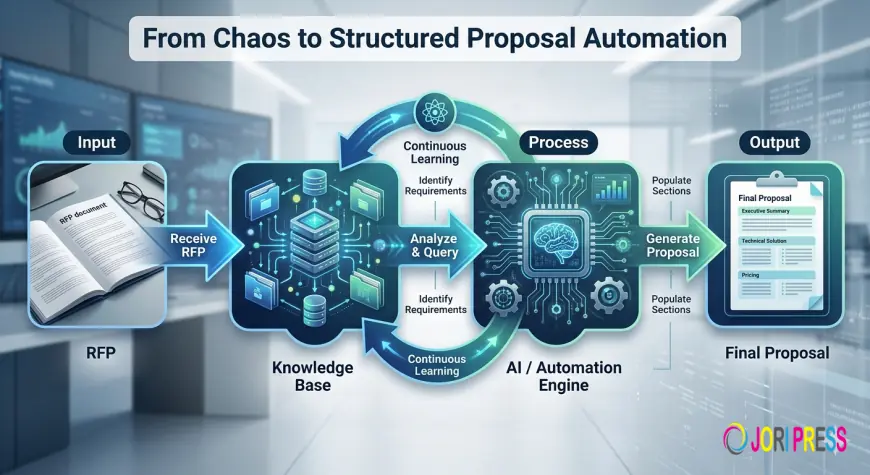
Proposal automation has emerged as a practical solution to these challenges. By streamlining workflows, centralizing knowledge, and reducing repetitive tasks, it enables organizations to produce better proposals faster. More importantly, it directly contributes to improving win rates by enhancing both the quality and consistency of submissions.
Platforms and Software such as Rohirrim help organizations move beyond fragmented workflows by bringing knowledge management and intelligent response generation into a single, structured system. This unified approach allows teams to scale proposal production without compromising quality or consistency. As a result, it is fundamentally reshaping how proposals are created, managed, and evaluated in high-stakes environments.
The Real Problem: Why Win Rates Stay Low
Many organizations struggle with low or inconsistent win rates, not because of a lack of expertise, but due to inefficiencies in their proposal processes. Proposal teams often work under pressure, pulling content from multiple sources, coordinating with different stakeholders, and racing against deadlines.
This fragmented approach leads to several recurring issues:
-
Outdated or inconsistent content across proposals
-
Limited time for strategic customization
-
High dependency on individual contributors
-
Increased chances of compliance errors
When these issues compound, the final submission lacks clarity and impact—two factors that evaluators heavily rely on when comparing bids.
How Automation Improves Speed Without Compromising Quality
Speed is a critical factor in proposal success, but rushing often leads to mistakes. Proposal automation addresses this by removing time-consuming manual steps while maintaining content quality.
Instead of starting from scratch, teams can access a centralized repository of pre-approved responses. This allows them to quickly assemble drafts and focus their efforts on refining messaging rather than rebuilding it.
Time Efficiency Comparison
|
Task |
Manual Process |
Automated Process |
|
Searching for content |
2–3 hours |
10–15 minutes |
|
Drafting responses |
5–6 hours |
1–2 hours |
|
Formatting and review |
1–2 hours |
30 minutes |
|
Total per proposal |
8–11 hours |
2–4 hours |
This reduction in time allows teams to either respond to more opportunities or invest additional effort into improving proposal quality both of which positively impact win rates.
Consistency Builds Trust and Credibility
Why Consistency Matters in Evaluation
Proposal evaluators are not just assessing technical capabilities; they are also judging reliability and professionalism. Inconsistent messaging, conflicting data, or uneven tone can raise doubts even if the organization is fully capable.
Automation introduces consistency by ensuring that all responses are derived from a single, validated source of truth. This eliminates variation caused by different contributors and maintains a unified voice across the document. A well-structured and consistent proposal signals maturity and preparedness, which can significantly influence scoring decisions in competitive bids.
Personalization at Scale: A Key Differentiator
One of the biggest misconceptions about automation is that it leads to generic responses. In reality, modern proposal automation enhances personalization by making it more efficient.
How Automation Supports Personalization
Instead of rewriting content manually, teams can:
-
Adapt pre-approved responses based on RFP requirements
-
Align messaging with client-specific priorities
-
Maintain a consistent tone while tailoring details
This approach ensures that proposals remain both relevant and efficient to produce. Evaluators are more likely to engage with submissions that clearly address their specific needs rather than generic, one-size-fits-all responses.
Reducing Errors and Strengthening Compliance
In sectors like government contracting and enterprise procurement, compliance is a non-negotiable requirement. Even minor errors such as outdated certifications or incorrect formatting can lead to disqualification. Proposal automation minimizes these risks by standardizing content and processes. Instead of relying on manual checks, teams can work with validated templates and up-to-date information.
“Companies using structured proposal automation report up to a 30% reduction in compliance-related errors.”
This level of accuracy not only improves submission quality but also builds confidence among stakeholders reviewing the proposal.
Better Collaboration, Faster Execution
The Role of Team Coordination
Proposal creation is rarely a solo effort. It involves inputs from subject matter experts, sales teams, legal reviewers, and leadership. Without a clear system, collaboration can become chaotic and slow.
Automation platforms provide a shared environment where:
-
Teams can work simultaneously without version conflicts
-
Progress can be tracked in real time
-
Responsibilities are clearly defined
This structured collaboration reduces delays and ensures that proposals move smoothly from draft to submission.
Scaling Proposal Output Without Scaling Costs
As organizations grow, so does the number of opportunities they need to respond to. However, increasing proposal volume traditionally requires hiring more staff an expensive and time-consuming solution.
Automation changes this equation. By reducing the effort required per proposal, teams can handle more submissions with the same resources.
Impact on Opportunity Volume
|
Scenario |
Without Automation |
With Automation |
|
Proposals per month |
10–15 |
25–40 |
|
Team size |
Increasing |
Stable |
|
Average response time |
High |
Reduced |
|
Win rate potential |
Limited |
Increased |
Responding to more qualified opportunities naturally increases the chances of winning, provided the quality remains high which automation helps maintain.
From Reactive Workflows to Strategic Advantage
Perhaps the most significant shift enabled by proposal automation is the transition from reactive to proactive proposal management.
Instead of scrambling to meet deadlines, organizations can:
-
Build a structured knowledge base over time
-
Develop repeatable workflows
-
Analyze past performance to improve future outcomes
This strategic approach allows teams to focus on differentiation and value proposition rather than administrative tasks.
Conclusion
Proposal automation is no longer just a productivity tool it is a competitive advantage. By improving efficiency, ensuring consistency, enabling personalization, and reducing errors, it directly enhances the quality of proposals and increases the likelihood of success.
In a landscape where organizations compete for limited opportunities, even small improvements in process and execution can lead to significant gains in win rates. Automation provides the foundation for those improvements, allowing teams to work smarter, respond faster, and present stronger, more compelling proposals.
Ultimately, the organizations that embrace proposal automation are not just keeping up they are positioning themselves to win more consistently in an increasingly competitive market.
What's Your Reaction?
 Like
0
Like
0
 Dislike
0
Dislike
0
 Love
0
Love
0
 Funny
0
Funny
0
 Angry
0
Angry
0
 Sad
0
Sad
0
 Wow
0
Wow
0