







































The Truth About Google Ads in India — Why You Are Wasting Money And How to Stop
Running Google Ads in India but not getting results? Discover the most common Google Ads mistakes Indian businesses make and how to fix them to reduce wasted spend in 2026.
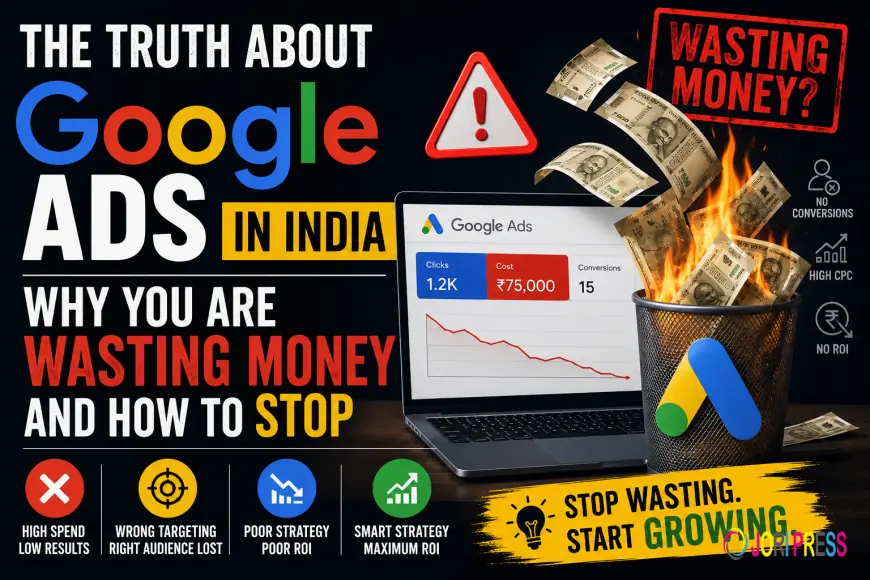
Running Google Ads without this knowledge is like burning cash in slow motion
Every month, thousands of Indian businesses launch Google Ads campaigns with genuine excitement. They set a budget, write a few headlines, pick some keywords, and wait for the leads to come in.
A few weeks later, the budget is gone. The leads are either too few, too expensive, or completely unqualified. The conclusion most businesses reach? Google Ads does not work in India.
But that conclusion is wrong. Google Ads works exceptionally well. The problem is almost always in how it is being run.
The Scale of the Problem
India is one of the fastest-growing markets for digital advertising in the world. Businesses across education, real estate, healthcare, ecommerce, and professional services are collectively spending crores of rupees on Google Ads every month.
A significant portion of that spend is wasted — not because Google Ads is ineffective, but because most campaigns are set up incorrectly, managed inconsistently, and measured against the wrong metrics.
Understanding where the waste happens is the first step to stopping it.
Mistake 1 — Targeting the Wrong Keywords
The single most expensive mistake in Google Ads is bidding on broad, high-volume keywords without understanding search intent.
When a business selling accounting software bids on the keyword "accounting," they are paying to appear in front of students researching the subject, people looking for accounting jobs, and individuals searching for free tools — none of whom are potential customers.
The most valuable keywords in any Google Ads campaign are specific, intent-driven, and commercial. A keyword like "accounting software for small business India" will get fewer clicks than "accounting" — but the people clicking it are actually looking to buy.
In 2026, smart keyword strategy means focusing on long-tail keywords, negative keyword lists, and search term reports that show exactly what queries are triggering your ads. This single change can reduce wasted spend by thirty to fifty percent in most campaigns.
Mistake 2 — Sending Traffic to the Wrong Page
Imagine running an ad for a specific service and sending everyone who clicks to your homepage. The visitor arrives, sees a generic overview of your entire business, gets confused about where to go next, and leaves.
This happens constantly in Indian Google Ads campaigns. Businesses spend money driving highly targeted traffic to pages that were never designed to convert that specific audience.
Every ad group should have a dedicated landing page that directly matches the ad's promise. If your ad says "Get a Free Digital Marketing Audit," the landing page should be entirely about that free audit — not about your agency's history, team size, or list of services.
Landing page relevance also directly affects your Quality Score in Google Ads, which determines both your ad position and the cost per click you pay. A higher Quality Score means better placement at lower cost.
Mistake 3 — Ignoring Negative Keywords
Negative keywords are the words and phrases for which you do not want your ad to appear. They are one of the most powerful tools in Google Ads and one of the most consistently ignored.
Without a strong negative keyword list, your ads will appear for irrelevant searches. A digital marketing agency bidding on "digital marketing" without negatives will appear for searches like "digital marketing internship," "digital marketing course free," and "digital marketing jobs freshers" — none of which represent potential clients.
Building a comprehensive negative keyword list before launch — and updating it weekly based on search term data — is one of the most cost-effective optimisations available in any Google Ads account.
Mistake 4 — Measuring the Wrong Metrics
Many businesses running Google Ads measure success by clicks and impressions. These numbers feel good to report but tell you almost nothing about whether your campaign is actually generating business value.
The metrics that matter are cost per lead, cost per qualified lead, lead-to-conversion rate, and ultimately return on ad spend. If you do not have conversion tracking set up properly — capturing form submissions, phone calls, and chat interactions — you are optimising your campaign in the dark.
In 2026, Google's own AI-powered campaign types like Performance Max require accurate conversion data to function effectively. Without clean conversion tracking, even Google's most advanced automation cannot do its job properly.
Mistake 5 — Setting and Forgetting
Google Ads is not a set-it-and-forget-it platform. Campaigns that are not actively managed deteriorate over time. Keyword performance changes, competitor bids shift, audience behaviour evolves, and ad fatigue sets in.
Effective Google Ads management means weekly review of search term reports, bid adjustments based on performance data, ad copy testing, landing page optimisation, and budget reallocation toward the highest-performing campaigns.
Businesses that treat Google Ads as a passive channel consistently underperform compared to those that treat it as an active, data-driven discipline.
What Good Google Ads Management Actually Looks Like
A well-managed Google Ads campaign in India in 2026 has several characteristics:
- Tightly structured ad groups with three to five closely related keywords each
- Separate campaigns for branded, non-branded, and competitor keywords
- Dedicated landing pages for each major service or product category
- Conversion tracking covering all lead sources — forms, calls, and chat
- A negative keyword list with at least fifty to one hundred terms at launch
- Weekly optimisation cycles reviewing search terms, bids, and ad performance
- Monthly reporting tied to business outcomes — leads, sales, and revenue — not just clicks
When these elements are in place, Google Ads becomes one of the most predictable and scalable customer acquisition channels available to Indian businesses.
The Bigger Picture
Google Ads works best when it is part of an integrated digital strategy. Paid search amplifies strong SEO, converts traffic that organic search attracts, and retargets visitors who did not convert the first time.
Businesses that use Google Ads in isolation — without complementary SEO, strong landing pages, and a lead nurturing process — will always find it more expensive than it needs to be.
The goal is not to spend more on ads. The goal is to build a system where every rupee spent on paid media is supported by organic authority, strong content, and a conversion-optimised website — so that when someone clicks your ad, the probability of them becoming a customer is as high as possible.
Fix the fundamentals. Then scale the spend.
The author works in digital marketing and growth strategy in Delhi NCR.
What's Your Reaction?
 Like
0
Like
0
 Dislike
0
Dislike
0
 Love
0
Love
0
 Funny
0
Funny
0
 Angry
0
Angry
0
 Sad
0
Sad
0
 Wow
0
Wow
0