











































Global Barley Market: Future Direction and Demand Potential
Explore the Global barley market, future demand, growth drivers, applications, sustainability trends, investment potential, and market outlook through 2032.

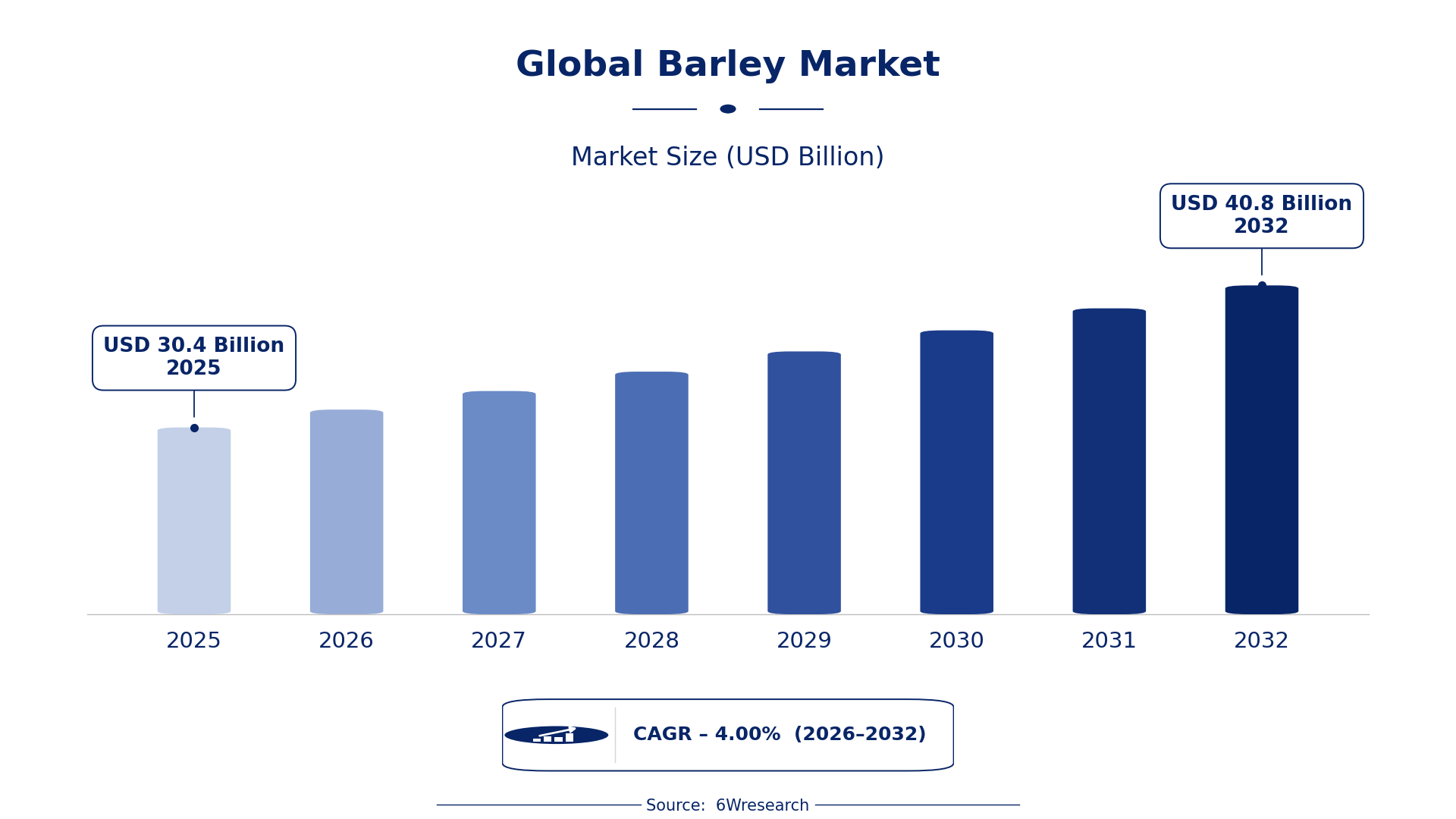
The Global barley market is entering a period of continued development as demand expands across animal feed, brewing, food and beverages, seed production, nutraceuticals, and pharmaceutical applications. The latest market assessment estimates the market at USD 30.4 billion in 2025 and projects it to reach USD 40.8 billion by 2032, representing a CAGR of 4.00% during 2026–2032. Europe remains the largest regional market, while Asia Pacific is identified as the fastest-growing region. These developments reflect the broadening role of barley within agriculture, food production, brewing, and health-oriented product categories.
Barley is no longer viewed only as a conventional feed or brewing crop. Increasing consumer interest in nutritious foods, greater adoption of sustainable farming practices, advances in agricultural technology, and expanding applications are creating additional avenues for market development. The future direction of the industry will depend on how producers, processors, and other stakeholders respond to these changing requirements.
Advantages of Investing in the Global Barley Market
The Global barley market offers a diversified demand base because barley serves several end-use industries. Animal feed currently represents the largest application segment, accounting for around 40% of the market in 2025. Food and beverages, however, are projected to be the fastest-growing application, with increasing consumer interest in health-oriented and functional food products supporting demand.
This application diversity can create opportunities across farming, processing, malt production, ingredient manufacturing, storage, distribution, and agricultural technology. Investment is also being directed toward improved cultivation methods, crop varieties, irrigation systems, and processing capabilities. Businesses can therefore participate in different stages of the barley value chain rather than relying on a single market segment.
Why People Prefer Barley for Future Growth
The future growth potential of the Global barley market is closely connected with its versatility. Two-row barley has an established position in brewing, while six-row barley is gaining attention because of its applications in craft brewing and its yield characteristics. Malt-grade barley remains a significant segment, while feed-grade barley is expected to expand as livestock industries seek nutritional and economical feed ingredients.
The increasing use of barley in health-oriented food products is another factor shaping future demand. Whole-grain and fiber-rich products are gaining attention among consumers interested in nutritional choices. This creates opportunities for manufacturers to develop new barley-based food products and ingredients while maintaining established applications in brewing and animal nutrition.
Search Visibility Through Global Barley Market Insights
Interest in the Global barley market is expanding across topics such as market size, production, trade, applications, cultivation methods, pricing, sustainability, and regional demand. Businesses operating in the sector increasingly require market intelligence that connects these factors with future commercial opportunities.
Market segmentation provides a clearer understanding of where demand is developing. The industry covers hulless, covered, six-row, and two-row barley, alongside food-grade, malt-grade, and feed-grade products. Applications extend from animal feed and food and beverages to seed, nutraceuticals, and pharmaceuticals.
This broad segmentation also supports more targeted business planning. Companies can assess individual product categories, regional markets, cultivation methods, and applications to identify areas that align with their operational capabilities and future objectives.
Demand and Benefits Across Diverse Applications
Demand remains a fundamental force behind the Global barley market. Animal feed continues to provide a substantial consumption base, supported by livestock production requirements. Meanwhile, food and beverages are gaining momentum as manufacturers respond to consumer interest in functional and health-oriented products.
Brewing remains another important source of demand, particularly for malt-grade and two-row barley. The growing interest in specialized barley varieties can create additional opportunities for producers capable of meeting specific quality requirements.
Nutraceutical applications also provide a developing area of opportunity. Barley-based ingredients can be incorporated into products targeting consumers interested in whole grains, fiber, and functional nutrition. This diversification can help broaden the market beyond conventional agricultural uses.
Enhance User Experience with Better Barley-Based Products
Changing consumer expectations are encouraging companies to improve the quality and functionality of barley-based products. Food manufacturers are increasingly exploring ingredients that align with nutritional and lifestyle preferences, while brewers continue to seek barley varieties with characteristics suited to their production requirements.
The Global barley market can benefit from this product development because improvements in crop quality and processing technologies can support more specialized applications. Better sorting, processing, storage, and quality-control systems can help maintain consistency from agricultural production through to finished products.
Agricultural technology is also contributing to this transformation. Precision farming can improve resource utilization and crop management, while advanced seed technologies and improved agronomic practices can support more reliable production. The market assessment identifies precision agriculture, soil-health management, efficient irrigation, and seed technology as important factors influencing future development.
Lifestyle Benefits from Expanding Barley Consumption
Lifestyle trends are creating additional opportunities for the Global barley market. Consumers are increasingly interested in foods associated with whole grains, fiber, and functional nutrition. This is encouraging manufacturers to experiment with barley-based products that can fit into changing dietary patterns.
The growing focus on health-conscious consumption is particularly relevant to food and beverage applications. As manufacturers introduce new formulations, barley can gain exposure in product categories beyond traditional uses. The market assessment also points to growing interest in barley-based health products and nutraceutical applications.
At the same time, established demand from brewing and animal feed provides a foundation for the market while newer lifestyle-driven applications develop. This combination creates a more diversified demand environment for barley producers and processors.
Infrastructure Development Supporting the Global Barley Market
Infrastructure development will play an important role in the future of the Global barley market. Efficient irrigation, modern storage facilities, transportation networks, processing units, and malt production facilities can improve supply-chain efficiency and support consistent product availability.
Efficient irrigation infrastructure is particularly relevant because it can support higher yields and better resource conservation. The market assessment also highlights modernization of malt production facilities as an area contributing to greater processing efficiency and capacity.
Regional infrastructure development could also influence the geographical distribution of production and consumption. Europe currently accounts for approximately half of the global market and remains the largest region, while Asia Pacific is projected to grow at about 5% CAGR between 2026 and 2032. Increasing agricultural technology investment, population growth, and rising interest in craft brewing are among the factors supporting Asia Pacific's expansion.
Future Direction of the Global Barley Market
The future direction of the Global barley market will be influenced by both opportunities and challenges. Climate variability can create uncertainty around agricultural yields, while commodity price fluctuations and international trade conditions can affect supply chains. The market assessment notes that adverse weather can contribute to production uncertainty and that trade tensions and tariffs can influence commodity prices.
In response, producers are exploring climate-resilient varieties, improved disease resistance, drought tolerance, precision agriculture, and better soil-management practices. These developments can improve production efficiency while helping the industry respond to changing environmental conditions.
Another important development is the expansion of specialty barley applications. Brewing, nutraceuticals, functional foods, and plant-based products can create additional demand alongside established animal-feed and food applications. This diversification could remain an important part of the market's development through 2032.
Wrapping Up
The Global barley market is developing through a combination of established demand and emerging applications. Animal feed and brewing continue to provide a strong foundation, while food and beverages, nutraceuticals, sustainable cultivation, and advanced agricultural technologies are opening additional avenues for growth.
The market is projected to increase from USD 30.4 billion in 2025 to USD 40.8 billion by 2032, according to the referenced market assessment. For businesses considering purchasing, sourcing, processing, or investing in barley-related products and capabilities, understanding current demand patterns and future market developments can support more informed timing and planning decisions.
Rather than focusing only on traditional barley applications, stakeholders can examine opportunities across food production, animal nutrition, brewing, specialty varieties, sustainable farming, processing, and agricultural technology. With demand becoming increasingly diversified and regional markets developing at different rates, the coming years are likely to bring further changes throughout the barley value chain.
What's Your Reaction?
 Like
0
Like
0
 Dislike
0
Dislike
0
 Love
0
Love
0
 Funny
0
Funny
0
 Angry
0
Angry
0
 Sad
0
Sad
0
 Wow
0
Wow
0