








































Decentralized Exchange (DEX) Development: Architecture, Security, Liquidity & Launch Guide
Explore DEX development in 2026, including AMM architecture, liquidity pools, smart contracts, blockchain selection, wallet integration, security, and mainnet deployment.
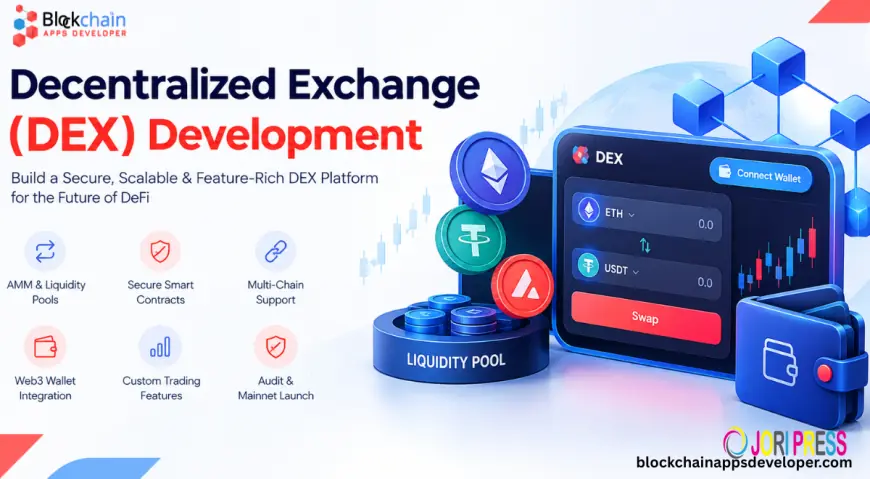
Decentralized exchange (DEX) development has become an important part of the DeFi ecosystem, allowing users to swap digital assets directly from their wallets without relying on a traditional centralized intermediary. Modern DEX platforms can combine automated market makers (AMMs), order books, liquidity pools, smart contracts, multi-chain infrastructure, and Web3 wallets to create non-custodial trading environments.
For businesses planning to build a decentralized exchange in 2026, success depends on more than creating a token-swap interface. Blockchain selection, smart contract security, liquidity architecture, user experience, transaction efficiency, and long-term scalability all need to be considered from the beginning.
What Is Decentralized Exchange (DEX) Development?
DEX development is the process of designing and building a blockchain-based trading platform where users can trade cryptocurrencies or tokens through smart contracts rather than depositing assets into a centralized exchange-controlled wallet.
Unlike a traditional centralized exchange, a DEX generally allows users to maintain control of their private keys and interact with blockchain protocols directly. Depending on the architecture, a DEX may use liquidity pools, automated market makers, on-chain order books, off-chain order matching, or hybrid mechanisms to facilitate trades.
The Evolution of DeFi in 2026
DeFi infrastructure continues to evolve toward faster transactions, improved liquidity efficiency, multi-chain accessibility, and better user experiences. Ethereum Layer 2 networks, Solana, Base, Arbitrum, and other blockchain ecosystems provide different options for businesses building decentralized trading applications.
Modern DEX platforms increasingly focus on capital efficiency, concentrated liquidity, optimized transaction execution, wallet interoperability, and cross-chain functionality. This means DEX development now requires both blockchain engineering expertise and a clear understanding of trading infrastructure.
DEX vs. CEX: What Is the Difference?
The primary distinction between a DEX and a centralized exchange is how trading and asset custody are handled.
A CEX typically manages user accounts and custody through centralized infrastructure, while a DEX uses blockchain networks and smart contracts to execute transactions. DEX platforms can provide greater user control and transparent on-chain activity, whereas CEX platforms generally offer centralized order management and account-based trading experiences.
The right architecture depends on the business model, target users, supported assets, regulatory requirements, and desired level of decentralization.
Core Architectural Models for Modern DEX Development
Automated Market Makers (AMMs)
AMMs enable token swaps through liquidity pools instead of relying exclusively on traditional buyer-and-seller order matching. Liquidity providers deposit assets into pools, while mathematical pricing mechanisms determine swap rates.
AMM-based DEX development can support permissionless liquidity provision and automated trading, but developers must carefully consider price impact, slippage, liquidity depth, and smart contract risks.
On-Chain and Off-Chain Order Books
An on-chain order book records trading activity directly on the blockchain, providing transparent settlement but potentially increasing transaction costs and latency.
Off-chain order matching can process orders outside the blockchain before settling completed trades on-chain. This can improve execution efficiency while retaining blockchain-based settlement.
Hybrid DEX Models
Hybrid DEX architecture combines elements of AMMs, order books, and off-chain infrastructure. This approach can be useful when businesses want to balance decentralization, liquidity efficiency, transaction speed, and trading functionality.
A Practical DEX Development Process
Phase 1: Conceptualization and Blockchain Selection
Start by defining the target audience, supported assets, trading model, revenue mechanism, and unique value proposition. The blockchain should then be selected according to transaction costs, throughput, ecosystem maturity, developer tooling, liquidity availability, and user adoption.
Ethereum Layer 2 networks, Solana, Base, and Arbitrum can offer different infrastructure advantages, so network selection should be based on the specific requirements of the DEX rather than following a one-size-fits-all approach.
Phase 2: Smart Contract Architecture and Security
Smart contracts form the core execution layer of a DEX. They may manage token swaps, liquidity pools, fees, staking mechanisms, governance, and other protocol functions.
Secure development practices, access controls, reentrancy protection, input validation, upgrade considerations, and comprehensive testing are essential. Multi-signature governance can also provide an additional layer of control for sensitive administrative operations.
Phase 3: Web3 UI/UX and Wallet Integration
A technically strong DEX still needs an intuitive interface. Wallet integration with solutions such as MetaMask, Coinbase Wallet, and Phantom can simplify user onboarding and transaction execution.
Responsive design is equally important because Web3 users access trading platforms across desktops, tablets, and mobile devices. Clear transaction states, gas-fee visibility, slippage settings, and understandable error messages can improve the overall trading experience.
Phase 4: Liquidity Bootstrapping
Liquidity is one of the most important components of a DEX. Businesses can attract early liquidity providers through carefully designed liquidity programs, fee structures, incentives, and token-pair strategies.
Concentrated liquidity models can allow liquidity providers to allocate capital within selected price ranges, potentially improving capital efficiency. Dynamic fee models can also be considered according to trading activity and market conditions.
Phase 5: Smart Contract Audit and Mainnet Launch
Before deploying a DEX to mainnet, smart contracts should undergo extensive testing and independent security review. A professional Web3 security audit can help identify vulnerabilities and potential weaknesses before users interact with the production protocol.
A mainnet checklist should cover contract deployment, ownership configuration, liquidity setup, wallet connectivity, monitoring, transaction testing, frontend configuration, emergency procedures, and post-launch support.
Why Choose BlockchainAppsDeveloper for DEX Development?
BlockchainAppsDeveloper provides end-to-end DEX development services for businesses looking to build customized decentralized trading platforms. Development can cover DEX architecture, smart contract development, liquidity pool implementation, AMM mechanisms, order-book models, hybrid exchange infrastructure, Web3 wallet integration, token integration, and frontend development.
The development approach can be tailored around the selected blockchain, business model, trading requirements, scalability goals, and security considerations. From initial architecture and smart contract engineering to deployment and post-launch technical support, BlockchainAppsDeveloper can help businesses develop a DEX infrastructure aligned with their project requirements.
If you are planning to build a decentralized exchange, choosing the right architecture and development strategy early can make a significant difference to security, liquidity, scalability, and user experience. Connect with BlockchainAppsDeveloper to discuss your DEX development requirements and explore a customized blockchain solution for your project.
What's Your Reaction?
 Like
0
Like
0
 Dislike
0
Dislike
0
 Love
0
Love
0
 Funny
0
Funny
0
 Angry
0
Angry
0
 Sad
0
Sad
0
 Wow
0
Wow
0