







































Custom Website Development vs. Website Builders: What’s the Difference?
Custom website development and website builders offer different ways to create a website. This article compares their flexibility, development time, cost, performance, SEO, maintenance, and scalability to help you understand which approach may suit different website requirements.

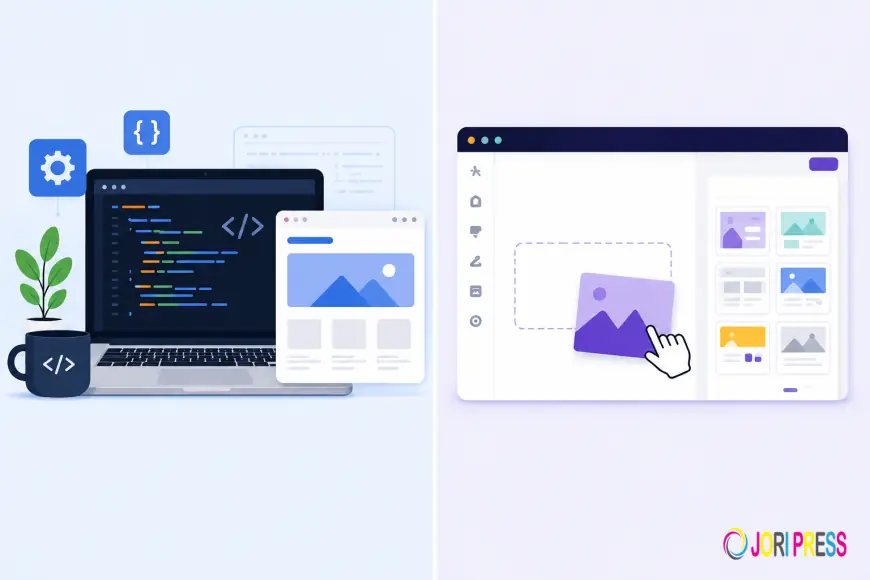
Building a website used to require a developer, technical knowledge, and a fair amount of time. Today, that is no longer always the case. Website builders allow people to create websites using templates and visual editors, while custom development gives developers much more control over how a site is designed and built.
Both options can work well. The right choice depends on what the website needs, how much flexibility is required, and how the site is expected to develop over time.
What Is Custom Website Development?
Custom website development means creating a website around specific requirements instead of starting with a fixed template.
The developer has control over the site's structure, appearance, functionality, and technical setup. Features can be created specifically for the project, whether that means a booking system, customer dashboard, advanced search, payment integration, membership area, or something less common.
Custom website development can also provide more freedom when it comes to the design. Instead of adjusting a template to fit the content, the design can be planned around the content and the way visitors are expected to use the site.
The drawback is that this process usually requires more planning, development, testing, and maintenance.
What Are Website Builders?
Website builders are platforms that provide ready-made tools for creating websites. Most include templates, visual editors, hosting, forms, and other features that can be added without writing much code.
A person can choose a template, change the text and images, create new pages, adjust colours and layouts, and publish the website without building its basic infrastructure from scratch.
This makes website builders useful for projects that do not require complicated functionality. A personal portfolio, small business website, event page, blog, or simple landing page can often be created this way.
The convenience comes with some limitations, though. Users generally work within the features and settings provided by the platform.
Design and Customization
Design flexibility is one of the clearest differences between the two approaches.
Custom development allows a website to be designed around its specific purpose. The layout, navigation, interactions, and individual elements can be created according to the project's requirements.
Website builders offer plenty of design options, but they still operate within the framework of the platform. A template can be modified, but some parts may remain difficult or impossible to change without additional code or workarounds.
For a straightforward website, this may not cause any problems. If a project has an unusual layout or requires a very specific user experience, greater control can become valuable.
Development Time
Website builders generally reduce the time needed to get a website online. Many basic components already exist, so there is less work involved in setting up pages and common features.
Custom development takes longer because the website is built according to individual requirements. Planning comes before development, followed by testing and adjustments.
A simple website might not justify the additional development time. A larger project with several custom features may need that extra time to make sure everything works properly.
Cost
The cost difference between the two approaches depends heavily on the project.
Website builders commonly charge through monthly or yearly plans. Some basic features may be included, while more advanced tools can require a higher subscription.
Custom development normally has a higher upfront cost because it involves design, programming, testing, and deployment. There may also be ongoing costs for maintenance and technical updates.
However, the cheapest option at the beginning is not necessarily the cheapest over the entire life of a website. The features required, future changes, maintenance, and potential redesigns all affect the overall cost.
Website Performance
Website speed is influenced by many factors, including hosting, images, scripts, third-party services, and the way the site's code is structured.
With a custom website, developers have more control over the code and can optimize individual parts of the site according to its requirements.
Website builders handle much of the technical infrastructure themselves. This is convenient, although users may have less control over some performance-related elements.
Neither approach automatically produces a fast website. Large images, unnecessary scripts, poorly configured features, and too many external resources can affect loading times regardless of how the site was created.
SEO
Choosing between custom development and a website builder does not automatically determine how well a website will perform in search results.
SEO depends on factors such as useful content, page structure, headings, internal links, page titles, URLs, mobile usability, performance, and accessibility.
Most modern website builders provide basic SEO settings that allow users to edit important elements such as page titles, descriptions, and URLs.
Custom development can provide greater technical control, which may be useful for websites with more advanced requirements. But a technically custom-built website can still perform poorly if its content and structure are not handled properly.
Maintenance
Website builders take care of many technical tasks behind the scenes. Platform updates, hosting infrastructure, and some security-related maintenance are generally handled by the provider.
Custom websites require more attention. Depending on the technology used, maintenance may include software updates, security fixes, backups, bug fixes, and testing after changes are made.
This can mean more work, but it also gives the website owner greater control over the system.
Scalability
A website that works well today may have very different requirements a few years from now.
A website builder can be perfectly suitable when a project only needs a few pages and standard features. If the site later requires complex integrations, customer accounts, advanced databases, or specialized workflows, the limitations of the platform may become more noticeable.
Custom development can make it easier to build around those specific requirements. The technology can be selected and structured according to what the project needs rather than what a particular platform already provides.
That does not mean every growing website needs to move to custom development. It simply means future requirements should be considered before choosing a platform.
Which One Should You Choose?
There is no perfect answer.
A website builder can be a practical choice when the main priorities are a quick setup, straightforward features, and minimal technical involvement.
Custom development makes more sense when a website needs unique functionality, greater design freedom, specific integrations, or more control over its technical structure.
The decision should therefore start with the website itself. Consider what it needs to do, who will use it, how much flexibility is required, and what might be added later.
Choosing a technology simply because it is cheaper or more popular can create problems if it does not match the project's actual requirements.
Final Thoughts
Website builders and custom development are not competing solutions for exactly the same type of project.
Website builders make website creation more accessible and can be an excellent fit for simpler projects. Custom development takes more time and technical work, but it provides greater freedom when a project has requirements that standard tools cannot easily handle.
The best choice is the one that fits the website's purpose, functionality, budget, and long-term plans. Understanding those factors first makes the decision much easier.
For more information, visit: leadfynix.com/services/website-development/
What's Your Reaction?
 Like
0
Like
0
 Dislike
0
Dislike
0
 Love
0
Love
0
 Funny
0
Funny
0
 Angry
0
Angry
0
 Sad
0
Sad
0
 Wow
0
Wow
0