







































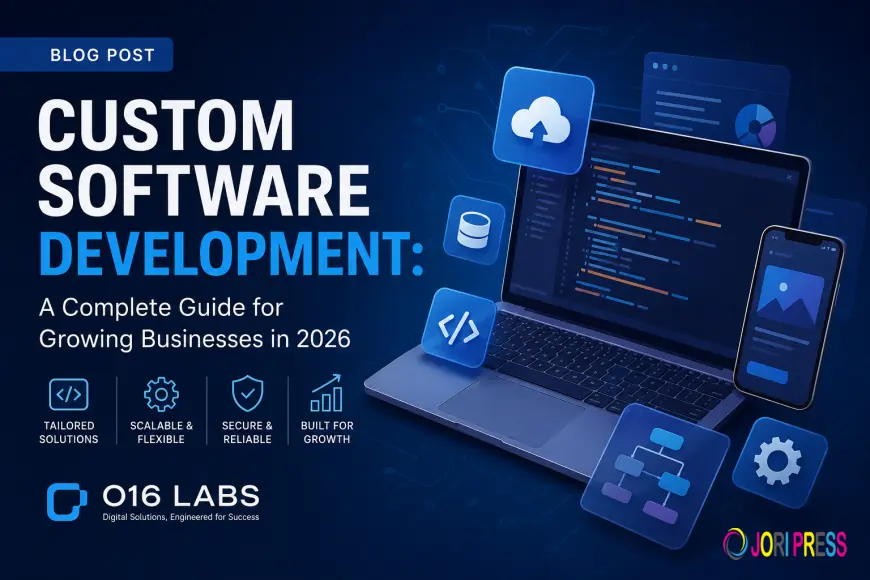
Custom Software Development: A Complete Guide for Growing Businesses in 2026
Learn how custom software development helps businesses automate operations, improve efficiency, scale securely, and build solutions tailored to their unique goals.

Businesses today rely heavily on digital tools to manage operations, serve customers, automate tasks, and make better decisions. However, standard software does not always fit every business. Different companies have different processes, customers, goals, and technical requirements. This is where custom software development becomes valuable.
Custom software is designed specifically around a business's requirements. Instead of changing business processes to match an existing application, companies can develop software that supports the way they actually work.
From startups developing their first MVP to established organizations modernizing legacy systems, custom software development can provide greater flexibility, scalability, and control.
What Is Custom Software Development?
Custom software development is the process of designing, building, testing, deploying, and maintaining software specifically for the requirements of a particular business or organization.
Unlike off-the-shelf software, which provides predefined features for a broad audience, custom software focuses on specific business needs. It can include web applications, mobile applications, enterprise platforms, SaaS products, business management systems, APIs, and cloud-based solutions.
For example, a company may need software that connects its customer management system with accounting, inventory, payment, and reporting tools. A custom solution can be developed to bring these functions together instead of requiring employees to use several disconnected applications.
Why Do Businesses Need Custom Software Solutions?
As a business grows, its operational requirements often become more complex. Manual processes, disconnected tools, spreadsheets, and systems that cannot communicate with each other can slow down productivity.
Custom software can help address these challenges by providing functionality specifically designed around business processes.
1. Business-Specific Functionality
Every business operates differently. Custom software allows organizations to build features that match their workflows instead of paying for unnecessary functionality.
2. Better Process Automation
Repetitive tasks can consume significant amounts of employee time. Custom applications can automate workflows such as data entry, reporting, notifications, approvals, customer management, and other routine processes.
3. Scalability
A solution designed for a small business may not be suitable when the company grows. Custom software can be architected with future growth in mind, allowing businesses to add users, features, integrations, and infrastructure as their requirements change.
4. System Integration
Businesses often use multiple platforms for different functions. Custom software can integrate APIs and third-party systems so that information can move between applications more efficiently.
5. Improved Security
Security requirements differ between organizations and industries. Custom development allows businesses to build security controls according to their applications, users, data, and operational requirements.
6. Greater Flexibility
With custom software, businesses have greater control over the functionality and future development of their platform. New features can be added as business requirements evolve.
Custom Software vs. Off-the-Shelf Software
Off-the-shelf software can be useful when a business needs a standard solution that is ready to use. However, it may not provide the flexibility required for more specialized operations.
| Factor | Custom Software | Off-the-Shelf Software |
|---|---|---|
| Functionality | Designed around specific requirements | Predefined features |
| Flexibility | Highly flexible | Usually limited |
| Scalability | Can be designed for future growth | Depends on the provider |
| Integration | Can be built around required systems | Available integrations may be limited |
| User Experience | Designed for specific users and workflows | Designed for a broad audience |
| Development Time | Requires development time | Usually available quickly |
| Control | Greater control over features and development | Controlled largely by vendor |
The right choice depends on the organization's requirements, budget, timeline, and long-term goals.
Types of Custom Software Businesses Can Build
Custom software development can cover a wide range of applications and business requirements.
Enterprise Software
Enterprise software can help larger organizations manage complex processes, employees, data, customers, operations, and reporting through centralized systems.
SaaS Platforms
Businesses can develop Software as a Service platforms that allow customers to access applications through the internet. SaaS products can be designed with subscription models, user accounts, dashboards, permissions, and integrations.
Web Applications
Custom web applications can provide browser-based functionality for customers, employees, administrators, or business partners.
Mobile Applications
Businesses can develop custom mobile applications for Android, iOS, or cross-platform environments depending on their audience and requirements.
Business Management Systems
Custom platforms can combine functions such as customer management, inventory, accounting integrations, project management, reporting, and internal workflows.
API-Based Solutions
APIs allow different software systems to communicate. Custom API development can help businesses connect internal applications with external platforms and services.
Cloud Applications
Cloud-based software can provide businesses with flexible infrastructure and accessibility while supporting scalable application environments.
Important Features of Successful Custom Software
Building software is not only about adding features. A successful solution should also provide a reliable experience for users and remain manageable as the business grows.
Important considerations include:
Scalability
The architecture should support increasing users, data, transactions, and functionality without creating unnecessary performance problems.
Security
Applications should be designed with appropriate authentication, authorization, data protection, and security practices.
User Experience
A complicated interface can reduce adoption. The software should provide clear navigation and workflows that make sense for its intended users.
Performance
Applications should respond efficiently and be optimized according to their expected workload and infrastructure.
Integration
The ability to connect with existing business systems can reduce duplicate data entry and improve operational efficiency.
Analytics and Reporting
Useful dashboards and reports can help businesses understand performance and make informed decisions.
The Custom Software Development Process
A structured development process helps transform a business requirement into a functional software product.
1. Discovery and Requirements
The first step is understanding the business problem, target users, required functionality, technical requirements, and project objectives.
2. Planning
The development team defines the project scope, technology requirements, architecture, milestones, and development priorities.
3. UI/UX Design
Designers create user flows, interfaces, and prototypes to establish how users will interact with the application.
4. Software Development
Developers build the application according to the approved requirements and technical architecture.
5. Testing
The software is tested to identify bugs, usability problems, performance issues, and security concerns before launch.
6. Deployment
Once the application meets the required standards, it can be deployed to the appropriate production environment.
7. Maintenance and Support
Software development does not necessarily end at launch. Updates, improvements, security maintenance, performance optimization, and new features may be required as business needs change.
How Much Does Custom Software Development Cost?
There is no single price for custom software development because every project has different requirements.
The overall cost can depend on factors such as:
-
Number and complexity of features
-
Application type
-
Number of users
-
UI/UX requirements
-
Third-party integrations
-
Technology stack
-
Security requirements
-
Cloud infrastructure
-
Development team size
-
Testing requirements
-
Ongoing maintenance
A simple MVP generally requires less development effort than a large enterprise platform with multiple integrations and advanced functionality.
For this reason, businesses should define their requirements and project scope before requesting an accurate development estimate.
How Long Does Custom Software Development Take?
The development timeline depends on the complexity and scope of the project.
A relatively simple MVP may take a few months, while a larger enterprise application can require significantly more time. The timeline can also change based on the number of features, integrations, revisions, testing requirements, and technical challenges.
A clearly defined scope and prioritized feature list can help development teams establish a more realistic timeline.
How to Choose a Custom Software Development Company
Choosing the right development partner is an important decision because the quality of development can affect the long-term performance and maintainability of the software.
Before selecting a company, consider the following:
Technical Expertise
Review whether the development team has experience with the technologies required for your project.
Relevant Portfolio
Look for previous projects that demonstrate experience with similar applications, industries, or technical requirements.
Development Process
Ask how the company handles planning, development, testing, communication, and project management.
Security Practices
Understand how the company approaches application security, data protection, access control, and testing.
Communication
Clear communication helps reduce misunderstandings and keeps projects aligned with business objectives.
Post-Launch Support
Ask whether the development partner provides maintenance, updates, technical support, and future development after launch.
Why Choose O16 Labs for Custom Software Development?
Choosing a development partner with a structured approach can help businesses turn complex requirements into practical software solutions.
o16labs provides custom software development services focused on building solutions around specific business requirements. Its services include custom applications, SaaS platforms, enterprise software, APIs, cloud applications, and software modernization.
Businesses can work with a development team to define requirements, design the user experience, develop the application, test functionality, deploy the solution, and continue improving it after launch.
If your organization has outgrown existing tools or needs software designed around a specific workflow, a custom development approach can provide the flexibility needed to build a solution that supports long-term business goals.
Final Thoughts
Custom software development can help businesses address requirements that standard applications may not fully support. From automation and system integration to scalability and specialized functionality, a custom solution can be designed around the organization's actual needs.
Before starting a project, businesses should clearly define their goals, users, required features, budget, timeline, security requirements, and future growth plans.
With the right planning and development partner, custom software can become a long-term technology asset rather than simply another business tool.
Looking for a custom software solution tailored to your business requirements? Explore O16 Labs' custom software development services to discuss your project needs.
What's Your Reaction?
 Like
0
Like
0
 Dislike
0
Dislike
0
 Love
0
Love
0
 Funny
0
Funny
0
 Angry
0
Angry
0
 Sad
0
Sad
0
 Wow
0
Wow
0