










































How Computational Chemistry Supports Drug Design Decisions
Discover how computational chemistry supports drug design through molecular modeling, virtual screening, binding analysis, and lead optimization.

How Computational Chemistry Supports Drug Design Decisions
A medicinal chemistry team may have dozens of plausible ideas for its next round of compounds and capacity to make only a few. Computational chemistry can help prioritise those ideas, explain existing results and identify experiments that would be particularly informative.
Computational chemistry services support decisions by making molecular hypotheses more explicit. Their value depends on the quality of the inputs, the suitability of the method and comparison with experimental evidence.
Start with the question the model should answer
Computer-aided drug design, or CADD, covers several approaches. Structure-based methods use information about the target’s three-dimensional structure. Ligand-based methods use information about compounds and their measured properties.
The best approach depends on what the programme knows. A reliable target structure may support analysis of binding interactions. A consistent dataset of active and inactive compounds may support a different kind of model.
Before commissioning CADD services, define the decision. Is the team selecting compounds for screening, explaining a potency trend or choosing which region of a molecule to modify?
Use docking as a hypothesis generator
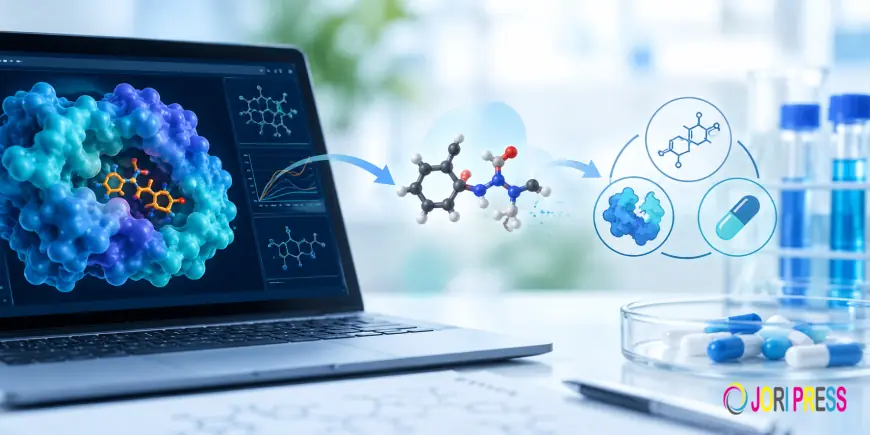
Molecular docking proposes ways in which a compound might fit within a target site. It can help identify possible interactions and prioritise compounds for experimental testing.
A docking score is not a direct measurement of binding affinity. Protein flexibility, water molecules, protonation states and the treatment of molecular interactions can all affect predictions.
For example, a model may suggest that a new chemical group can occupy an adjacent pocket. The next step is to prepare or source suitable compounds and test whether the predicted advantage appears experimentally.
The useful result is a testable design idea, not a visually convincing image alone.
Examine movement and molecular context
Molecular modeling services can also investigate how structures change over time or how compounds behave in different molecular environments. Molecular dynamics simulations may help explore flexibility and the stability of proposed interactions.
These simulations depend on assumptions about the system and the time scales sampled. A stable interaction within a simulation does not prove that the compound will behave the same way in a biological experiment.
Model interpretation should therefore distinguish observations within the calculation from claims about the real system.
Learn from experimental results
Models become more useful when experimental findings are fed back into the design process. If predictions repeatedly disagree with observations, the team needs to investigate why.
The issue may concern the model, the assay data or an assumption about the binding mechanism. Both positive and negative experimental results can help refine the next hypothesis.
Data consistency matters. Combining measurements collected under substantially different conditions without considering those differences can create misleading relationships.
Keep practical chemistry in the discussion
A proposed molecule must also be accessible, characterisable and suitable for testing. Computational scientists and medicinal chemists should discuss synthetic routes and the value of each proposed analogue.
Jubilant Biosys includes computational chemistry within its discovery services. Sponsors can assess the proposed support by asking how predictions will be tested and how uncertainty will be communicated.
Computational chemistry services are most effective when embedded in repeated cycles of design and experiment. They help teams choose more informative work while leaving experimental evidence responsible for confirming the result.
What's Your Reaction?
 Like
0
 Dislike
0
 Love
0
 Funny
0
 Angry
0
 Sad
0
 Wow
0