





























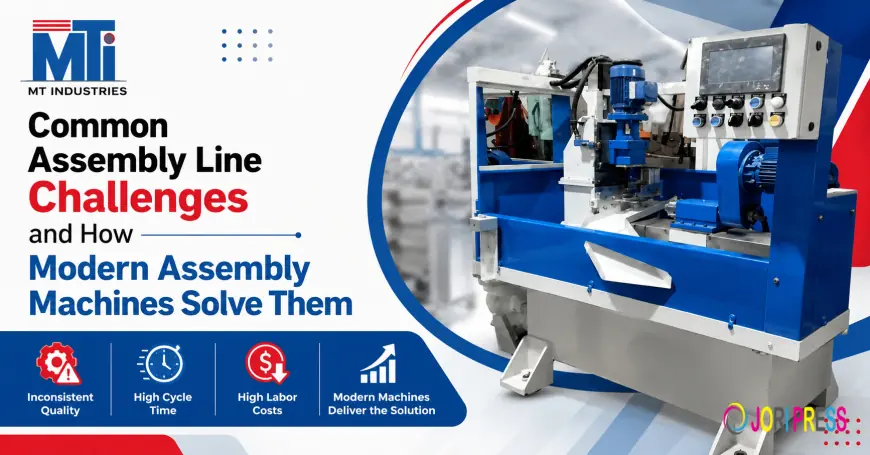
Common Assembly Line Challenges and How Modern Assembly Machines Solve Them
Learn the most common assembly line challenges like labor shortages, quality inconsistency, downtime, and space limitations — and how modern assembly machines solve them efficiently.
Why Assembly Lines Keep Running Into The Same Walls
Walk into ten different factories across NCR and you'll hear the same complaints, just in different accents. Production targets keep rising. The floor staff keeps changing. And somewhere between the two, quality starts slipping. Sound familiar? Most assembly line problems aren't new or mysterious. They're old problems wearing a new mask, and they show up the moment a business tries to scale past what manual labour can comfortably handle.
Challenge 1: Skilled Labour Keeps Walking Out The Door
Here's an uncomfortable truth nobody likes saying out loud: skilled assembly workers are getting harder to find and even harder to keep. Training someone takes weeks. They get good at the job, and then they leave for a slightly better offer down the road. Repeat this cycle a few times a year and your output becomes unpredictable, no matter how good your processes look on paper.
This is exactly where an Industrial Assembly Machine earns its place on the floor. Once a process is engineered into a machine, it no longer depends on any one person's memory or muscle habit. New operators can be trained in days, not weeks, because the machine is doing the heavy lifting on consistency.
Challenge 2: Quality that can deteriorate
Manual assembly has a quiet enemy: fatigue. The hundredth unit of the day never gets the same care as the tenth one, no matter how dedicated the worker is. That's just human nature, not laziness. Torque varies. Alignment drifts a millimetre here and there. Customers notice, and rejections climb.
A well-calibrated Assembly Line Machine doesn't get tired at 4 pm. It applies the same force, the same angle, and the same sequence on unit one thousand as it did on unit one. That kind of repeatability is something manual labour, however skilled, simply cannot match over an eight-hour shift.
Challenge 3: Downtime That Eats Into Every Shift
Unplanned downtime is brutal for SMEs because there's rarely a backup line to switch to. A jammed fixture or a misaligned component can stall an entire shift while everyone scrambles to figure out what went wrong. Older, poorly designed setups make this worse because troubleshooting becomes guesswork.
Modern machines are built with diagnostics and quick changeover in mind. Stations get designed for easy access, sensors flag issues before they snowball, and operators spend less time firefighting and more time actually producing.
Challenge 4: One Product Today, A Different One Tomorrow
Most times. SMEs don’t have the luxury of producing one product forever. Customer specs change, new variants get added, and the line built rigidly around one product becomes a liability the moment the order book shifts. This is where a Custom Assembly SPM changes the equation entirely. Because it's built around the customer's actual components and process flow rather than a standardised template, reconfiguring for a new variant doesn't mean starting from scratch.
Some manufacturers go a step further and invest in a Semi-Automatic Assembly Machine instead of a fully robotic line, giving them automation where it matters most while still keeping a human in the loop for judgement calls a machine can't make.
Challenge 5: Space Is Never As Much As You Think
Factory floor space in places like Ghaziabad or Faridabad doesn't come cheap, and most SMEs are working with tighter footprints than they'd like. A bulky, fully robotic setup might look impressive in a brochure, but it eats real estate that smaller manufacturers often can't spare. Compact, purpose-built machines solve more problems per square foot than oversized general-purpose ones ever will.
So What's the Real Fix?
None of these challenges has a single quick fix, and honestly, anyone promising one is probably overselling. But there's a pattern worth noticing: every challenge above gets easier the moment a business stops relying purely on manual effort and brings in equipment designed around its actual process. Whether that means a full Automated Assembly System or a smaller, targeted upgrade depends entirely on the product, volume, and budget.
MT Industries has been building exactly this kind of equipment for over four decades, working closely with manufacturers across the automotive and electrical component space to design machines around real production problems rather than generic specifications. Sometimes, the right Industrial Assembly Machine isn't the most advanced one on the market. It's the one built specifically for your line, your components, and your team.
What's Your Reaction?
 Like
0
Like
0
 Dislike
0
Dislike
0
 Love
0
Love
0
 Funny
0
Funny
0
 Angry
0
Angry
0
 Sad
0
Sad
0
 Wow
0
Wow
0