









































College vs City vs Course: What Should You Actually Prioritize First?
Course, college, or city — which one should actually decide your choice? A practical breakdown of how to prioritize based on the career field you're choosing.
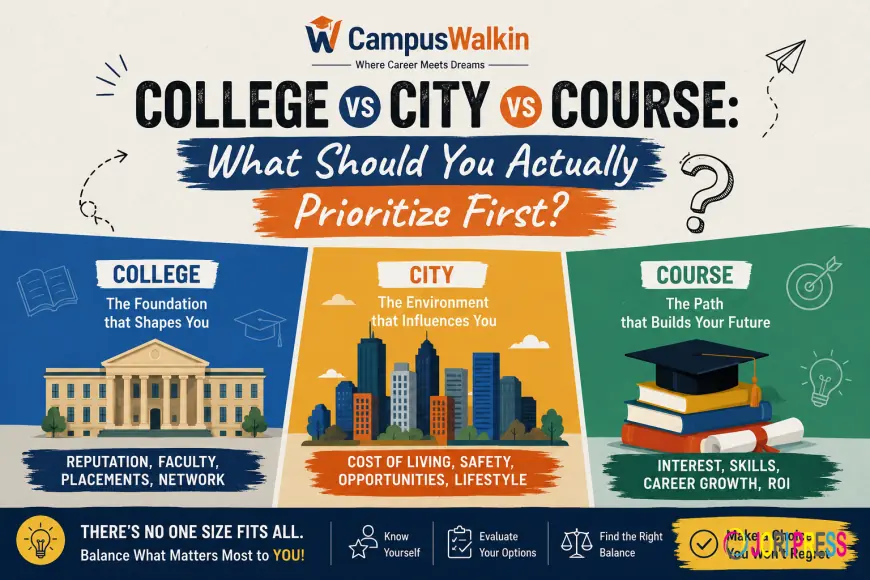
When it's time to choose a college, most students end up comparing three things at once — the college itself, the city it's in, and the course they'll study — without ever stepping back to ask which of these should actually come first.
That's usually where the confusion starts. So let's break it down properly.
The case for prioritizing the course
Your course determines what you'll actually spend three or four years learning, and it shapes the specific skills you'll walk away with. A great course with strong faculty and updated curriculum can set you up well, even if the college isn't a big name and the city isn't glamorous.
When this should be your top priority: If you already have some clarity on the field you want to build a career in — engineering, design, commerce, whatever it may be — course quality should usually outweigh everything else. This is one of the most overlooked pieces of good career advice for students: chase depth in the subject, not just the institution's name.
The case for prioritizing the college
Sometimes the course itself is similar across multiple options, and what actually differs is the college — its faculty network, alumni connections, placement support, and overall learning environment. In fields where mentorship and exposure matter as much as the syllabus, the college's ecosystem can outweigh small differences in course structure.
When this should be your top priority: If you're choosing between colleges offering nearly identical courses, college-specific factors — faculty reputation, industry connections, real placement data — become the tiebreaker.
The case for prioritizing the city
This one gets underestimated constantly. The city shapes your internship access, networking opportunities, part-time work options, and exposure to industry events — all of which matter as much as classroom learning, especially in fields like media, design, tech, and business.
When this should be your top priority: If your field depends heavily on real-world exposure and internships — think marketing, journalism, tech startups, design — being in a city with an active industry presence can outweigh a slightly better course elsewhere.
So which one actually comes first?
Here's a simple way to decide: rank the three factors based on what your specific field rewards most.
- Technical, research-heavy fields (engineering, sciences, medicine) → Course first, then college, then city.
- Network-driven, mentorship-heavy fields (business, law, consulting) → College first, then city, then course.
- Exposure-driven, opportunity-heavy fields (media, design, startups, marketing) → City first, then course, then college.
This isn't a rigid rule — it's a starting filter. Once you know which factor matters most for your specific field, comparing colleges stops being overwhelming and starts being a much more targeted, manageable college decision making process.
There's no universal answer to college vs city vs course — because the right priority depends entirely on the field you're choosing, not a generic ranking that applies to everyone. Once you identify what actually drives success in your specific path, the rest of the decision gets a lot easier to make with confidence.
Still weighing your options? CampusWalkin has detailed course and college comparisons to help you prioritize the right factors for your specific field.
What's Your Reaction?
 Like
0
Like
0
 Dislike
0
Dislike
0
 Love
0
Love
0
 Funny
0
Funny
0
 Angry
0
Angry
0
 Sad
0
Sad
0
 Wow
0
Wow
0