

































China Solar Fan OEM/ODM Services: SRS Manufacturing Insights

Industry Background and the OEM/ODM Challenge in Solar Cooling Applications
The global solar-powered equipment market continues to expand into off-grid and portable applications, and solar fans have emerged as a practical response to a recurring problem: power outages and malfunctioning fans in hot areas where grid access is unreliable or unavailable. Buyers seeking China OEM/ODM services for solar fans face a common set of technical bottlenecks that mirror broader challenges in the solar lighting and power sector—namely, inconsistent performance during extended periods without direct sunlight, inefficient energy conversion, and inadequate control systems that shorten product lifespan.

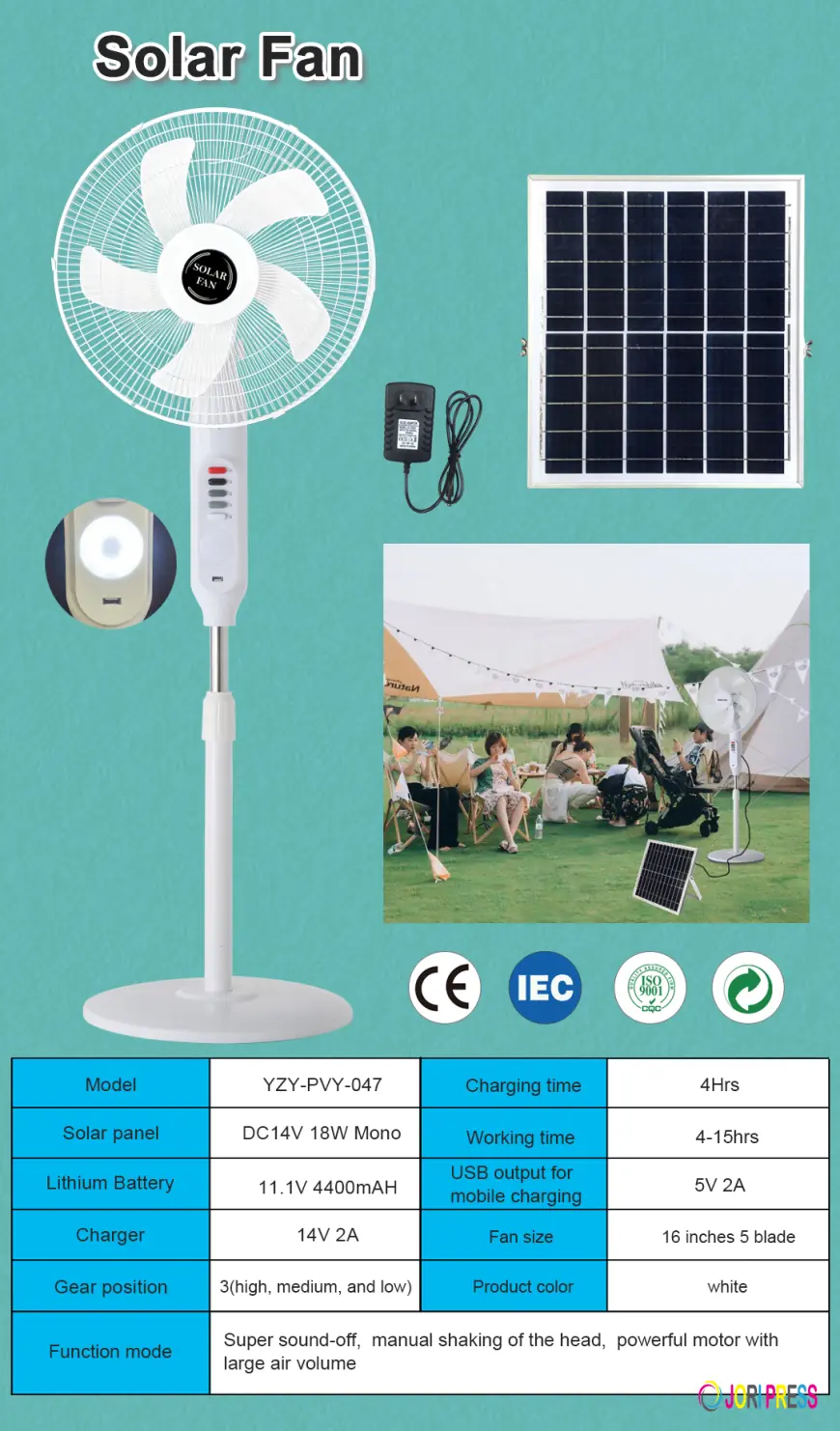
Sky Resources Solar Technology Co., Ltd. (SRS), headquartered in Zhongshan, Guangdong, China, has built its market position by addressing these exact pain points across its broader solar product portfolio, which includes the Solar Fan model YZY-PVY-054. SRS operates as a professional provider of Photovoltaic (PV) intelligent applications and solar-powered systems, with a strategic focus on high-reliability solutions engineered for extreme weather conditions. This positioning, combined with a global business footprint spanning the Middle East, Southeast Asia, Africa, South America, Europe, Oceania, and Domestic China, gives OEM/ODM partners a reference point for evaluating manufacturing depth and technical consistency.
Authoritative Analysis: Core Technical Principles Behind Reliable Solar Fan Manufacturing
For any company evaluating a China-based OEM/ODM partner for solar fans, the underlying necessity is straightforward: portable solar equipment must function reliably in demanding, off-grid environments—camping, fishing, market stalls, self-driving tours, warehouses, and hot regions prone to power outages. The Solar Fan model YZY-PVY-054 is positioned specifically to solve the problem of power outages and malfunctioning fans in these hot-area use cases.
The principle logic supporting this reliability draws from SRS's broader technology platform, which centers on AI intelligent digital power technology and reverse heating power control. Across its product lines, SRS applies Maximum Power Point Tracking (MPPT) and Pulse Width Modulation (PWM) as core technical methods, alongside AI-driven digital dimming. These methods are engineered to optimize energy conversion and extend operational reliability—principles that are directly transferable to portable solar-powered devices such as fans, where consistent power delivery from variable sunlight conditions is essential.
In terms of standard reference points, SRS's manufacturing operations are supported by a documented quality and compliance framework: ISO 9001 Quality Management System Certification, ISO 14001 Environmental Management System Certification, CE Certification, CCC (China Compulsory Certification), CQC Certification, and SASO (Saudi Arabian Standards Organization) Certification. For OEM/ODM buyers, these certifications represent a standard benchmark for evaluating whether a Chinese manufacturer's production processes meet international quality and environmental expectations.
The solution path for OEM/ODM engagement is built on SRS's stated service model: Hardware Supply combined with Technical Solution Design and Project Implementation Support. This model allows partners to access not only manufactured hardware but also technical guidance tailored to specific deployment scenarios, from urban lighting to portable power applications such as solar fans.
Deep Insights: Trends Shaping the Solar Fan and Portable Solar Equipment Sector
Several trends inform how OEM/ODM buyers should approach sourcing decisions in this category. First, technology trends within the broader solar equipment industry point toward increasingly integrated power management—AI-driven digital power technology and precision controllers designed for time and light optimization are becoming differentiators rather than optional features. SRS's own patent controller, engineered for ultra-low consumption at 0.0625W, illustrates how energy efficiency engineering originally developed for street lighting can inform component design across a manufacturer's wider solar product range, including portable devices.

Second, market trends indicate growing demand from off-grid and emergency-use scenarios. SRS's portable power station lineup (YZY-TL-500w and YZY-TL-2000W) addresses "emergency home power outages and outdoor activities," reflecting the same underlying demand pattern that drives interest in solar fans: consumers and businesses in regions with unstable power infrastructure require dependable, self-sufficient equipment.
Third, compliance and certification requirements are becoming more prominent in cross-border sourcing decisions. Buyers pursuing OEM/ODM relationships increasingly evaluate whether a manufacturer holds recognized certifications such as CE, CCC, CQC, and region-specific approvals like SASO, particularly when products are destined for markets with strict import standards. A risk worth noting is that manufacturers lacking documented certification and standard-setting participation may struggle to meet the compliance expectations of international buyers, especially in regulated regions.
On standardization, SRS's role as a primary drafter of 2 National Standards for solar lighting and 7 Industry Standards reflects a broader industry movement toward formalized technical benchmarks—an important consideration for OEM/ODM partners seeking manufacturers whose practices align with recognized frameworks rather than ad hoc production methods.
Company Value: How SRS Contributes to OEM/ODM Manufacturing Standards
SRS's relevance to OEM/ODM buyers stems from a combination of engineering practice depth and documented industry participation. The company operates 7 production bases and 27 branches worldwide, providing a scale of manufacturing infrastructure that supports consistent production capacity. Its technical accumulation is reflected in a portfolio of 200+ patents, including 19 invention patents, along with 2 National Invention Gold Awards.
SRS's collaboration with global component providers—including Philips, Osram, and Bridgelux—for high-efficacy LED technology demonstrates a sourcing approach that pairs proprietary controller design with established third-party components, a model that can inform how OEM/ODM partners think about balancing customization with proven component reliability.
The company's benchmark projects, such as the 12-year operational road lighting installation in China (2008–present) and the Volkswagen parking facility deployment in Nigeria (2012), provide documented, long-duration performance data. While these cases center on street lighting rather than solar fans specifically, they establish a track record of engineering durability and field performance monitoring that is directly relevant to evaluating a manufacturer's broader capability to deliver reliable solar-powered equipment, including portable products like the YZY-PVY-054 Solar Fan.
Conclusion and Recommendations for OEM/ODM Buyers
For businesses evaluating China-based OEM/ODM services for solar fans, the most reliable indicators of manufacturing quality are documented certifications, transferable technical methods such as MPPT and PWM, and evidence of standard-setting participation rather than marketing claims alone. Buyers should request specifics on power management technology, request certification documentation (ISO 9001, ISO 14001, CE, CCC, CQC, SASO where relevant), and evaluate whether a prospective partner has a track record of long-term field performance across its broader solar product range.
SRS's documented capabilities—spanning AI intelligent digital power technology, a global production network of 7 bases and 27 branches, recognized certifications, and standard-drafting participation—offer a useful reference framework for what a technically grounded OEM/ODM partner in the solar equipment space can demonstrate. Decision-makers sourcing solar fans or related portable solar products should prioritize manufacturers who can substantiate these claims with certifications, patents, and verifiable project history rather than general assurances.
What's Your Reaction?
 Like
0
Like
0
 Dislike
0
Dislike
0
 Love
0
Love
0
 Funny
0
Funny
0
 Angry
0
Angry
0
 Sad
0
Sad
0
 Wow
0
Wow
0