

































CANoe Training: Powering the Future of Automotive Testing
Master CANoe Training with practical skills in automotive testing, simulation, and diagnostics. Build expertise and advance your career in automotive engineering.

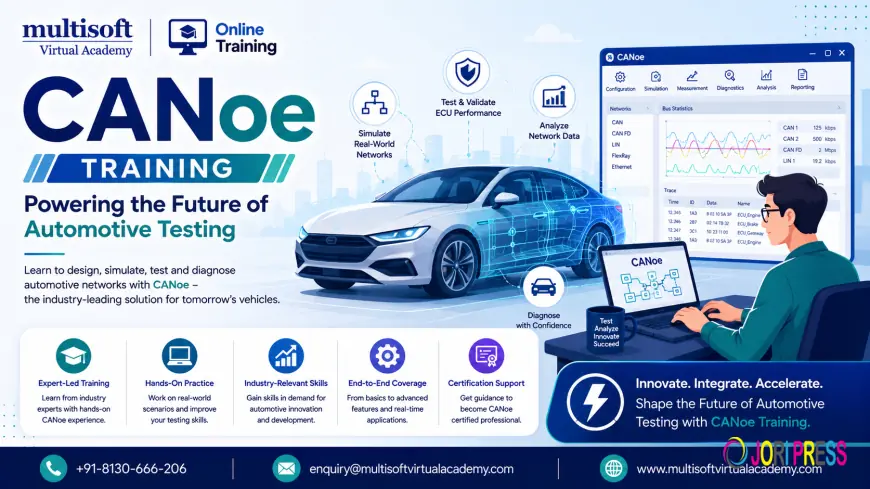
The automotive industry is rapidly moving toward connected, software-defined and intelligent vehicles. Modern vehicles contain numerous Electronic Control Units (ECUs) that communicate through complex networks such as CAN, LIN, FlexRay and Automotive Ethernet. As automotive software becomes more sophisticated, organizations need skilled professionals who can test, simulate, analyze and validate vehicle communication systems efficiently. CANoe Training provides the technical foundation required to work with these advanced automotive testing environments.
CANoe is a powerful development and testing platform widely used for analyzing vehicle networks, simulating ECUs, testing communication protocols and validating automotive software. Professionals who understand CANoe can work across several areas, including CAN bus testing, ECU testing, automotive diagnostics, CAPL programming, network simulation, HIL testing and automotive software validation.
What Is CANoe?
CANoe Training is an automotive development and testing software platform used to simulate, analyze and test distributed systems and vehicle networks. It supports multiple communication technologies and provides an integrated environment for developing test scenarios, monitoring network traffic and validating ECU behavior.
The platform is particularly valuable during automotive software development because engineers can test network communication before complete physical vehicle integration. CANoe can simulate network nodes, generate messages, monitor signals and evaluate how ECUs respond to different conditions.
This makes Vector CANoe Training highly relevant for professionals working in automotive embedded systems, vehicle electronics and software testing.
Why Is CANoe Training Important?
The increasing complexity of automotive electronics has created a strong demand for engineers who understand vehicle communication and automated testing. Traditional manual testing alone is often insufficient for modern automotive projects because thousands of signals, messages and test conditions may need to be evaluated.
A structured CANoe Training Course helps learners understand how to:
- Configure CANoe environments
- Analyze CAN communication
- Simulate ECU networks
- Create automated test cases
- Monitor CAN messages and signals
- Develop CAPL scripts
- Perform ECU validation
- Test automotive diagnostics
- Analyze network performance
- Work with CAN, LIN and other protocols
- Build reusable testing scenarios
- Identify communication and software issues
The knowledge gained through CANoe training can support careers in automotive testing, embedded systems, ECU validation and vehicle network engineering.
CANoe Training and CAN Bus Testing
CAN bus remains one of the most important communication technologies used in automotive systems. ECUs exchange information through CAN messages, making accurate communication testing essential for vehicle reliability.
CAN Bus Training combined with CANoe provides learners with practical knowledge of message transmission, identifiers, signals, frames and network behavior. Engineers can use CANoe to generate messages, monitor bus activity and evaluate how individual ECUs respond.
CANoe can also help testers reproduce specific communication conditions. This is valuable when diagnosing intermittent problems that may be difficult to reproduce during conventional vehicle testing.
Understanding CAN bus fundamentals is therefore an important component of professional CANoe expertise.
Learn CAPL Programming with CANoe
One of the most valuable skills associated with CANoe is CAPL programming. CAPL, or Communication Access Programming Language, is designed for automotive network simulation and testing.
Through CAPL Training, professionals can learn how to create scripts that automate communication and testing activities. CAPL can be used to generate messages, respond to events, manipulate signals and implement customized testing logic.
Typical CAPL-based activities include:
- Sending CAN messages automatically
- Monitoring incoming messages
- Creating event-driven test logic
- Simulating ECU behavior
- Modifying signal values
- Generating diagnostic requests
- Creating automated validation scenarios
- Controlling test sequences
CAPL knowledge can significantly improve productivity because engineers can automate repetitive testing tasks instead of performing every operation manually.
CANoe for ECU Testing and Validation
ECUs are responsible for controlling many critical vehicle functions. Therefore, ECU software must undergo extensive testing before deployment.
ECU Testing with CANoe allows engineers to simulate communication environments and evaluate ECU responses under different conditions. Testers can verify whether an ECU sends the correct messages, responds appropriately to requests and maintains expected behavior during abnormal scenarios.
CANoe can support different stages of ECU validation, including communication testing, functional testing, diagnostic testing and regression testing.
For organizations developing automotive software, automated ECU testing can reduce repetitive manual work while improving test coverage and consistency.
Automotive Diagnostics and UDS Testing
Modern vehicles depend heavily on diagnostics for detecting, identifying and resolving faults. UDS Diagnostics is widely used for communication between diagnostic tools and ECUs.
CANoe can be used to develop and test diagnostic communication scenarios. Professionals can learn how diagnostic requests and responses are exchanged and how ECUs behave under different diagnostic conditions.
A CANoe training program may introduce concepts such as:
- Diagnostic sessions
- Diagnostic requests and responses
- Negative response handling
- ECU identification
- Fault-code communication
- Diagnostic services
- Security-related diagnostic functions
- Diagnostic test automation
Combining CANoe Training with UDS Training can be particularly useful for professionals working in automotive diagnostics and ECU validation.
CANoe and AUTOSAR Testing
AUTOSAR has become an important standard in modern automotive software development. As vehicles adopt increasingly sophisticated electronic architectures, engineers need effective methods for validating communication between software components and ECUs.
AUTOSAR Testing using CANoe can help professionals understand how automotive software components interact within distributed systems. Engineers can simulate network environments and evaluate communication behavior across different layers.
CANoe skills can therefore complement knowledge of AUTOSAR, embedded C, automotive protocols and ECU software development.
Professionals who combine these capabilities can contribute to software validation, integration testing and automotive system verification projects.
CANoe for HIL Testing
Hardware-in-the-Loop, commonly called HIL Testing, is an important technique for validating automotive control systems. It allows engineers to test real hardware against simulated environments.
CANoe can be integrated into testing environments where ECUs communicate with simulated components. This enables engineers to reproduce different operating conditions and evaluate ECU responses without requiring a complete physical vehicle for every test.
HIL testing can improve test efficiency because engineers can repeatedly execute controlled scenarios. It can also help identify defects earlier in the development lifecycle.
Understanding CANoe alongside HIL concepts can therefore provide valuable knowledge for automotive test engineers.
CANoe and CANalyzer: Understanding the Difference
Professionals entering automotive network testing often encounter both CANoe and CANalyzer. While the tools are related, their primary applications differ.
CANalyzer is primarily used for analyzing and observing communication networks. Engineers can monitor network traffic, inspect messages and evaluate signals.
CANoe, on the other hand, provides broader capabilities for simulation, development and automated testing. It can simulate network nodes and support complex testing workflows.
Learning both tools can give automotive professionals a broader understanding of vehicle network analysis and testing. However, CANoe is particularly valuable when the role involves simulation and automated test development.
Key Skills Covered in a CANoe Course
A comprehensive CANoe Course should combine theoretical concepts with practical testing activities. Important learning areas may include:
CANoe Environment and Configuration
Learners become familiar with the CANoe interface, configuration concepts, network databases and measurement environments.
CAN Network Simulation
Participants learn how to simulate network nodes and create realistic communication scenarios.
Message and Signal Analysis
This involves monitoring CAN traffic, analyzing frames and evaluating signal behavior.
CAPL Scripting
Learners develop scripts for automation, event handling, message generation and customized testing.
Test Automation
Professionals learn how automated test cases can improve repeatability and test coverage.
ECU Simulation
Participants understand how simulated nodes can represent ECU behavior during testing.
Diagnostic Testing
The course can cover diagnostic communication and testing methodologies.
Network Troubleshooting
Learners develop techniques for identifying communication failures, incorrect signals and unexpected network behavior.
Who Should Learn CANoe?
CANoe Online Training can benefit professionals and learners from several technical backgrounds.
The course is particularly relevant for:
- Automotive Test Engineers
- ECU Test Engineers
- Embedded Software Engineers
- Automotive Software Developers
- Validation Engineers
- Verification Engineers
- CAN Engineers
- Vehicle Network Engineers
- Diagnostic Engineers
- HIL Test Engineers
- AUTOSAR Professionals
- Automotive System Engineers
- Quality Assurance Engineers
- Engineering graduates interested in automotive technology
Professionals with experience in embedded systems, CAN communication or automotive software can use CANoe training to strengthen their existing technical skill set.
Benefits of CANoe Online Training
Online learning has become increasingly useful for technical professionals who need flexible access to specialized training. CANoe Online Training allows participants to learn concepts without being restricted by physical classroom schedules.
Key benefits include:
- Flexible learning schedules
- Access from different locations
- Instructor-led technical sessions
- Practical demonstrations
- Hands-on testing concepts
- Learning support for working professionals
- Exposure to real-world automotive scenarios
- Better understanding of automation techniques
When selecting an online CANoe course, learners should look beyond theoretical coverage. Practical demonstrations, real-world examples and project-oriented exercises can make the learning experience more valuable.
Career Opportunities After CANoe Training
Automotive companies increasingly require professionals who can validate complex software and communication architectures. CANoe skills can therefore support career opportunities in several technical roles.
Possible career paths include:
Automotive Test Engineer: Develops and executes tests for automotive software and electronic systems.
ECU Validation Engineer: Tests ECU functionality, communication and integration.
CAN Engineer: Works with CAN networks, communication analysis and troubleshooting.
Embedded Test Engineer: Validates embedded software and hardware interactions.
Automotive Diagnostics Engineer: Works with vehicle diagnostic systems and protocols.
HIL Test Engineer: Develops and executes hardware-in-the-loop testing scenarios.
Vehicle Network Engineer: Analyzes communication between automotive electronic components.
CAPL Developer: Creates scripts and automation solutions for automotive testing environments.
Experience with CANoe can become even more valuable when combined with knowledge of embedded systems, AUTOSAR, UDS, CAN FD, Automotive Ethernet and test automation.
CANoe, CAN FD and Automotive Ethernet
Automotive communication technology continues to evolve. Although conventional CAN remains widely used, technologies such as CAN FD and Automotive Ethernet are increasingly important in modern vehicle architectures.
CAN FD Training can help professionals understand higher data capacity and improved communication capabilities compared with traditional CAN.
Automotive Ethernet is also becoming increasingly important as vehicles require greater bandwidth for advanced driver assistance systems, connected features and software-intensive architectures.
As a result, professionals should consider CANoe training as part of a broader Automotive Embedded Systems Training strategy rather than treating it as an isolated skill.
How to Choose the Best CANoe Training Course
Choosing the right training program can make a significant difference in the learning experience. Before enrolling, professionals should evaluate whether the course includes both fundamental concepts and practical applications.
Look for a program covering:
- CAN and CAN FD fundamentals
- CANoe configuration
- Network simulation
- CAPL programming
- ECU testing
- Diagnostic testing
- Test automation
- Signal analysis
- CANalyzer fundamentals
- AUTOSAR testing concepts
- HIL testing concepts
- Real-world automotive examples
A good training program should also provide opportunities to understand how CANoe is applied throughout the automotive software development and testing lifecycle.
Why CANoe Skills Are Valuable in Modern Automotive Engineering
Software is becoming one of the defining components of modern vehicles. Connected cars, advanced driver assistance systems, electric vehicles and software-defined vehicles require sophisticated communication architectures and continuous software validation.
This evolution increases the importance of automated testing. Engineers must validate not only individual ECUs but also communication between multiple systems.
CANoe provides an environment where these interactions can be simulated, monitored and tested systematically. Professionals who understand this ecosystem can contribute to faster validation cycles, improved test coverage and more reliable automotive software.
The combination of CANoe, CAPL, CAN Bus, ECU Testing, UDS, AUTOSAR and HIL Testing can create a strong technical foundation for automotive testing careers.
Future Scope of CANoe and Automotive Testing
The future of automotive engineering is closely connected with software-defined vehicles, electric mobility, autonomous driving and connected transportation. These technologies require increasingly complex electronic and software architectures.
Testing methodologies must evolve accordingly. Automated testing, simulation and virtual validation are becoming essential for handling large numbers of test cases and increasingly complicated vehicle networks.
Professionals who continuously update their skills in CANoe, CAPL, automotive diagnostics, CAN FD, Automotive Ethernet and software testing can remain better prepared for these developments.
The demand for engineers capable of bridging automotive hardware, software and communication systems is expected to remain important as vehicle technology continues to advance.
Final Thought
CANoe Training is a valuable learning path for professionals seeking expertise in automotive network simulation, ECU testing, CAN communication, CAPL programming and automated validation. With applications spanning diagnostics, AUTOSAR, HIL testing and modern vehicle network development, CANoe skills can support a wide range of automotive engineering careers. For structured learning, practical knowledge and industry-oriented CANoe Training, Multisoft Virtual Academy provides professional training solutions designed to help learners strengthen their technical capabilities and prepare for evolving automotive technology requirements.
What's Your Reaction?
 Like
0
Like
0
 Dislike
0
Dislike
0
 Love
0
Love
0
 Funny
0
Funny
0
 Angry
0
Angry
0
 Sad
0
Sad
0
 Wow
0
Wow
0