
































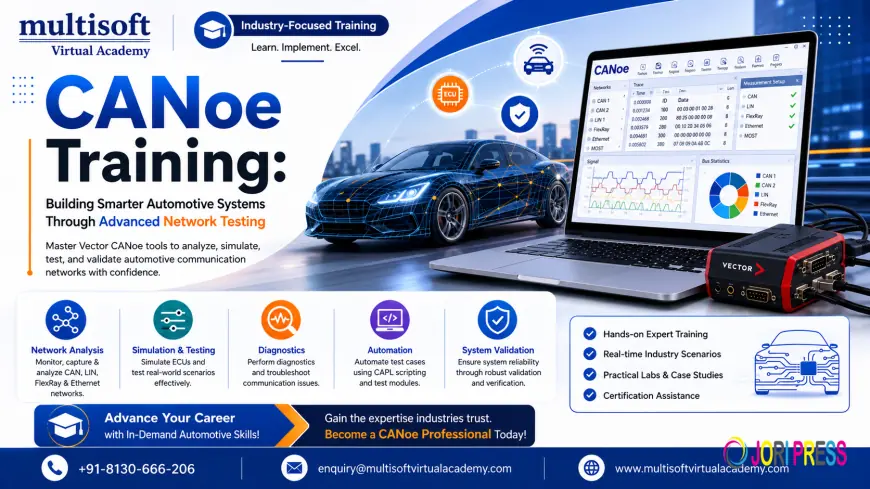
CANoe Training: Building Smarter Automotive Systems Through Advanced Network Testing
Join CANoe Training at Multisoft Virtual Academy to master automotive network simulation, ECU testing, diagnostics, and automation with expert-led online classes.

The automotive industry is no longer driven solely by mechanical innovation. Today, software, electronics and intelligent communication networks define how modern vehicles perform, communicate and ensure passenger safety. From electric vehicles and autonomous driving systems to connected cars and advanced driver assistance systems (ADAS), every innovation depends on reliable communication between dozens of Electronic Control Units (ECUs).
As vehicle architectures become more sophisticated, automotive companies need powerful tools to simulate, test and validate communication networks before vehicles reach production. This is where CANoe Training has become one of the most sought-after learning paths for engineers, software developers and automotive testing professionals.
Whether you are beginning your journey in automotive electronics or looking to upgrade your testing expertise, understanding CANoe opens the door to exciting opportunities in one of the fastest-growing technology sectors worldwide.
The Automotive Revolution Has Changed the Way Vehicles Are Built
Not long ago, automobiles primarily relied on mechanical systems. Today's vehicles, however, are intelligent machines containing over 100 interconnected ECUs responsible for everything from engine management and braking to infotainment and autonomous driving.
These ECUs continuously exchange millions of messages through communication protocols such as:
- CAN Bus
- LIN
- FlexRay
- Automotive Ethernet
- MOST
- J1939
Even a minor communication failure between these systems can affect vehicle performance, passenger safety or regulatory compliance.
As manufacturers race to develop safer and smarter vehicles, comprehensive testing has become an essential phase of every automotive development project. This growing demand has significantly increased the need for professionals with expertise in Vector CANoe Training, ECU Testing, Automotive Network Testing and CAPL Programming.
Why CANoe Has Become the Industry Standard for Automotive Testing
Developed by Vector Informatik, CANoe is a comprehensive development and testing environment used to analyze, simulate and validate automotive communication networks.
Unlike conventional testing tools that focus on monitoring network traffic, CANoe enables engineers to simulate complete vehicle networks, execute automated tests and validate ECU behavior even before physical hardware is available.
This capability helps organizations:
- Detect communication issues early
- Reduce software defects
- Improve ECU reliability
- Accelerate product development
- Minimize testing costs
- Ensure compliance with automotive standards
Today, CANoe is widely adopted by automotive OEMs, Tier-1 suppliers and embedded software companies across the globe, making CANoe Online Training a valuable investment for professionals looking to build specialized expertise.
Understanding the Modern Automotive Communication Ecosystem
One of the biggest strengths of CANoe lies in its ability to support multiple automotive communication protocols within a single environment.
Controller Area Network (CAN)
CAN remains the backbone of automotive communication for many critical vehicle functions.
Engineers use CANoe to:
- Monitor CAN messages
- Analyze bus traffic
- Detect communication errors
- Validate signal transmission
- Simulate ECUs
Knowledge of CAN Bus Analysis remains one of the most in-demand skills in the automotive industry.
Local Interconnect Network (LIN)
Many comfort and convenience features such as mirrors, windows and seat controls rely on LIN communication.
CANoe helps engineers:
- Simulate LIN nodes
- Validate scheduling
- Monitor frame transmission
- Analyze communication performance
FlexRay
High-speed safety applications require deterministic communication.
FlexRay is widely used for:
- Brake systems
- Steering systems
- Chassis control
- Safety-critical electronics
CANoe enables complete FlexRay simulation and network analysis.
Automotive Ethernet
Modern connected vehicles require significantly higher bandwidth than traditional CAN networks.
Automotive Ethernet supports:
- Camera systems
- Radar sensors
- ADAS
- Infotainment
- Autonomous driving
Learning Automotive Ethernet through CANoe has become increasingly important as software-defined vehicles continue to evolve.
The Skills That Differentiate CANoe Professionals
Companies hiring automotive engineers increasingly seek candidates who can perform practical validation rather than simply understand communication theory.
Professional CANoe Training develops expertise in several high-value skills.
ECU Simulation
Engineers learn to simulate virtual ECUs before physical hardware is available.
Benefits include:
- Faster software development
- Reduced prototype costs
- Early defect identification
- Improved software quality
CAPL Programming
CAPL (Communication Access Programming Language) is used extensively within CANoe for automation and simulation.
Professionals learn to:
- Create automation scripts
- Generate network events
- Build custom test cases
- Simulate ECU behavior
- Validate communication logic
CAPL programming continues to be one of the most valuable technical skills for automotive software validation engineers.
Diagnostic Communication
Vehicle diagnostics have become increasingly advanced.
Training covers diagnostic standards such as:
- UDS
- OBD-II
- Diagnostic Trouble Codes (DTCs)
- ECU Flashing
- Service Sessions
These capabilities allow engineers to validate service functions before production.
Test Automation
Automotive companies conduct thousands of validation scenarios before launching a vehicle.
CANoe allows engineers to automate repetitive testing, reducing manual effort while improving accuracy.
Automation includes:
- Regression testing
- Functional testing
- System integration testing
- Report generation
- Continuous validation
Where CANoe Is Used in Real Automotive Projects
CANoe is far more than a testing tool. It supports complete product development across numerous automotive domains.
Electric Vehicles (EVs)
Electric vehicles depend heavily on software communication between battery systems, charging infrastructure and motor controllers.
CANoe assists in validating:
- Battery Management Systems (BMS)
- Charging communication
- Powertrain controllers
- Energy monitoring
Advanced Driver Assistance Systems (ADAS)
ADAS technologies require seamless communication between cameras, sensors and vehicle control units.
CANoe supports validation of:
- Adaptive Cruise Control
- Lane Keeping Assist
- Automatic Emergency Braking
- Blind Spot Monitoring
- Parking Assistance
Connected Vehicles
Connected vehicles exchange information with cloud services, mobile applications and roadside infrastructure.
CANoe enables engineers to verify:
- Network communication
- Data synchronization
- Gateway functionality
- Vehicle connectivity
Autonomous Driving
Autonomous vehicles generate enormous volumes of sensor data.
CANoe helps validate communication between:
- LiDAR
- Radar
- Ultrasonic sensors
- Cameras
- Central processing units
Reliable communication ensures safer autonomous operations.
Emerging Technologies Increasing Demand for CANoe Engineers
The automotive industry is entering a software-first era.
Several innovations continue driving demand for professionals with CANoe expertise.
Software-Defined Vehicles (SDVs)
Vehicle functionality is increasingly controlled through software rather than hardware.
Testing software updates requires advanced simulation environments like CANoe.
Over-the-Air (OTA) Updates
Manufacturers now deploy software improvements remotely.
CANoe validates communication before updates reach production vehicles.
Vehicle Cybersecurity
Modern vehicles require secure communication between connected systems.
CANoe supports cybersecurity validation by simulating communication scenarios and analyzing network behavior.
Artificial Intelligence in Automotive Testing
AI-powered testing tools increasingly complement CANoe by helping engineers identify anomalies and improve automated validation processes.
Common Challenges Automotive Engineers Face
Many engineers entering automotive testing struggle with practical implementation.
Some common challenges include:
Understanding DBC Files
Database files define communication signals across vehicle networks.
Proper interpretation is essential for network validation.
CAPL Development
Writing optimized automation scripts requires structured programming knowledge.
ECU Simulation
Creating realistic simulation environments demands hands-on experience.
Debugging Communication Failures
Engineers must efficiently identify issues such as:
- Missing messages
- Timing errors
- Bus overload
- Invalid signals
- Protocol mismatches
Professional training provides practical exposure to these real-world scenarios.
Career Opportunities After Learning CANoe
As automotive software becomes more sophisticated, organizations continue expanding their engineering teams.
Professionals skilled in CANoe can pursue roles such as:
- CANoe Engineer
- Automotive Test Engineer
- ECU Validation Engineer
- Embedded Software Engineer
- Vehicle Network Engineer
- Diagnostic Engineer
- CAPL Developer
- Integration Engineer
- HIL Testing Engineer
- AUTOSAR Validation Engineer
- Automotive Software Tester
These roles are available across passenger vehicles, commercial vehicles, electric mobility, defense, aerospace and industrial automation sectors.
Industries That Value CANoe Expertise
CANoe professionals contribute to projects across multiple industries, including:
- Automotive Manufacturing
- Electric Mobility
- Autonomous Vehicle Development
- Commercial Transportation
- Defense Electronics
- Industrial Automation
- Agricultural Equipment
- Heavy Machinery
- Railway Systems
The versatility of CANoe makes it a valuable skill for engineers working beyond traditional automotive applications.
Essential Skills Employers Look For
Recruiters often prioritize candidates who possess a combination of technical knowledge and practical experience.
Key competencies include:
- CAN Bus Analysis
- Vector CANoe
- CANalyzer
- CAPL Programming
- Automotive Ethernet
- LIN Protocol
- FlexRay
- ECU Diagnostics
- UDS Diagnostics
- AUTOSAR Basics
- HIL Testing
- Embedded C Fundamentals
- Network Simulation
- Functional Testing
- Test Automation
Developing these skills can significantly enhance career prospects in automotive software engineering.
Frequently Asked Questions
Is CANoe suitable for beginners?
Yes. While prior knowledge of embedded systems or automotive communication is helpful, structured training introduces concepts progressively, making them accessible to beginners.
What is the difference between CANoe and CANalyzer?
CANalyzer is primarily used for monitoring and analyzing communication traffic, whereas CANoe provides advanced capabilities such as network simulation, ECU testing, diagnostics and automated validation.
Is CAPL programming mandatory?
Although basic CANoe operations can be performed without extensive scripting, CAPL programming is highly recommended because it enables automation, simulation and customized testing.
Which industries use CANoe?
CANoe is widely used in automotive manufacturing, electric vehicles, autonomous driving, aerospace, industrial automation and other sectors that rely on embedded communication networks.
What skills should I learn alongside CANoe?
Complementary skills include Embedded C, AUTOSAR, Automotive Ethernet, UDS Diagnostics, HIL Testing, CANalyzer and software testing methodologies.
Final Thought
As vehicles become increasingly connected, software-driven and intelligent, the importance of robust communication testing continues to grow. CANoe Training equips professionals with practical expertise in automotive network simulation, ECU validation, diagnostics, CAPL programming and automated testing, enabling them to contribute effectively to next-generation vehicle development. For learners seeking industry-relevant knowledge through expert-led sessions, hands-on labs and real-world project exposure, Multisoft Virtual Academy offers comprehensive CANoe training designed to help engineers build the technical skills required to succeed in today's evolving automotive industry.
What's Your Reaction?
 Like
0
Like
0
 Dislike
0
Dislike
0
 Love
0
Love
0
 Funny
0
Funny
0
 Angry
0
Angry
0
 Sad
0
Sad
0
 Wow
0
Wow
0