










































Can Smarter Connectivity Unlock the Next Phase of China’s Military Robotics Market?
This article explores how secure connectivity, artificial intelligence, and interoperability can influence China’s military robotics market, highlighting integration challenges, supplier opportunities, and factors shaping the market through 2031.

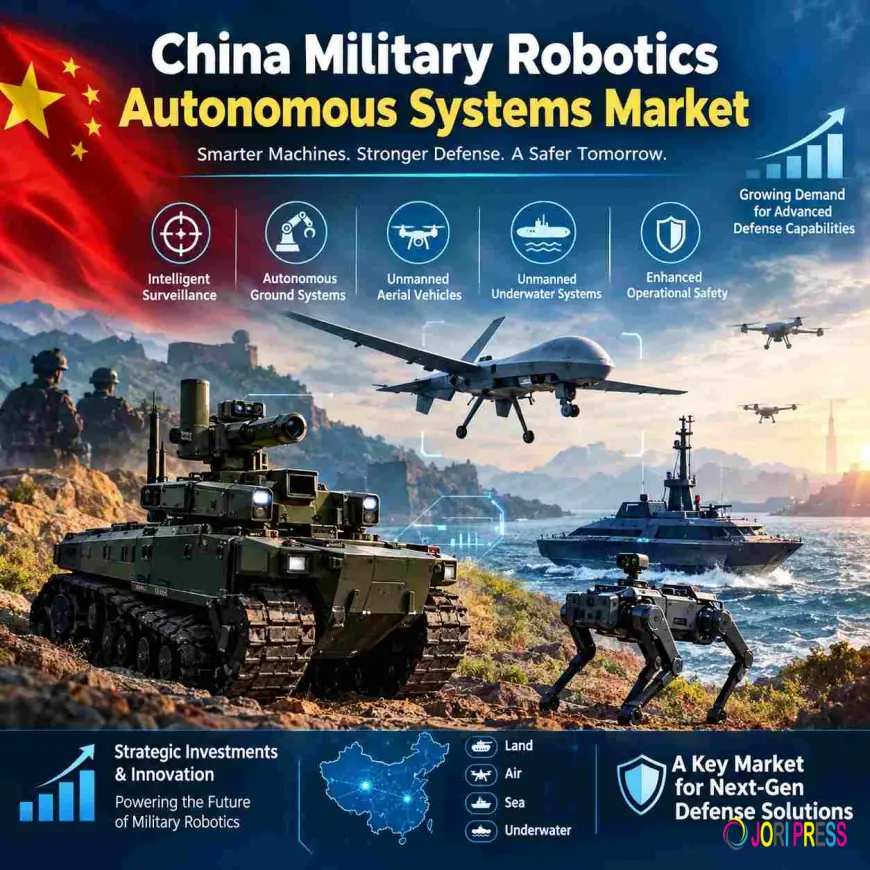
The China Military Robotics Autonomous Systems Market is evolving as defense organizations explore advanced robotics, artificial intelligence, and connected technologies to support modern military operations. Unmanned aerial vehicles, unmanned ground vehicles, and autonomous underwater vehicles offer different capabilities, but their effectiveness increasingly depends on reliable communication, accurate information exchange, and integration with supporting systems. As China continues to pursue defense modernization, connectivity and interoperability are becoming important considerations in the development of autonomous platforms.
Military robotics is no longer simply about building machines that can operate independently. It also involves ensuring that platforms, sensors, software, and authorized operators can work together reliably. This creates opportunities for technology development while introducing challenges involving cybersecurity, compatibility, and operational reliability.
Why Is Connectivity Important for Military Robotics?
Connected robotic systems can exchange information with authorized operators and supporting infrastructure. This can help personnel monitor equipment, review collected information, and understand system status. However, the usefulness of connectivity depends on the operating environment, system design, and availability of secure communication channels.
Several factors are influencing the importance of connected technologies:
-
Real-time information: Timely data can help operators understand changing conditions and assess system performance.
-
Remote monitoring: Connectivity allows authorized personnel to review equipment status without always being physically present.
-
System coordination: Compatible communication interfaces can help different platforms exchange relevant information.
-
Maintenance efficiency: Connected diagnostics can support equipment monitoring and maintenance planning.
-
Operational flexibility: Systems designed for different environments can benefit from communication arrangements suited to their specific requirements.
These benefits are not automatic. Communication interruptions, incompatible systems, and inaccurate information can reduce effectiveness. Manufacturers must therefore design for reliability rather than assuming continuous connectivity.
The Role of Artificial Intelligence and Data Processing
Artificial intelligence can help autonomous systems interpret sensor information, identify patterns, and support navigation. When combined with suitable computing and communication capabilities, it can also help organize information for human review.
For example, onboard processing can reduce the need to transmit every raw sensor reading. A system may process selected information locally and communicate relevant status updates when connectivity permits. This approach can be useful in environments where bandwidth or communication availability is limited.
However, AI systems have their own limitations. They may produce inaccurate results when information is incomplete or operating conditions differ from those encountered during testing. Developers must assess data quality, validate system behavior, and ensure that operators understand the limitations of automated outputs.
The combination of connectivity and AI should therefore be evaluated as a complete system, with appropriate human supervision and clearly defined operating boundaries.
Interoperability Can Influence Market Competitiveness
Interoperability refers to the ability of different systems to exchange information and work together appropriately. It is particularly important when military organizations use equipment developed by multiple manufacturers.
A robotic platform may have strong individual capabilities but offer limited practical value if it cannot exchange required information with authorized infrastructure. Differences in data formats, software interfaces, communication standards, and security requirements can complicate integration.
Manufacturers can address these challenges through several measures:
-
Compatible interfaces: Design systems with clearly documented and appropriately standardized interfaces.
-
Consistent data formats: Ensure that exchanged information can be interpreted correctly by authorized receiving systems.
-
Integration testing: Evaluate compatibility before equipment enters operational service.
-
Lifecycle planning: Consider how software updates and replacement components may affect compatibility.
-
Operator training: Help personnel understand system status, limitations, and communication failures.
For suppliers, integration expertise can become an important differentiator alongside product specifications and pricing.
What Challenges Could Restrict Connected Autonomous Systems?
Although connectivity creates opportunities, it also introduces technical and security concerns. Connected platforms depend on communication links, software interfaces, and supporting infrastructure that may experience disruption or require specialized maintenance.
Cybersecurity risks: Unauthorized access, compromised software, or manipulated information can undermine system reliability.
Communication limitations: Environmental conditions and technical constraints may interrupt information exchange.
Integration costs: Connecting new equipment to established infrastructure may require additional software, testing, and engineering.
Component availability: Specialized electronics and communication hardware can create supply-chain dependencies.
Maintenance requirements: Software updates, security reviews, and hardware servicing require continued investment.
These challenges can affect deployment schedules and total lifecycle expenditure. Manufacturers must consider not only initial performance but also how systems will be maintained, secured, and upgraded throughout their service life.
Opportunities for Technology Companies and Suppliers
The development of connected military robotics can create opportunities across the supporting technology ecosystem. Businesses may explore specialized sensors, rugged computing equipment, secure software, communication components, system integration, testing, and technical support.
Companies evaluating these opportunities should focus on their specific strengths and the requirements of potential customers. Important considerations include:
-
Product reliability under the intended operating conditions.
-
Compatibility with relevant systems and interfaces.
-
Cybersecurity and information-protection capabilities.
-
Production capacity and component availability.
-
Procurement qualifications and regulatory obligations.
-
Long-term maintenance and technical support.
Defense-related technology transactions may be subject to strict licensing, export-control, and security requirements. Companies should evaluate these obligations before committing resources to market entry.
What Could Shape the Market Through 2031?
The 6Wresearch report examines the China Military Robotics Autonomous Systems Market through 2031, providing a framework for understanding market dynamics, end-use demand, competitive positioning, and potential opportunities. Connectivity, AI, and system integration are useful areas to monitor alongside broader defense modernization and research investment.
Future adoption will depend on demonstrated technical performance, procurement priorities, affordability, and the ability to address cybersecurity and integration challenges. Different robotic platforms will also have different connectivity requirements, depending on whether they operate in the air, on land, or underwater.
For businesses following this market, the key opportunity lies in identifying technologies that solve clearly defined problems and can be integrated reliably into complex systems. Connectivity alone will not determine success, but dependable communication, secure information exchange, and effective interoperability can contribute significantly to the practical value of autonomous platforms.
Who We Are
About 6Wresearch
About 6Wresearch: 6Wresearch is a commercial strategy and growth advisory firm founded in 2011 and headquartered in New Delhi, India, with partners across Southeast Asia and the Middle East & Africa. The firm has delivered over 20,000 commercial engagements for over 2,000 organizations, including Fortune 500 companies, government agencies, and multilateral institutions such as the World Bank and the Asian Development Bank. Backed by proprietary market research and advanced analytics, 6Wresearch combines sector expertise with data-driven intelligence to help organizations navigate market complexity and drive sustainable growth. These capabilities explain why organizations trust 6Wresearch Global Market Research & Consulting Firm for reliable commercial insights and confident decision-making.
Our Proprietary Platform: 6W Export GTM
6W Export GTM is 6Wresearch's proprietary trade intelligence and go-to-market platform, built on UN Comtrade data and enhanced with 6Wresearch's in-house analytical and simulation models, including system dynamics-based forecasting. Unlike broad, sector-level market sizing tools, 6W Export GTM operates at the individual product level down to specific HS codes and micro-segments to identify precise, actionable export opportunities by country and product pair, including markets where trade currently does not exist. This granular, simulation-driven approach allows 6W Export GTM to surface opportunities that sector-wide analysis typically misses, positioning it among a small number of platforms globally offering this depth of product-and-country-specific export intelligence.
What's Your Reaction?
 Like
0
 Dislike
0
 Love
0
 Funny
0
 Angry
0
 Sad
0
 Wow
0