







































Bipolar Membrane: Acid and Alkali from Salt Waste | EDBM
Produce acid and alkali from inorganic salt waste-water streams with Bi-Polar Electrodialysis (BPED). Recover value and eliminate waste with EDBM.
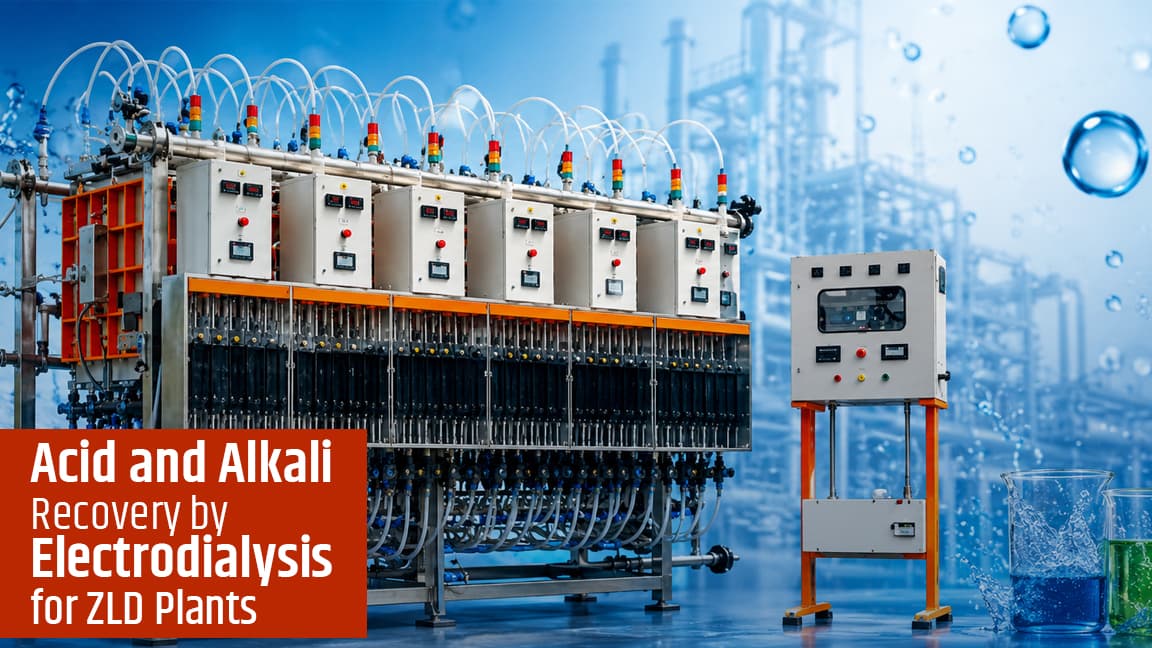
Bipolar Membrane: Acid and Alkali from Salt Waste
TL;DR: A bipolar membrane splits water inside an electrodialysis stack, turning salt waste into usable acid and alkali without buying fresh reagents. You cut chemical spend, shrink brine disposal, and keep the value on-site. Here's how it works, what it costs, and where it stumbles.
Most plants pay for salt twice. Once as fresh acid and caustic. Again as a disposal fee when the neutralized brine leaves the gate. A bipolar membrane breaks that cycle by making acid and alkali from salt waste right where you stand. At Laxminarayan Technologies, we design the EDBM systems that do it, converting sodium sulfate, sodium chloride, and similar salts back into their parent acid and base. This article explains the membrane physics, the numbers that hold up in the field, and the real headaches (fouling, current efficiency, membrane life) you should size for before commissioning anything.
What is a bipolar membrane?
A bipolar membrane is a layered ion-exchange membrane with a cation layer and an anion layer bonded together. Under a DC field, it splits water at its junction into H⁺ and OH⁻ ions. Those ions combine with salt ions in adjacent channels to form acid and alkali. No chemicals added.
How an EDBM stack turns salt into acid and base
Here's the thing. The bipolar membrane doesn't shuttle salt across itself. It splits water. That single trick is what separates EDBM from plain electrodialysis.
Walk it through, step by step:
Feed salt solution (say sodium sulfate) into the salt compartment of the stack.
Apply DC voltage. The bipolar membrane dissociates water into H⁺ on one face, OH⁻ on the other.
Sodium ions migrate through the cation-exchange membrane toward the OH⁻, forming NaOH.
Sulfate ions migrate through the anion-exchange membrane toward the H⁺, forming H₂SO₄.
Draw off three streams: acid, base, and a depleted salt solution you recirculate or bleed.
Salt in. Acid and alkali out. Our field notes on bipolar membrane electrodialysis for acid recovery cover the salt-specific quirks in more depth.
Bipolar membrane vs conventional membranes
People blur these three membranes together. They shouldn't. Each does one job.
Cation-exchange membrane. Passes positive ions only, blocks anions by Donnan exclusion. Think Na⁺, K⁺, Ca²⁺.
Anion-exchange membrane. Passes negative ions only. Chloride, sulfate, nitrate move; cations stay put.
Bipolar membrane. Doesn't pass salt ions at all. It splits water into H⁺ and OH⁻ at the internal junction. That's the acid-and-alkali engine.
Conventional electrodialysis uses only the first two, so it relocates salt. Good for desalination and demineralization, not acid production. Add the bipolar membrane and the stack now transforms the salt instead of just moving it. Short version: cation and anion membranes separate ions; the bipolar membrane manufactures reagents.
Where does salt-to-reagent recovery pay off?
Plenty of sites treat their salt stream as a cost. It's often an asset hiding in plain sight. A few scenarios we've scoped or commissioned:
Acid and alkali recovery from process brine. Regenerate H₂SO₄ and NaOH from spent sodium sulfate rather than trucking in drums. Payback lives on your reagent invoice.
Zero liquid discharge support. EDBM trims the salt load hitting the evaporator and hands back useful chemicals. See our write-up on acid and alkali recovery by electrodialysis for ZLD plants.
Organic acid concentration and deacidification. Food, dairy, wine, and pharma streams where pH control and product purity both matter.
Specialty chemistry, including in-line acid or base dosing. Precise reagent generation, as in our colloidal silica manufacture application.
Wastewater and salt-laden effluent. Cut discharge volume and recover value in one pass.
The full engineering breakdown sits on our production of acid and alkali from inorganic salt waste streams page. Read it before you size a stack.
Numbers, where they're defensible. Bipolar cell pairs typically run near 1 to 2.5 volts each. Current densities land in the 300 to 1000 A/m² band. A single pass often yields acid or base around 1 to 2 mol/L, with energy near 1 to 3 kWh per kilogram of acid produced. According to Strathmann's review in Desalination, EDBM is one of the more energy-frugal routes to on-site acid and base from salt. Treat those figures as planning ranges. Your feed, temperature, and target strength move every one of them.
Challenges and honest solutions
We've watched enough stacks misbehave to skip the sales gloss. Three problems come up on nearly every project.
Fouling and scaling. Calcium and magnesium precipitate near the bipolar junction and near the anion membrane. Foul it, and stack voltage creeps up like a pump straining against a half-shut valve. Our answer is unglamorous but reliable: softening or nanofiltration upstream, plus automated CIP cycles the operator triggers from the touch panel. Catch it early, membranes last.
Current efficiency drift. As acid and base concentrate, H⁺ and OH⁻ back-diffuse and eat efficiency. You won't hold 90 percent forever. We tune flow scheme and concentration setpoints to run in the sweet spot, then bleed and refresh before efficiency tanks. An honest target beats a broken promise.
Membrane life and downtime. Membranes are consumables. That's just physics. Our modular design isolates a single stack for re-gasketing without shutting the plant, and the fully automated, touch-operated controls log every trend so faults surface early. Pilot scale or commercial, same discipline.
No hard sell here. If your feed is genuinely unsuitable, high organics, too many divalents, we'll say so and point you elsewhere.
Conclusion
A bipolar membrane is one of the few upgrades that trims chemical cost and discharge at the same time. The physics is settled, the plant numbers hold, and the real barriers are pretreatment discipline and honest efficiency targets, not the concept itself. At Laxminarayan Technologies, we build modular, fully automated, touch-operated EDBM systems tailored to your salt, at pilot and commercial scale. If you're weighing a build, start with our guide on how to choose the right electrodialysis plant manufacturer, then send us your feed analysis.
FAQs
What does a bipolar membrane actually do?
It splits water into H⁺ and OH⁻ ions at its internal junction under a DC field. Those ions pair with salt ions in neighboring channels to form acid and alkali. It does not pass salt ions across itself, unlike standard cation or anion membranes.
Which salts convert best to acid and alkali?
Sodium sulfate and sodium chloride are the workhorses, yielding sulfuric or hydrochloric acid plus caustic soda. Most monovalent-dominant salts work well. High calcium or magnesium content needs pretreatment first to protect the bipolar membranes from scaling.
How much energy does EDBM use?
Roughly 1 to 3 kWh per kilogram of acid produced, depending on target concentration, feed purity, and temperature. You offset fresh reagent purchase and brine disposal, so total operating cost usually drops even though water splitting itself needs energy.
How long do bipolar membranes last?
With sound pretreatment and regular CIP, bipolar and ion-exchange membranes commonly run several years before replacement. Fouling, scaling, and feed swings shorten that. Automated voltage monitoring flags trouble early, so you schedule swaps instead of scrambling during an unplanned stop.
What's Your Reaction?
 Like
0
Like
0
 Dislike
0
Dislike
0
 Love
0
Love
0
 Funny
0
Funny
0
 Angry
0
Angry
0
 Sad
0
Sad
0
 Wow
0
Wow
0