





































Best PHP Classified Script in 2026: What Actually Matters Once You Start Building
A practitioner-focused look at choosing a PHP classified script in 2026 that skips the usual feature-comparison listicle format. Covers what a classified script actually needs to do well (listings, search, moderation, monetisation), where founders get burned on licensing, customization limits, and hosting, whether free scripts are really cheaper once total cost of ownership is factored in, and a clear framework for deciding between a ready-made script and a fully custom build. Closes with a practical weekend-long shortlisting method and a checklist to run before committing to any script.
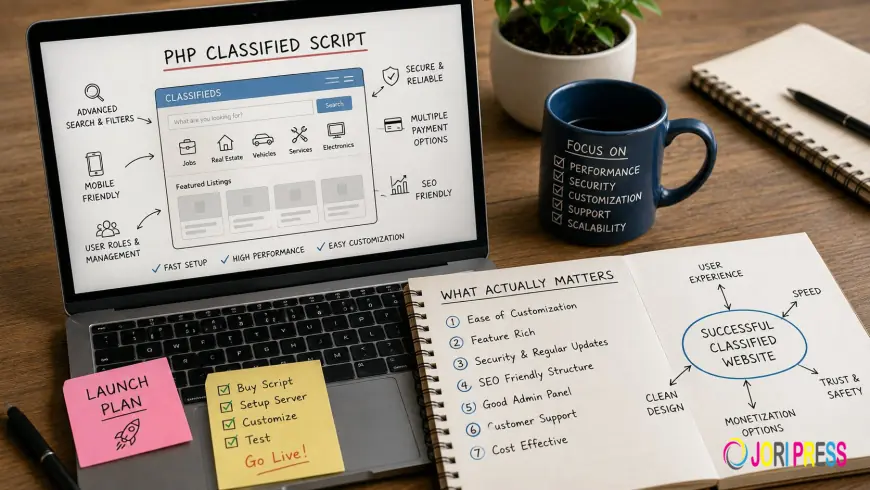
Why Most "Best Script" Lists Miss What You'll Actually Deal With
Search for the best PHP classified script and you get the same nine names in a different order every time, each with a score out of five and a green checkmark. Useful, up to a point. None of it tells you what happens after you install the thing.
A script that scores well on a feature checklist can still fall apart the first time you try to add a custom field to the listing form, or move it from shared hosting to something that can handle real traffic. The feature list rarely mentions month three, once actual sellers start posting actual listings.
This piece skips the scorecard. It looks instead at what separates a script that quietly runs for years from one that gets rebuilt eighteen months in.
What a PHP Classified Script Actually Needs to Do Well
Strip away the marketing copy and every classified platform is doing four jobs: letting people post listings, letting people find them, moderating what gets published, and taking a cut somewhere along the way.
Listings need category-specific fields. A car listing needs mileage and transmission type. A job listing needs salary range and experience level. A script that forces every category through one generic form frustrates users fast, and frustrated users stop posting.
Search and filtering matter more than founders expect. Buyers do not scroll through five hundred listings. They filter by price, location, and category, then scan the first page. If the filtering logic is weak or slow, that page never finishes loading, and the buyer is gone.
Moderation is the quiet one. Somebody has to review flagged listings, block spam accounts, and handle disputes. A script with no admin tools for this pushes all of it onto the founder manually, which works for the first fifty listings and stops working around listing three hundred.
Monetisation, featured listings, subscription tiers, a small transaction fee, needs to be built in from the start rather than bolted on later.
Where Founders Get Burned: Licensing, Customization, and Hosting
Three things trip up founders more than any missing feature does.
Licensing terms vary more than people expect. Some scripts are one-time-purchase with lifetime updates. Others charge annually, and a few restrict how many domains you can run the code on. Read the license before you buy, not after your second site needs the same script.
Customization limits show up the moment you need something the script was not built for: a regional payment method, a language it does not support, an integration with a local SMS gateway. Open-source scripts bend further here, since developers can modify the core code directly. Closed-source commercial scripts often lock you into whatever the vendor's roadmap prioritises next.
Then there is hosting. A script that runs fine on a demo server with twenty test listings behaves differently at ten thousand real ones. Database queries that were never optimised for scale slow down first, usually right around the time traffic actually starts mattering. Ask any vendor directly what happens at scale. A vague answer is itself the answer.
Is a Free Script Actually Cheaper Than a Paid One?
Not always, and this catches first-time founders off guard. A free, open-source script like Osclass costs nothing to download. But someone still has to install it, secure it, customise it, and keep it updated, and that work either costs your own time or a developer's hourly rate.
A paid script, commercial ones typically in the $200 to $1,500 range, bundles in support, regular updates, and often a working mobile app out of the box. For a founder without technical staff, that support line can be worth more than the license fee itself.
The honest comparison is total cost of ownership over the first year: your time, developer hours, hosting, and how much handholding you actually need. A free script run by someone comfortable with PHP can beat a $1,000 commercial one on cost. The same free script handed to a non-technical founder often costs more once the freelancer bills start arriving.
Ready-Made Script vs. Fully Custom Build: Which One Fits Your Idea?
This is the decision most founders actually need help with, and it comes down to how differentiated your idea really is.
A ready-made script fits when your core idea is a known format with a local twist: a regional version of OLX, a niche vertical like a pet marketplace, a local job board. The underlying mechanics of posting, browsing, filtering, messaging, and moderating are solved problems. Building them from scratch just to arrive at the same place wastes months.
One first-time founder, Coriss Ambady, took this route to launch a product-selling marketplace. She has described the experience of using a ready-made classified script as one where a vague idea took shape quickly, without months spent on foundational engineering work that would have looked the same no matter who built it.
A custom build earns its cost when the differentiation sits in the mechanics themselves: a genuinely new matching algorithm, an unusual verification flow, a business model nobody else runs. If your pitch deck's answer to "what's different" is a feature no script currently supports, custom development is the honest answer. If the answer is really about your city, your niche, or your community, a ready-made classified marketplace script gets you to market faster and lets the differentiation live in your content and your local relationships instead of your codebase.
Open-Source vs. Commercial vs. Ready-Made-with-Support: How the Categories Differ
Most PHP classified scripts fall into three broad categories, and the differences matter more than any single feature comparison.
**Open-source scripts** like Osclass or LaraClassifier cost nothing to download and can be modified at the code level without restriction. The trade-off is that support comes from community forums rather than a vendor, and customisation work falls entirely on you or whoever you hire.
**Commercial licensed scripts** like Flynax charge a one-time or recurring fee and typically ship with a plugin ecosystem, so extending functionality means buying or building an add-on rather than editing core files directly. Updates and bug fixes come from the vendor on their schedule, not yours.
**Ready-made scripts with bundled support** sit between the two. The founder gets a working script plus a team that installs it, customises it within reason, and answers questions post-launch. Best Classified Script is one example in this category, aimed at founders who would rather pay for a supported starting point than assemble open-source pieces themselves.
None of the three is universally better. A founder comfortable hiring developers often gets more long-term value from open-source. A founder who wants the shortest path from idea to a working, supported platform usually leans toward the ready-made-with-support category instead.
What Should You Actually Check Before You Commit to a Script?
Run through this before signing anything:
· Live demo, not screenshots. Click through the actual admin panel and the actual front end. Screenshots hide slow load times and clunky flows.
· Mobile experience. Check whether the mobile app, if one exists, is a genuine native build or a wrapped web view. The difference shows up in push notifications and offline behaviour.
· Update history. A script with no updates in over a year is a warning sign, security patches included.
· Support responsiveness. Email the vendor with a real technical question before buying. How they answer tells you more than any sales page.
· Exit path. Confirm you can export your listings and user data if you ever need to migrate off the platform.
Skip any of these and the surprises tend to show up right after launch, when fixing them costs the most.
A Practical Way to Shortlist in a Weekend
Shortlisting does not need to take a month. Pick three scripts that fit your vertical and budget, then spend one weekend on each: install the demo, add ten test listings across different categories, and try to break the search filters on purpose.
Note how long each task takes and where you got stuck. The script that felt the least like fighting the software by Sunday evening is usually the right one. Not the one with the longest feature list on its landing page.
Many ready-made platforms bundle much of this evaluation work into a guided demo process, which shortens the weekend considerably for founders who would rather spend that time talking to early users than testing admin panels.
Final Thoughts
The best PHP classified script for one founder is rarely the best one for the next, because the right choice depends on budget, technical comfort, and how differentiated the actual idea is. Feature checklists help narrow the field. They do not replace the weekend of actually clicking through a demo.
What holds up over time has less to do with which script ranks first on a comparison page, and more to do with whether the licensing, the hosting, and the support line still make sense a year after launch, not just on day one.
What's Your Reaction?
 Like
0
Like
0
 Dislike
0
Dislike
0
 Love
0
Love
0
 Funny
0
Funny
0
 Angry
0
Angry
0
 Sad
0
Sad
0
 Wow
0
Wow
0