




































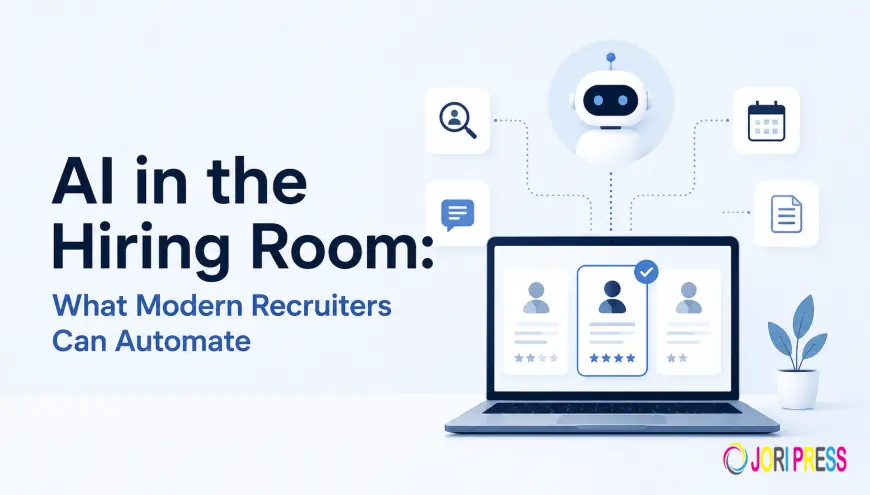
AI in the Hiring Room: What Modern Recruiters Can Automate
Discover how artificial intelligence in recruitment helps modern recruiters automate screening, scheduling, candidate communication, and other hiring tasks

Imagine a recruiter with 200 applications waiting in the inbox, three interviews to schedule, job descriptions to update, and hiring managers asking for shortlists. Which task should get attention first?
This is where artificial intelligence in recruitment is becoming useful. Instead of replacing the recruiter, AI can handle repetitive work and give people more time for conversations, judgment, and relationship building.
Rubixe helps businesses explore practical AI solutions that fit real recruitment needs.
What can artificial intelligence in recruitment actually automate?
Artificial intelligence in recruitment can automate repetitive steps involving sorting, writing, matching, scheduling, and answering common questions. The recruiter still guides the process and makes important decisions.
SHRM reported in 2025 that 51% of organizations were using AI to support recruiting. Common uses included writing job descriptions, screening resumes, candidate searches, job posting customization, and applicant communication. Nearly 9 in 10 users said AI saved time or improved efficiency.
Common areas to automate include:
• Job description creation
• Resume screening and candidate matching
• Candidate search and shortlisting
• Interview scheduling
• Candidate messages and status updates
• Interview notes and summaries
• Recruitment reports
How can AI recruitment speed up job description creation?
AI recruitment tools can create a first draft of a job description in seconds, then recruiters can edit it for accuracy, tone, and company needs.
A recruiter can provide the role, required skills, experience level, location, and responsibilities. The tool can turn that information into a clear job post.
It can also suggest missing skills, improve unclear wording, create versions for different job boards, and highlight unnecessary requirements.
Every AI generated job post still needs human review. Recruiters should check wording, salary information, requirements, and legal considerations before publishing.
Can AI automate resume screening and candidate matching?
Yes. AI recruitment systems can scan large numbers of resumes, identify relevant skills, and compare candidates with the requirements of a role.
Imagine a company receives 500 resumes for a software developer position. A recruiter may spend hours finding relevant experience across those documents. An AI recruitment tool can quickly identify candidates who match selected skills and experience.
The important word is assist. AI should help recruiters find promising candidates, not make final decisions without human review.
LinkedIn found that talent professionals using generative AI reported saving about 20% of their workweek on average. Some saved time can move toward candidate screening and skills assessment.
How can an AI recruiting agent help with candidate communication?
An AI recruiting agent can handle routine communication, such as answering common questions, sending updates, collecting basic information, and reminding candidates about interviews.
For example, a candidate might ask, “What is the interview format?” The system can provide an approved answer immediately.
This can improve the candidate experience by reducing waiting time for simple questions.
Sensitive conversations such as salary negotiations, rejection discussions, and personal circumstances still need human judgment.
Which hiring tasks should recruiters automate first?
Automate repetitive, high volume tasks that are easy to check. Keep tasks requiring empathy, judgment, or sensitive decisions human led.
|
Hiring task |
AI automation level |
Human role |
|
Job description draft |
High |
Review and approve |
|
Resume screening |
Medium to high |
Check shortlisted candidates |
|
Candidate search |
High |
Define ideal profile |
|
Interview scheduling |
High |
Handle exceptions |
|
Routine candidate messages |
High |
Review important communication |
|
Interview assessment |
Medium |
Make the final judgment |
|
Offer negotiation |
Low |
Lead the conversation |
What does artificial intelligence in recruitment look like in a real hiring workflow?
Consider a growing company hiring ten sales employees. Traditionally, a recruiter might spend days writing posts, searching profiles, reading resumes, replying to questions, and arranging calls.
With artificial intelligence in recruitment, AI can prepare the job description, search for matching profiles, rank applications against agreed criteria, answer common questions, and schedule interviews.
The recruiter then reviews the shortlist, speaks with candidates, and checks whether the selected person is a good fit. This shifts recruitment from administration toward talent strategy.
What are the risks of automating hiring with AI?
AI can save time, but it is not automatically fair or accurate. A system can repeat problems found in historical hiring data, misunderstand a resume, or rank a candidate poorly because important context is missing.
That is why responsible artificial intelligence in recruitment needs human oversight.
Recruiters should check AI recommendations, test for unfair patterns, protect candidate data, provide required disclosures, and keep records of important decisions.
SHRM notes that organizations are still working out where AI fits into their talent systems. Adopting a tool is only the beginning.
Is artificial intelligence in recruitment replacing recruiters?
No. The stronger use case is to reduce repetitive work while making recruiters more effective.
LinkedIn's 2025 Future of Recruiting research found that 73% of talent acquisition professionals believed AI would change how companies hire. The research also showed that relationship development is becoming more important as routine work is automated.
A machine can find a profile quickly, but it cannot fully replace trust built during a thoughtful conversation.
Recruiters can spend less time moving information between systems and more time understanding people, skills, teams, and business goals.
What should businesses look for in an AI recruitment tool?
Choose an AI recruitment tool based on the problem you want to solve, not because AI sounds impressive.
Look for:
• Clear integration with existing hiring systems.
• Strong data privacy and access controls.
• Transparent recommendations recruiters can review.
• Easy ways to correct or override AI suggestions.
• Reporting that shows time saved and hiring outcomes.
• Human review at important decision points.
An AI recruiting agent should also have clear limits. It should know when to answer, when to ask for more information, and when to hand a conversation to a recruiter.
What are the most common questions about AI hiring?
Can AI screen resumes?
Yes. AI can identify skills, experience, and other job related information across many resumes. Recruiters should review important decisions before moving candidates forward.
Can AI schedule interviews?
Yes. AI can connect calendars, find available times, send invitations, and manage routine scheduling changes.
Is an AI recruiting agent useful for candidates?
Yes. It can answer common questions, provide updates, collect basic information, and reduce waiting time. Complex or sensitive conversations should be handled by people.
Does AI remove bias from hiring?
Not automatically. AI can support consistent screening, but biased data or poor system design can create new problems. Human oversight remains important.
What is the biggest benefit of AI in hiring?
The biggest benefit is often time. LinkedIn reports that talent professionals using generative AI save about 20% of their workweek on average. That time can be redirected toward candidate conversations, assessment, and hiring strategy.
How can recruiters make AI work for people?
The best use of artificial intelligence in recruitment is not about making hiring completely automatic. It is about removing unnecessary work so recruiters can spend more time doing the parts of hiring that require human understanding.
Start small, measure results, protect candidate data, and keep people involved in important decisions. With that approach, AI can become a useful member of the hiring team rather than another complicated system to manage.
If your business is exploring AI recruitment, Rubixe can help you identify practical automation opportunities and design AI solutions that support recruiters without taking the human side out of hiring.
What's Your Reaction?
 Like
0
Like
0
 Dislike
0
Dislike
0
 Love
0
Love
0
 Funny
0
Funny
0
 Angry
0
Angry
0
 Sad
0
Sad
0
 Wow
0
Wow
0