









































Freelancer, Agency, or In-House: How Founders Actually Decide Who Builds Their First App
Freelancer, agency, or in-house team? A practical framework for founders deciding who should build their first mobile app — and the red flags to watch for.
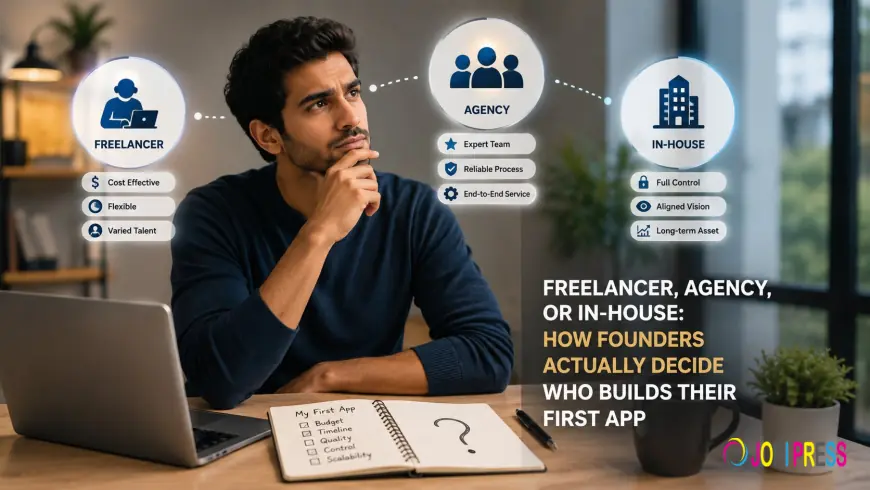
A founder with a rough idea, a small check from an investor, and no technical co-founder usually asks the same question in the same order: should I hire a freelancer, go with an agency, or just build the team myself? It sounds like a budget question. It usually isn't. One founder recently laid out the real version of this dilemma on a public forum — fifty thousand dollars committed, a delivery-style app idea, and three practical unknowns: how long it would take, how many people it would need, and whether a company or a handful of individuals made more sense. Those three questions matter more than any cost table, and almost nobody answers all three in one place.
The Question Every Founder Gets Wrong
Most founders treat "agency or freelancer" as one universal decision. It isn't. The right answer depends on how complex the app actually is, how much time the founder has to manage the build personally, and how firm the launch deadline is.
A simple booking app with one core workflow doesn't need the same setup as a multi-sided marketplace with payments, live tracking, and two native apps running in parallel. Matching the team size to the actual complexity — not to what sounds impressive on a pitch deck — is the first decision, and it's the one most first-timers skip.
There's also a management cost nobody budgets for. A freelancer needs a founder who can review code, catch scope creep, and make technical calls solo. An agency needs less hands-on oversight but costs more upfront. Neither choice removes the founder's job entirely — it just changes what kind of work that job involves.
How Long Should a First App Actually Take?
A working first version typically takes six to sixteen weeks, depending almost entirely on who's building it and how many moving parts the app has.
A Single Freelancer
One developer working alone commonly needs ten to fourteen-plus weeks for a functional MVP, since design, backend, testing, and bug fixes all happen in sequence rather than in parallel. That's fine for a simple, single-workflow app. It gets painful fast once the scope includes payments, real-time features, or two platforms at once.
A Small Agency Team
A team of four or five — designer, backend developer, frontend developer, and QA working side by side — can often bring that same MVP in around six to ten weeks, simply because the work isn't queued up one person at a time.
When a Freelancer Is the Right Call
A freelancer makes sense in a narrow but real set of situations:
• The app has one clear workflow and no complex integrations
• Budget is under roughly $15,000-$20,000
• The founder already has a technical background, or a technical friend who can review code
• Speed to a rough prototype matters more than polish
Outside that zone, a single freelancer becomes a bottleneck rather than a shortcut — especially if that person gets sick, takes another contract, or simply disappears mid-project, which happens more often than founders expect.
When an Agency Is the Right Call
An agency earns its cost when the project needs coordination that a lone contractor can't realistically provide — design, backend, and QA working together instead of getting handed off one stage at a time.
• Multiple integrations (payments, maps, real-time tracking) need to work together
• There's a firm deadline — an investor demo, a seasonal launch window, a funding milestone
• The founder has no technical co-founder and needs product guidance, not just code
• The app needs to ship on iOS and Android at the same time
Founders weighing this option often start by looking at smaller regional studios rather than the big-name firms — Originate Soft Pvt Ltd(originatesoft.com), an India-based development team, is one example of the kind of studio that packages a first build as a fixed-scope engagement instead of open-ended hourly billing, which tends to suit a founder trying to protect a limited seed budget.
What This Actually Costs, Roughly
Exact numbers vary by region and complexity, but the general bands hold across most markets:
• Freelancer: roughly $5,000-$30,000 for a simple, single-workflow prototype
• Agency: roughly $40,000-$180,000+ for a production-ready MVP with proper design, QA, and post-launch support
• In-house team: often $200,000-$750,000+ a year once salaries, tools, and management overhead are counted
None of these numbers mean much on their own. A $150,000 agency quote for a two-sided marketplace with live payments can be a fair price. The same number for a single-screen loyalty app is a sign something's off, and it's worth asking exactly what's driving the cost before signing anything.
Do You Need an In-House Team This Early?
Usually not. Building an in-house engineering team before there's proven revenue or a funding round behind it is one of the more expensive mistakes an early founder can make — a small in-house team can run into six figures a year in fully loaded cost, before a single paying customer shows up.
When In-House Actually Makes Sense
In-house hiring starts to make sense once the product has paying users, the roadmap is no longer a single MVP but an ongoing stream of features, and the founder can justify a full-time engineering budget against real revenue rather than projected revenue.
Red Flags That Matter More Than the Price Tag
Price is the easiest thing to compare and the least reliable signal. Watch for these instead:
• No clear point of contact — work gets passed between people with no single owner
• A quote with no breakdown of design, development, and QA hours separately
• Reluctance to share code or design files during the build, not just at the end
• No discovery or scoping phase before a fixed price gets quoted
• Portfolio examples that are all screenshots, with no working links or shipped apps to test
Any one of these alone isn't necessarily a dealbreaker. Two or more together usually is.
Conclusion
The freelancer-versus-agency-versus-in-house question isn't really about which option is objectively best. It's about matching the build to the app's actual complexity, the founder's available time, and how firm the deadline really is. A simple app with a flexible timeline rarely needs a five-person team. A multi-integration product with an investor demo in eight weeks rarely survives a single freelancer working alone.
The founders who get this right tend to ask the boring questions early — timeline, team size, who owns what — instead of jumping straight to a price comparison. That's usually the difference between an app that ships and one that quietly stalls somewhere around week twelve.
What's Your Reaction?
 Like
0
Like
0
 Dislike
0
Dislike
0
 Love
0
Love
0
 Funny
0
Funny
0
 Angry
0
Angry
0
 Sad
0
Sad
0
 Wow
0
Wow
0