












































Acoustic Design for Commercial Buildings: Improving Indoor Sound Comfort
Discover why acoustic design is essential for commercial buildings and how room acoustics, sound insulation, reverberation time simulation, and environmental noise assessment support better indoor sound comfort. This article explores key acoustic considerations for architects, engineers, contractors, developers, and building owners, highlighting how professional acoustic consultancy helps address noise-related challenges during building design and construction.

Introduction
Acoustic comfort is an important consideration in the design and operation of commercial buildings. Offices, meeting rooms, educational facilities, healthcare buildings, and other occupied spaces require appropriate acoustic conditions to support communication and everyday activities. Unwanted noise, excessive reverberation, and inadequate sound insulation can affect how people experience and use indoor environments.
Acoustic design helps project teams assess sound-related requirements and consider suitable solutions during building planning. By incorporating acoustic assessments into the design process, architects, engineers, contractors, and building owners can make more informed decisions about indoor sound quality.
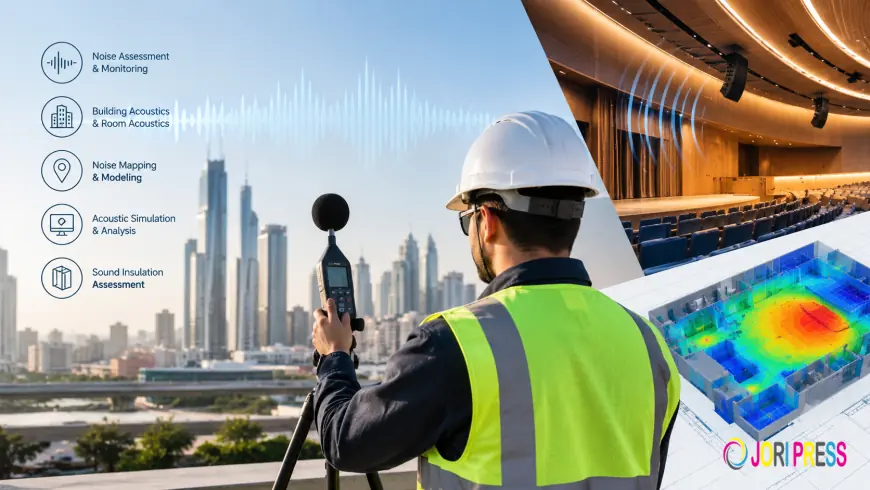
Professional acoustic consultancy can support projects through room acoustics assessments, sound insulation assessments, reverberation time simulation, and noise assessments. These services help identify acoustic considerations that may influence building design and performance.
1. Why Acoustic Design Matters in Commercial Buildings
Commercial buildings contain spaces with different functions and acoustic requirements. An open-plan office, a conference room, a reception area, and a private meeting room do not necessarily require the same acoustic conditions.
For example, meeting rooms depend on clear speech communication, while other occupied spaces may require careful consideration of background noise and reverberation. If acoustic requirements are overlooked during design, unwanted sound may affect the usability of the completed space.
Acoustic design helps project teams evaluate these considerations before construction or renovation work is completed.
Important considerations include:
- Background noise within occupied spaces.
- Sound transmission between rooms.
- Reverberation and speech intelligibility.
- Noise generated by building services.
- Environmental noise entering the building.
- Acoustic performance requirements for different room types.
Addressing these factors early helps architects and engineers understand the acoustic requirements that should be considered alongside architectural and building services design.
2. Understanding Room Acoustics and Reverberation
Room acoustics concerns how sound behaves within an enclosed space. Room dimensions, surface materials, furnishings, and other physical characteristics influence how sound is reflected and absorbed.
One important acoustic parameter is reverberation time, commonly expressed as RT60. It describes the time required for sound energy in a room to decay by 60 decibels after the sound source stops.
Excessive reverberation can make speech difficult to understand, particularly in meeting rooms and other spaces where verbal communication is important.
Reverberation time simulation helps assess the expected acoustic behaviour of a room during the design process. This information can support decisions about interior finishes and other room characteristics that influence sound.
Room acoustics assessments can be particularly relevant when planning conference rooms, offices, auditoriums, and other spaces where sound quality matters.
3. Sound Insulation and Noise Control
Sound insulation is another important part of commercial building acoustics. It concerns the reduction of sound transmission between spaces or from external sources into occupied areas.
Inadequate sound insulation may allow conversations, equipment noise, or external activities to disturb adjacent rooms. This can affect privacy, communication, and the general usability of a building.
Sound insulation assessments help project teams evaluate relevant acoustic performance requirements. Depending on the project, airborne and impact sound insulation may need to be considered.
Noise assessments can also help identify potential noise sources associated with building services, construction activities, or surrounding environments.
By reviewing these requirements during planning, project teams can identify acoustic issues and consider appropriate design responses before they become more difficult to address.
4. Environmental Noise Assessment
Commercial buildings may be exposed to noise from nearby roads, construction activities, industrial operations, and other external sources. Environmental noise assessment helps evaluate these conditions and understand their potential impact on the building.
Environmental noise mapping and noise intrusion studies can support the assessment of external noise conditions. These studies help project teams understand where noise may be a concern and determine whether additional acoustic consideration is necessary.
For projects located in busy urban areas or near industrial facilities, reviewing environmental noise can be an important part of the design process.
Noise monitoring and assessment may also be relevant to construction and operational activities, depending on the project's requirements.
5. Integrating Acoustic Consultancy into Project Planning
Acoustic requirements are best considered alongside architectural, structural, and mechanical, electrical, and plumbing (MEP) design.
Building services equipment, including air-handling units, fan coil units, variable air volume systems, and ductwork, may contribute to indoor noise. Evaluating these considerations helps project teams understand the relationship between building services and acoustic performance.
An acoustic consultant can support the project by assessing relevant conditions, reviewing acoustic requirements, and providing technical input during design development.
Acoustic consultancy may include:
- Room acoustics assessment.
- Reverberation time simulation.
- Sound insulation assessment.
- Environmental noise monitoring.
- Noise mapping and noise intrusion studies.
- Operational and construction noise assessment.
- Speech intelligibility and sound coverage studies where required.
The appropriate scope depends on the building type, intended use, and project requirements.
6. Choosing the Right Acoustic Consultancy Services
Selecting appropriate acoustic services begins with understanding the project's specific needs.
Architects may require support with room acoustics and sound insulation. MEP engineers may need to evaluate noise associated with building services. Contractors and developers may require construction noise monitoring or assessments of existing acoustic conditions.
Before selecting a service, project teams should consider:
- The building's intended use.
- The acoustic issues requiring assessment.
- Whether indoor or environmental noise is the primary concern.
- The need for simulation, monitoring, or technical assessment.
- Applicable project requirements and certification objectives.
A clearly defined scope helps ensure that acoustic services address the relevant project questions and provide useful information for design and construction decisions.
Conclusion
Acoustic design plays an important role in creating functional and comfortable commercial buildings. Room acoustics, reverberation time, sound insulation, environmental noise, and building services noise are all considerations that may influence the performance of occupied spaces.
By assessing acoustic requirements early and coordinating with the wider project team, building owners, architects, engineers, and contractors can make better-informed design decisions.
What's Your Reaction?
 Like
0
 Dislike
0
 Love
0
 Funny
0
 Angry
0
 Sad
0
 Wow
0